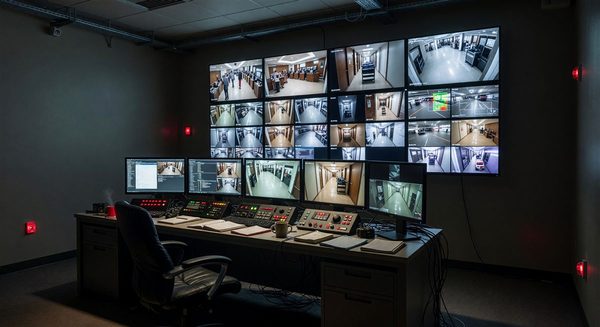
Hotel security technology has historically operated in silos: electronic door locks from one manufacturer, CCTV from another, parking access control from a third, fire alarm from a fourth — each with its own software interface, each managed separately, and often unable to share data with the others. This fragmentation creates operational gaps: a security event that triggers a fire alarm, involves a guest room access, and appears on CCTV requires manual correlation across three separate systems, each requiring its own interface.
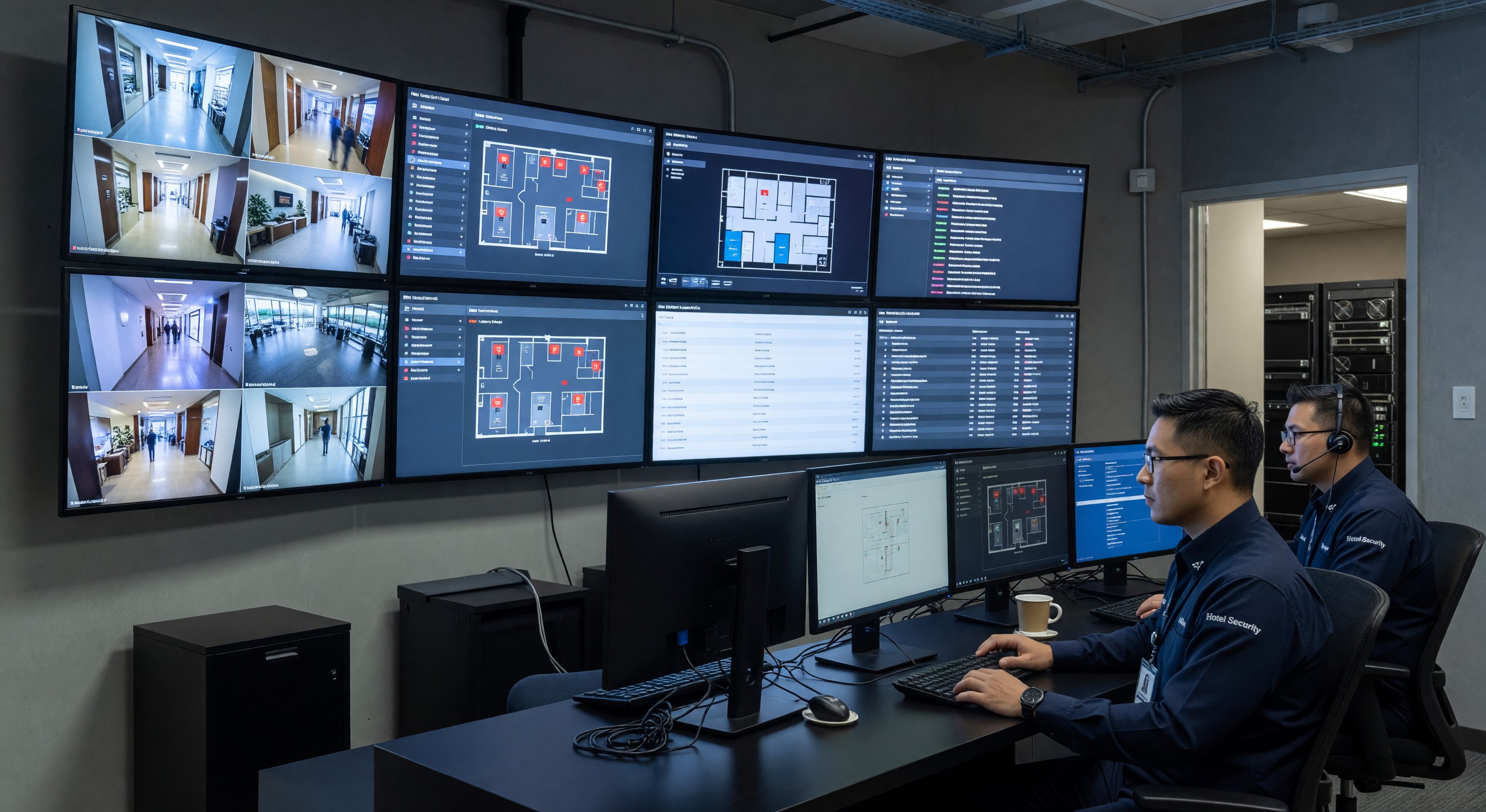
The movement toward integrated or “converged” security platforms — unified software environments where access control, video management, building systems data, and AI analytics are accessible in one interface — represents one of the most significant architectural shifts in hotel security management of the past decade. This guide covers what security convergence means in practice, the integration models available to hotel operators, and how to evaluate whether platform convergence makes sense for a specific property.
What Security Convergence Enables
Event correlation: When a fire alarm activates on Floor 7, the integrated platform can simultaneously show CCTV footage from Floor 7 cameras, which access control doors are in the alarm zone, and the current access status of those doors — in a single interface. A security officer reviewing the event doesn’t need to navigate three separate software systems and mentally correlate what they see across screens.
Automated response sequences: An integrated platform can trigger automated responses to specific event types — when an after-hours motion detection alert occurs in a restricted area, the system can automatically alert the security officer on duty, lock the access control doors in the area, and begin recording to cloud storage, all without human action.
Unified audit trail: When investigating a security incident, a converged system provides a single search interface for all relevant event data — access events, video footage, alarm activations, and building system states — indexed by time and location, rather than requiring manual searches across multiple system logs.
Guest room status awareness: Integration between the hotel’s room status system and access control creates a unified view of which rooms are occupied, which are in do-not-disturb status, and which room access events are unexpected given the room’s status. An access event in a supposedly vacant room triggers an alert; a guest room door that has been open for an extended period during the night may warrant a wellness check.
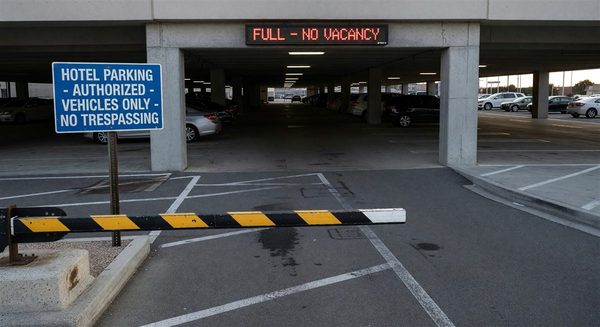
Parking integration: Vehicle access events (entry and exit from parking facility) can be correlated with hotel guest check-in data, alerting security when vehicles with no corresponding reservation enter the property after hours, or when vehicle access patterns are inconsistent with expected patterns.
Integration Architecture Models
Best-of-breed with open APIs: The hotel deploys best-in-class products for each security function (CCTV, access control, parking) and integrates them through open APIs. This approach provides maximum flexibility in product selection but requires careful API compatibility validation and ongoing integration maintenance when any component is updated. Middleware platforms (Genetec, PSIM platforms) can serve as the integration layer.
Platform consolidation: The hotel standardizes on a single security platform vendor that provides all security functions (access control, VMS, intrusion) from one company with native integration. Examples: CCURE 9000, Lenel OnGuard, Software House. This approach simplifies integration but limits flexibility in choosing best-in-class for specific functions.
Cloud-native security platforms: Newer security platforms (Openpath, Verkada, Rhombus) offer cloud-managed security infrastructure with native integration across access control and video functions. These platforms prioritize ease of management and reduce on-premises server infrastructure, at the cost of dependency on internet connectivity and cloud provider reliability.
Current State of Hotel Security Integration Maturity
As of 2025, most hotel security deployments remain partially integrated rather than fully converged:
- Video management systems (VMS) with some access control integration are common at larger full-service properties
- Parking access control often remains separate from the main security system
- Fire alarm data is rarely integrated into the security management platform despite NFPA 72 providing data connectivity standards
- Building automation system data (door position sensors, HVAC alarms, elevator status) is typically visible only in the BAS interface
The most integrated implementations are found at large convention hotels, casinos (where security investment is proportionally high), and properties that have undergone comprehensive security renovations in the past 3–5 years.
Cybersecurity Implications of Security Convergence
Converging security systems onto shared network infrastructure and shared management platforms creates a concentrated attack surface. If the integrated security platform is compromised, an attacker potentially has access to door lock control, video surveillance feeds, and building system data simultaneously.
Convergence security requirements:
- Dedicated network segment for security systems, firewalled from both guest WiFi and hotel operational networks
- MFA for all access to the converged security management platform
- Regular security patching for all platform components (VMS, access control servers, network infrastructure)
- Vendor security practices due diligence — evaluate vendor patch cadence, vulnerability disclosure policy, and security incident history
- Incident response planning that specifically addresses compromise of the security platform itself
Implementation Considerations for Hotels
Start with a security assessment: Before investing in platform convergence, conduct a security assessment that identifies the actual integration gaps that create operational risk. Not every hotel needs full platform convergence — a 150-room limited-service hotel may find that separate but well-maintained systems are adequate.
Prioritize video + access control integration: The highest-value integration in most hotel security programs is between CCTV and door access control, enabling event correlation for investigations and automated monitoring rules.
Plan for lifecycle alignment: Different security system components have different refresh cycles — VMS hardware every 5–7 years, access control readers every 10–15 years, cameras every 7–10 years. Plan convergence architecture that doesn’t require all components to be replaced simultaneously.
Frequently Asked Questions
Is security technology convergence worth the investment for limited-service hotels? Probably not for most limited-service properties. The integration value is highest when there are multiple security event streams (CCTV, access control, parking, building systems) that require correlation during investigations. A 100-room limited-service hotel with basic CCTV and electronic room locks may not generate the event volume that makes a converged platform operationally valuable. Evaluate based on your specific security incident frequency and investigation complexity.
What is a PSIM and is it relevant for hotel security? PSIM (Physical Security Information Management) platforms are middleware systems that integrate data from multiple disparate security technologies — different access control brands, different camera manufacturers, different sensor types — into a unified operational interface. PSIM platforms are primarily deployed in complex environments (airports, campuses, data centers) where many heterogeneous security systems must be integrated. For most hotels, a simpler approach — selecting compatible systems from compatible vendors — is more practical than deploying a full PSIM platform.
How does security platform convergence affect vendor lock-in risk? Convergence on a single vendor’s platform creates significant switching cost — replacing the core platform would require replacing all integrated components simultaneously. Mitigate lock-in risk by: requiring open API documentation for all integrated systems, ensuring data export capability for all stored security data (video archives, access logs, alarm histories), and negotiating long-term pricing protections in platform contracts. Evaluate the vendor’s market stability and financial health before committing to platform consolidation.
Can hotels integrate parking security with the main hotel security platform? Yes, with the right parking access and revenue control (PARC) system. Modern PARC systems with open API capability can share vehicle access event data with VMS and access control platforms, enabling correlation of parking events with hotel security events. LPR data from the parking system is particularly valuable when combined with guest reservation data and CCTV coverage of lobby areas to track suspicious vehicle activity or identify vehicles associated with security incidents.
Further Reading from Authoritative Sources
- NIST hotel security technology convergence and unified system cybersecurity standards — NIST provides cybersecurity framework standards for converged physical-digital security systems, network segmentation requirements for integrated security platforms, audit trail integrity standards, and API security guidance applicable to hotel security technology convergence architecture, platform cybersecurity requirements, and unified audit trail specifications.
- AHLA hotel security technology integration and convergence program standards — AHLA provides hospitality industry standards for security technology program development, system integration selection, vendor evaluation for converged platforms, and operational security management applicable to hotel security convergence planning, platform procurement decisions, and security operations center design.