Hotel perimeter security is often the first and most overlooked element of a comprehensive security program. While significant attention goes to in-room lock systems and lobby CCTV, the property boundary — where unauthorized individuals either gain access or decide it’s not worth the effort — receives less systematic planning.
For directors of engineering who have responsibility for the physical plant including exterior areas, understanding perimeter security as a system — not just a collection of individual elements — is essential to building a coherent approach.
Defining the Hotel Perimeter
The perimeter is not simply the property line. It’s the boundary between public and private space, and it includes multiple layers:
Outer perimeter: The property line, public sidewalk adjacency, and street-facing areas. Control here is primarily about visibility and deterrence rather than hard access control.
Vehicle access points: Driveways, parking entrances, and service drives. These are controlled access points where physical barriers and/or staffing can screen vehicles and persons.
Pedestrian access points: Primary entrances, secondary entrances, emergency exits, and any pedestrian connections between public areas and parking or service areas.
Building envelope: The wall of the building itself — windows, doors, emergency exits, and any other penetrations.
Each layer requires different security measures. A comprehensive perimeter program addresses all four.
Outer Perimeter Considerations
Hotels in urban environments often have minimal separation between the public sidewalk and the building. In these cases, the “perimeter” is essentially the building exterior, and security measures focus on building entrances and public-facing areas.
Hotels with larger grounds — resort properties, suburban full-service hotels, airport properties — have more opportunity for perimeter definition through landscaping, fencing, and lighting.
Landscaping as a security tool: Dense, thorny vegetation (roses, barberries, hollies) planted beneath windows or along perimeter boundaries creates a natural deterrent. Low-growing landscaping near entrances maintains sightlines. Avoid creating concealment zones — tall shrubs adjacent to entry points hide people approaching.
Lighting: Perimeter lighting should eliminate dark zones where someone could approach the building unobserved. This is both a security and a guest safety measure. Pathway lighting should guide legitimate users along intended routes while ensuring adequate illumination of adjacent areas.
Vehicle Access Control
Hotel vehicle access points are where the most consequential perimeter decisions are made. The balance between guest access convenience and security varies significantly by property type:
Resort properties: Often use staffed entry points with attendants who greet arriving vehicles. The combination of personal interaction and a physical barrier gate provides high security confidence while maintaining a service-oriented first impression.
Urban full-service hotels: Primary entrance typically unstaffed and open for guest and taxi/rideshare drop-off. Parking garage access via ticket or credential system.
Select-service properties: Typically an open driveway with no vehicle access control beyond the parking lot layout.
Barrier Gates at Parking Access Points
Parking garage entries are natural perimeter control points. A properly designed parking access control system at the garage entrance:
- Prevents unauthorized vehicles from entering the parking structure
- Creates a record of every vehicle entering and exiting
- Enables credential-based access for hotel guests without requiring a staffed checkpoint
The barrier gate is the physical element of this system. Gate arms need to be appropriately specified for the intended purpose — a gate arm designed for a low-traffic lot may not have adequate cycle durability for a hotel property where hundreds of vehicles enter and exit daily.
Service and Loading Dock Access
The service entrance and loading dock often receive less security design attention than the front of house. This is a mistake — the loading dock is a legitimate entry point for many people who aren’t hotel employees, and its adjacency to back-of-house operations creates security risk if not properly controlled.
Controls for service area access:
- Staffed receiving function during receiving hours
- Controlled access door connecting the dock to the interior
- Camera coverage of the dock area
- Sign-in procedure for all delivery and vendor personnel
Pedestrian Access Control
Primary and Secondary Entrances
Most hotels have one primary entrance and multiple secondary entrances (typically connected to parking areas, fitness centers, or adjacent functions). Each entrance represents a control point decision.
Primary entrance: Typically monitored by front desk staff who have line-of-sight to the entrance and can observe unusual activity. Adding a concierge or doorman for higher-tier properties supplements the observation function.
Secondary entrances: The security challenge. These are access points where guests enter after parking, and where unauthorized individuals may also attempt to enter. Solutions:
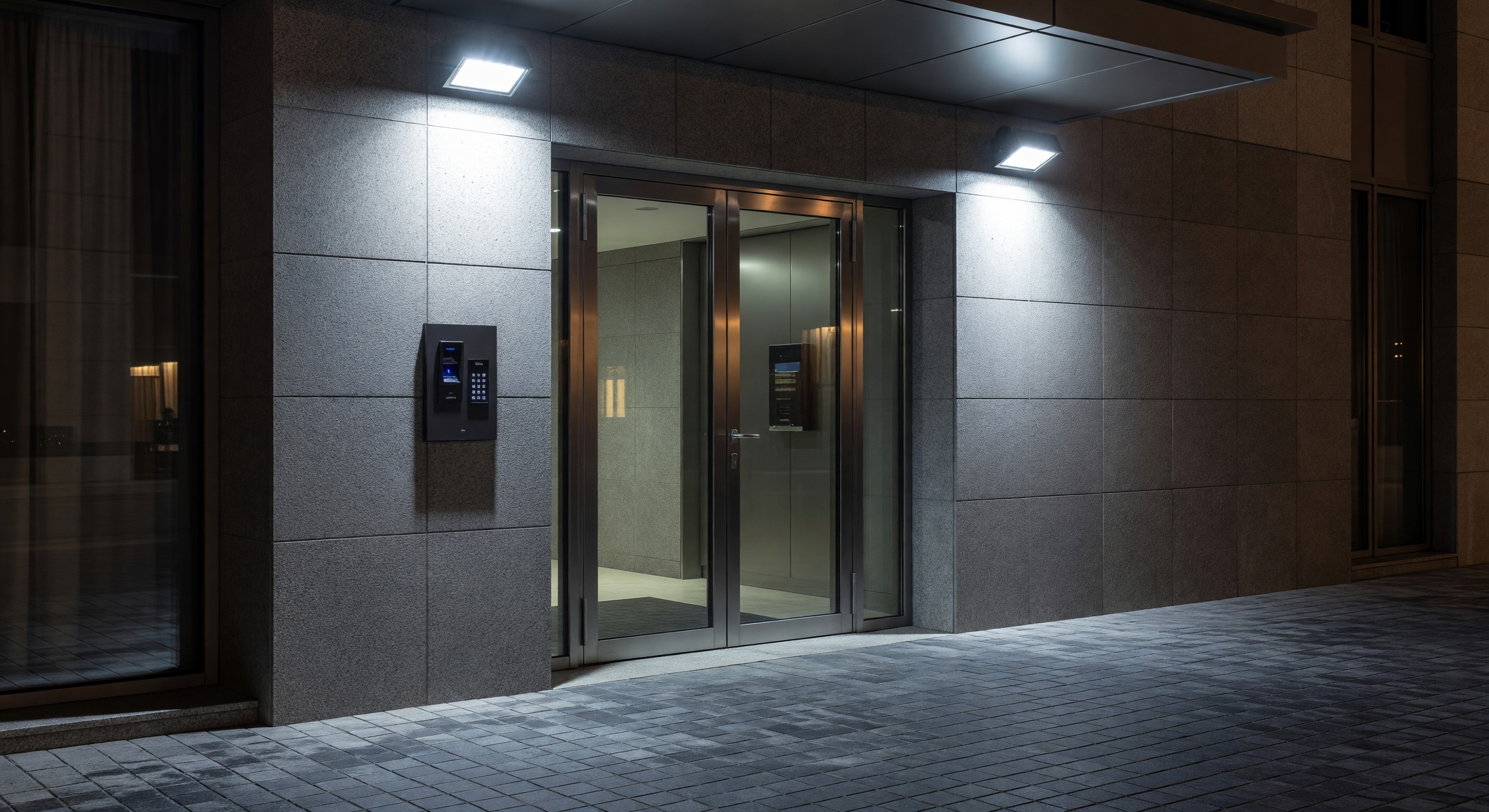
- Require keycard access from exterior (guest credential opens the door from outside; anyone inside can exit freely)
- CCTV coverage with active monitoring or recording
- Physical design that limits concealment near secondary entry points
- Regular staff sweeps of secondary entry areas
Emergency Exit Management
Emergency exits are required to remain operable from the inside at all times — this is a life safety requirement, not a security choice. Managing the security implications of required emergency exits:
- Install door contact alarms that alert when emergency exits are used outside of emergency conditions
- Post appropriate signage (alarm will sound)
- Include emergency exit areas in CCTV coverage
- Respond promptly to emergency exit alarms — both to investigate and to reset the alarm
Outdoor Areas and Pools
Pool areas and outdoor gathering spaces present specific perimeter security challenges:
Pool access control: Most hotel pools require guest-only access. Options include keycard-controlled gates, wristband systems issued at check-in, and staff-managed access. In reality, pool access at many hotels is effectively uncontrolled. This creates both a liability and a security issue — non-guests using the pool represent a safety and insurance concern.
Outdoor furniture and equipment: Outdoor furniture is surprisingly attractive to theft. Property marking, storage of valuable outdoor equipment overnight, and camera coverage of outdoor areas reduce losses.
Outdoor lighting for safety and security: Pool decks, walkways, and parking lot perimeters need specific lighting standards. The Illuminating Engineering Society recommends minimum 1.0 footcandle for pedestrian-accessible areas and minimum 0.5 footcandle for parking lots. Below these levels, slip-and-fall and crime risk increases.
Security Staffing at the Perimeter
Technology supplements but doesn’t replace human presence in high-risk areas. Security staffing decisions at the perimeter:
Doorman/greeter: High-contact service role that also provides a visible deterrent at the primary entrance. Not a trained security professional, but a presence that prevents the most casual unauthorized entry.
Security rounds: Uniformed security officers conducting regular exterior patrols. The visible presence of security on the grounds deters opportunistic crime. Document rounds with a guard tour verification system.
Parking attendants: In properties with staffed parking, attendants who observe and report unusual activity in the parking areas extend the security network to a high-risk zone.
Integrated Security Design
The most effective perimeter security designs integrate multiple elements — cameras, lighting, physical barriers, and staff — into a coherent system where each element reinforces the others.
A camera that’s poorly placed in a dark corner produces unusable footage. Lighting that illuminates the walkway but leaves the parking lot edge in shadow creates a two-zone problem. A card-controlled entrance with a staff shortcut that bypasses the control undermines the whole system.
Periodic security audits — ideally by an experienced physical security consultant — evaluate the perimeter security system as a whole and identify gaps that aren’t apparent from the perspective of any single element.
FAQ
How do we balance a welcoming hotel entrance with security requirements? The two are not in conflict when designed well. A staffed entrance with a well-lit, open design is both welcoming and provides active surveillance. The security goal is to identify and respond to threats; the presence of a friendly, observant staff member accomplishes this as well as or better than technology alone.
What should we do when we observe a non-guest regularly accessing the property through a secondary entrance? First, understand the access point — is it a controlled entry they’re bypassing, or an uncontrolled entrance? If bypassing a control, investigate how (propped door? Tailgating?). If the person has no legitimate reason to be on the property, ask them to leave and document the interaction. Repeated access by non-guests through a specific point suggests a design or enforcement gap that needs addressing.
How do we improve parking lot security without installing full access control infrastructure? In the near term: improve lighting, add camera coverage, increase security rounds through the lot, and add perimeter landscaping that reduces concealment. These measures are lower cost than full access control and improve security meaningfully. Full access control is a capital investment for when it can be justified economically.
What regulations govern hotel perimeter security requirements? Local zoning and building codes govern physical structures (fencing, barriers). Life safety codes govern emergency exit requirements. Beyond these, hotel perimeter security is generally not prescriptively regulated — which means there is no minimum standard except liability exposure for inadequate security measures that enable crimes that could have been prevented.
Further Reading from Authoritative Sources
- AHLA hotel perimeter security and property safety standards — AHLA provides hospitality industry standards on property perimeter security, access control program design, and guest safety practices applicable to hotel perimeter security program development and liability management.
- OSHA hotel workplace safety and exterior area security standards — OSHA provides workplace safety standards including exterior lighting requirements, emergency egress provisions, and parking facility safety standards applicable to hotel perimeter security design and outdoor area safety compliance.