The guestroom lock is the most security-critical piece of hardware in a hotel. It’s also one of the highest-touch devices on property — used thousands of times per day across the portfolio. For facility managers, electronic key card systems require a different kind of management attention than most building systems: they sit at the intersection of security, guest experience, and IT infrastructure.
This guide covers the key card technology landscape, system selection considerations, maintenance requirements, and the management practices that keep lock systems reliable.
Key Card Technology Overview
Magnetic Stripe (Magstripe)
Magnetic stripe key cards were the dominant hotel lock technology from the 1980s through the early 2000s. The card stores a simple encoded credential on a magnetic stripe that the lock reader decodes. Magstripe systems are inexpensive and widely understood.
The limitations are significant: magstripe cards are easily demagnetized by proximity to other cards, phones, and magnets. “My key stopped working” is overwhelmingly a magstripe demagnetization problem. Magstripe also offers minimal security — the encoding is relatively easy to duplicate with widely available tools.
Most properties still running magstripe systems are candidates for an upgrade. The ongoing labor cost of re-encoding cards for demagnetization complaints alone often justifies the capital investment in a newer technology.
RFID (Radio Frequency Identification)
RFID lock systems use contactless credential transmission — the guest holds or taps the card near the reader rather than inserting it. The most common standard in hotels is 13.56 MHz RFID (the same frequency used in chip-based access cards).
RFID cards are far more reliable than magstripe because they don’t have a physical contact element that degrades. They’re also harder to copy without specialized equipment. The guest experience is better — no need to orient the card correctly, works even inside a wallet in some implementations.
NFC and Mobile Keys
Near Field Communication (NFC) is an RFID subset that enables smartphones to act as key credentials. Mobile key systems — where guests receive their room key on their smartphone via an app — are now standard in branded full-service and upper-upscale hotels.
Mobile keys improve the check-in experience (guests can go straight to their room without stopping at the desk), reduce plastic card costs, and are harder to lose than a physical card. The technology requires NFC-capable smartphones and a compatible lock platform.
BLE (Bluetooth Low Energy)
Some newer lock systems use Bluetooth Low Energy for credential transmission. BLE enables longer read ranges than NFC (the phone doesn’t need to be held against the reader), which can enable hands-free unlocking as a guest approaches the door. This technology is still maturing in the hotel context but is being deployed by the major branded chains.
Lock Hardware Considerations
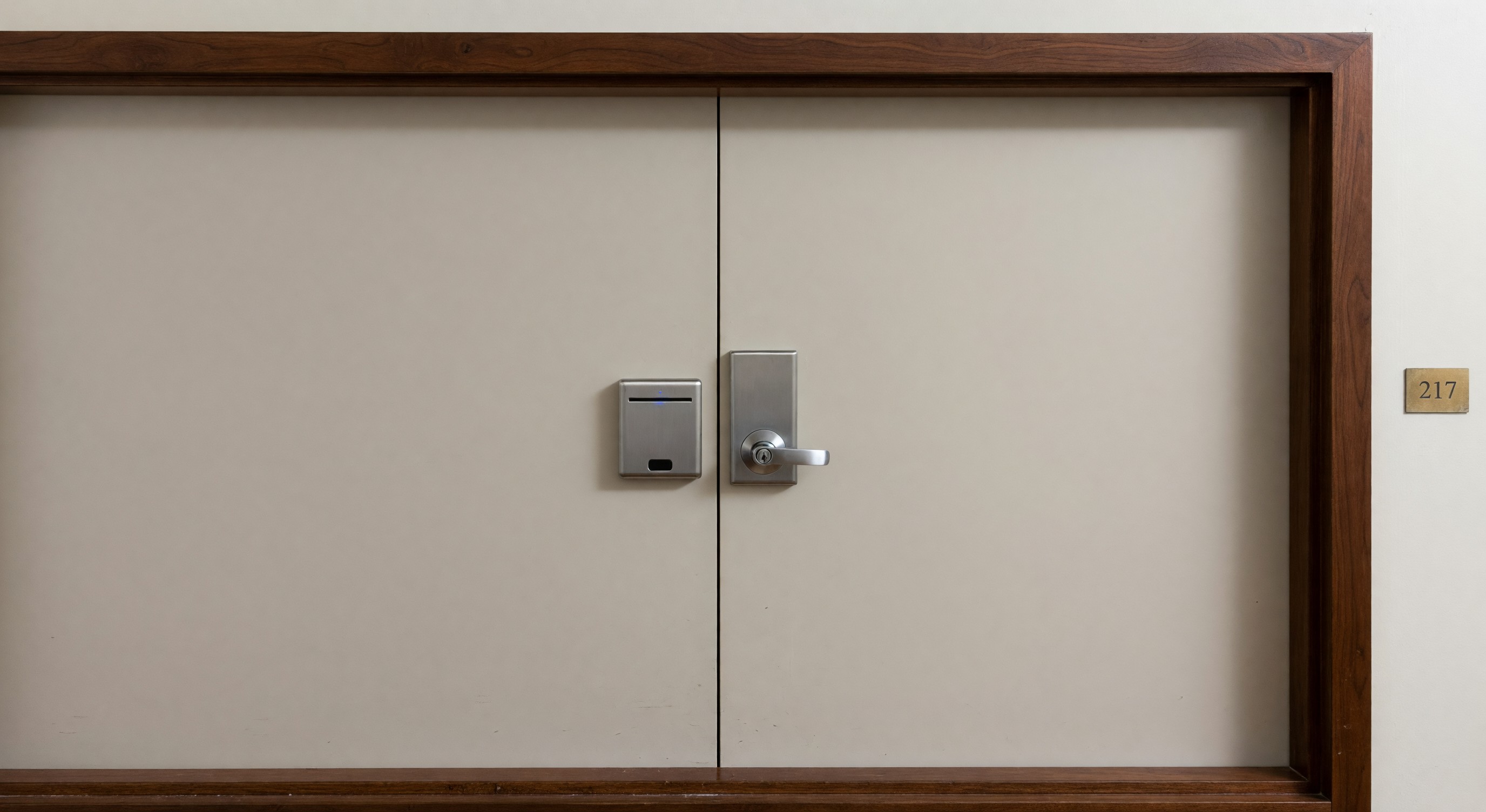
The lock body itself — the physical hardware on the door — is separate from the credential technology. Most commercial hotel locks use a mortise or cylindrical lock configuration with a battery-powered electronic module.
Battery life: Hotel room locks are battery-powered and typically run 1–2 years on a set of batteries. The lock controller monitors battery level and transmits alerts through the property management system interface when batteries are running low. A proactive battery replacement program — rather than waiting for failure warnings — is essential for large properties where a dead lock battery means a locked-out guest at 2 a.m.
Communication architecture: Older lock systems are entirely “offline” — each lock stores the master key list locally and communicates nothing to the central system in real time. Modern “online” locks connect to the property network and allow real-time credential management, audit log access, and remote lockout. The value of online locks is significant from both a security and operational standpoint.
Mortise vs. cylindrical: Mortise locks are higher security and more durable. Cylindrical locks are less expensive but have a shorter lifespan in high-use hotel environments. Full-service hotels should use mortise locks throughout.
Encoder Management
The key card encoder is the workstation where room credentials are written to key cards. In a typical hotel, this lives at the front desk and is used hundreds of times per day. Encoder reliability is directly connected to guest service at check-in.
Encoder maintenance:
- Clean the encoding head weekly with a specialized cleaning card
- Test a sample of encoded cards daily to verify encoding quality
- Keep a spare encoder on property or have a rapid-response repair agreement with your vendor
- Maintain a log of encoding failures to identify declining encoder performance before it fails completely
Card stock management:
- Maintain a 30–60 day supply of key cards on property
- Store cards away from magnetic fields (away from the encoder itself when not in use)
- Track card consumption against room revenue to identify unusual patterns that might indicate card theft or misuse
Integration with Property Systems
PMS Integration
The lock system must integrate with the property management system to function properly. This integration:
- Automatically sets the check-in and checkout dates on encoded keys
- Manages do-not-disturb and make-up-room status via keycard interactions
- Provides room access event logs for dispute resolution
- Enables remote checkout and express services
The PMS-lock interface is a common source of technical problems. System updates on either side can break the integration, and the issue may not surface until the next time a guest has a lock problem. Regular integration testing — at least after any system update — is good practice.
Emergency and Master Key Management
Electronic lock systems manage multiple credential levels:
- Guest key: Accesses the assigned room only, active for the reservation period
- Floor master: Accesses all rooms on a specific floor (used by housekeeping)
- Property master: Accesses all rooms
- Emergency key: Overrides electronic system (mechanical key backup)
Managing these credential levels is a security-critical function. Floor master and property master keys should be audited regularly — access logs reviewed to confirm they’re being used appropriately. Lost master key cards should trigger a security review and potential re-keying of affected areas.
Common Failure Modes
Lock not reading cards: Check battery level first. If battery is adequate, inspect the card reader for debris or damage. Test with a freshly encoded card to rule out a card-encoding issue.
Cards demagnetizing quickly: If guests are returning with demagnetized cards within hours, suspect a storage or handling issue — card stored next to a phone, placed in a magstripe wallet with other cards, etc. Also check whether the encoder is producing cards at the correct encoding strength.
Lock won’t release: This is a guest-locked-out emergency. Every property should have a documented emergency access procedure that gets an engineer to the room within 15 minutes at any hour.
Door not latching properly: Often a door alignment or latch bolt issue rather than a lock electronics issue. Regularly check door hardware — hinges, strike plates, door closers — as part of preventive maintenance.
System Lifecycle Planning
Hotel lock systems typically have a hardware lifespan of 15–20 years for the lock body and 7–10 years for the electronic components before they become obsolete or unsupportable. Software platform updates and the evolution of key credential technologies (particularly the shift to mobile keys) often drive replacement decisions before hardware failure.
Budget for lock system capital replacement on a 10-year cycle for the electronics, with a mechanical hardware inspection at 12–15 years.
FAQ
How quickly should we respond to a guest locked out of their room? The standard for a guest-reported lockout is under 10 minutes to reach the room, any time of day or night. This requires an on-call engineering or security presence at all hours. Lockouts that take 30+ minutes generate strong negative reviews and can escalate into incident claims.
What’s the best way to handle the key card demagnetization complaint? Train front desk staff to re-encode without questioning the guest. The cost of a second key card is trivial; the cost of a debate with a guest is not. Track the frequency of re-encoding requests by room to identify guests who may be mishandling cards, and use the data to inform technology upgrade decisions.
When should we consider upgrading from magstripe to RFID? If you’re seeing more than 3–5% of check-ins generate a lock complaint within 24 hours, the economics of an RFID upgrade almost certainly favor replacement. Factor in the labor cost of desk staff time, engineering dispatches, and the guest experience impact.
Can we keep our current PMS if we upgrade the lock system? Usually yes, but verify compatibility before purchasing. Most major lock system vendors support integration with the leading PMS platforms. Confirm the specific version compatibility and the integration’s functionality before signing any contracts.
Further Reading from Authoritative Sources
- AHLA hotel key card system standards and electronic lock management — AHLA provides hospitality industry standards on electronic lock system management, mobile key program adoption, and guest security practices applicable to hotel key card system selection, maintenance program design, and operational performance benchmarking.
- HFTP hotel lock system integration and technology standards — HFTP provides hospitality technology professionals with electronic lock system integration standards, PMS connection requirements, and mobile key technology frameworks applicable to hotel key card system evaluation, deployment, and ongoing operational management.