Hotel fraud losses represent a significant and often underestimated operating expense for properties of all sizes. Industry estimates from hotel associations suggest that fraudulent chargebacks, booking fraud, and loyalty program fraud collectively cost the US hotel industry hundreds of millions of dollars annually. Individual properties may not track fraud losses systematically, underestimating their total exposure.
This guide covers the primary hotel fraud categories, the operational and technological countermeasures that reduce exposure, and the chargeback dispute process that determines whether fraudulent losses are recovered or absorbed.
Booking Fraud: The Growing Threat
Credit card testing: Fraudsters who have stolen large batches of credit card numbers need to verify which cards are active. Hotel online booking engines — which can process multiple low-value transactions (booking cancellation deposits) at minimal friction — are attractive testing grounds. Hotels that see clusters of same-IP bookings with different card numbers, high cancellation rates for bookings made with the same card at the same time, or unusual geographic mismatches (US IP booking a hotel in the same city for a guest claiming to be flying in from overseas) should flag these patterns.
Fraudulent direct bookings: Stolen credit card information is used to book hotel rooms. The booking may be for the cardholder’s use (the fraudster travels using a stolen identity), for third-party use (booking rooms for others who pay cash to the fraudster), or for resale. These bookings often show: different billing and contact information, high-value room requests, extended stays booked at last minute, or requests for early check-in that allow card processing before the legitimate cardholder detects the fraud.
OTA fraud and fake bookings: Fraudsters occasionally create fake reservations through OTAs (using stolen OTA accounts or fraudulent payment methods), with the goal of receiving commission from the hotel’s OTA account or reselling the reservation to a legitimate traveler. These bookings often involve unusual payment methods or modifications to the reservation shortly before arrival.
Credit Card Chargeback Prevention
Chargebacks — the return of funds to a guest by their card issuer — represent one of the most significant fraud loss categories for hotels. Not all chargebacks are fraudulent (legitimate disputes occur), but fraudulent chargebacks (“friendly fraud”) where guests claim they didn’t make a purchase or didn’t receive services cost hotels significant revenue.
Effective chargeback dispute documentation: The key to successfully disputing a chargeback is documentation. Successful disputes typically include:
- Signed registration card (imprint or electronic signature) showing the guest accepted charges
- Key card access audit trail showing the room was accessed (proving the guest checked in)
- PMS records showing room was occupied and services were provided
- Any itemized folio receipts signed by the guest
- IP address and device fingerprint of the device that made the online booking
Most card brands allow 30–60 days to respond to a chargeback. Hotels that don’t have systems to generate and retrieve this documentation efficiently lose disputes by default.
Pre-authorization and holds: Taking a sufficient authorization hold at check-in (typically the estimated total charges plus a reasonable incidental deposit) reduces chargeback exposure by ensuring funds are reserved before services are consumed. Cards that decline the authorization should be investigated before providing room access.
Contactless check-in chargeback risk: Digital check-in without physical signature or personal verification increases chargeback dispute difficulty. Compensating controls — enhanced ID verification, email confirmation of reservation terms, digital acknowledgment of policies at digital check-in — are important documentation components for contactless arrivals.
Identity Fraud at Check-In
Fraudsters using stolen identity information (someone else’s reservation, loyalty account, or credit card) attempt to check into hotel rooms. Countermeasures:
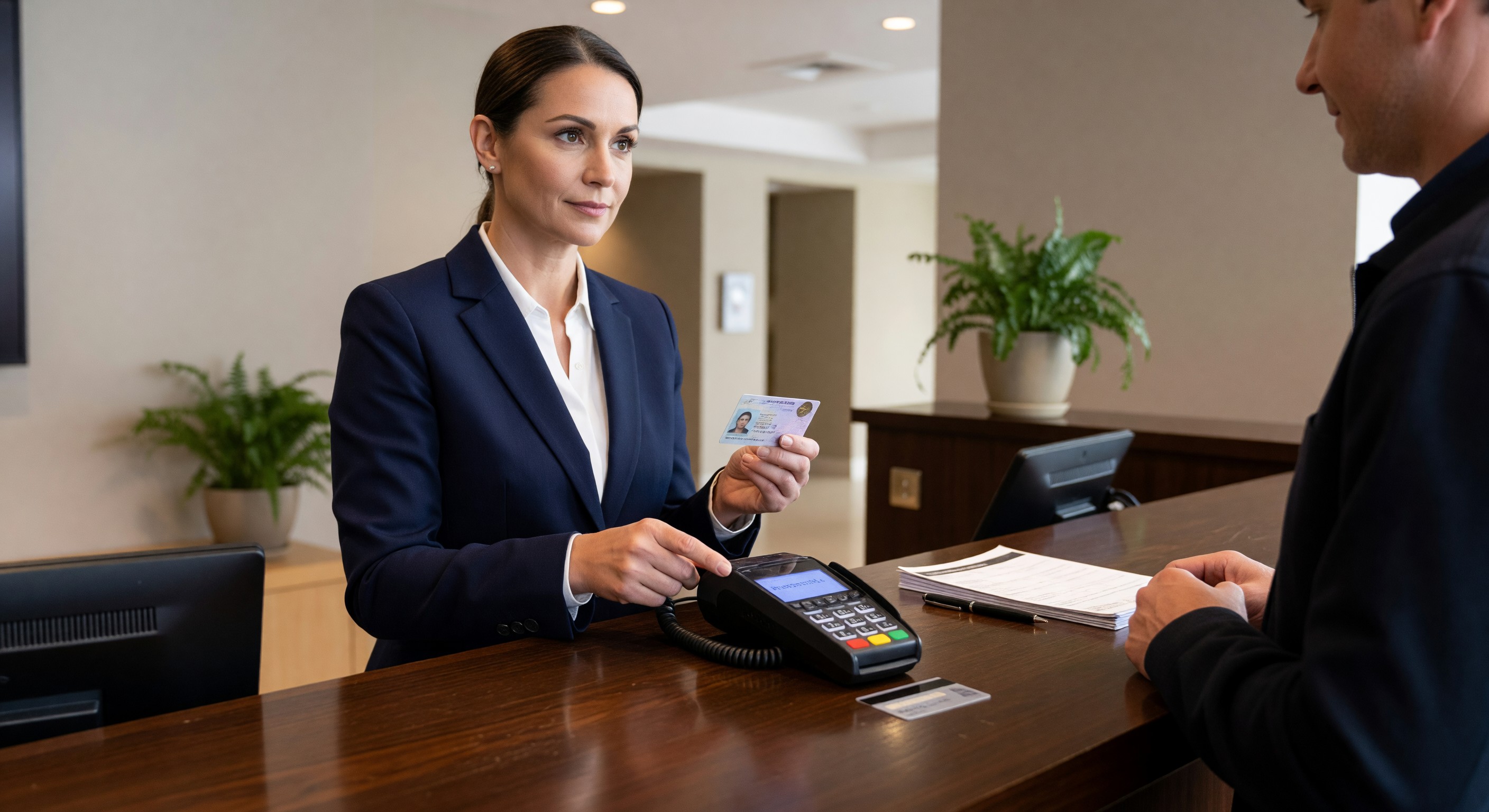
Government ID verification: Require government-issued photo ID at check-in and verify that the name on the ID matches the reservation and payment card. Train front desk staff to verify ID authentically — quickly checking name and photo against the guest in front of them, not just accepting the ID without comparison.
Digital ID verification for mobile check-in flows: As noted in the check-in technology context, liveness check combined with document scanning verifies the digital check-in guest matches the presented ID.
Card verification: When a card-not-present transaction exists (OTA booking, online booking), collecting the physical card at check-in and verifying card number, expiration, and CVV against the reservation records detects bookings where a card was used without physical possession.
Suspicious indicator training: Staff should be trained to recognize patterns that may indicate identity fraud: guest who doesn’t know their own reservation details, guest who becomes agitated when asked for identification, significant discrepancy in guest’s description of themselves versus ID photo, or third-party paying for a reservation with no connection to the room guest.
Loyalty Program Fraud
Hotel loyalty programs are significant fraud targets. Common schemes:
Account takeover: Fraudsters obtain loyalty account credentials (through phishing, credential stuffing using leaked passwords from other breaches, or social engineering of the hotel’s customer service) and transfer or redeem points from legitimate member accounts.
Point purchase fraud: Using stolen credit cards to purchase points directly from loyalty programs.
Reservation fraud using loyalty points: Booking reservations with fraudulently acquired points, sometimes for resale.
Countermeasures:
- Multi-factor authentication for loyalty account access (particularly for redemption transactions)
- Redemption velocity alerts (large point redemptions trigger human review)
- Address and phone number verification for accounts not previously used for redemption
- Staff training on social engineering attacks targeting loyalty account access (“a member called and needs their PIN reset”)
Operational Fraud Prevention Protocols
Beyond technology, operational discipline prevents fraud:
Dual-control for refunds: Refunds and adjustments above a threshold ($100–$500 typically) require manager approval with documentation of the reason.
No cash refund for credit card transactions: Refunds should return to the original payment card — not in cash, gift cards, or alternative payment methods that are preferred by fraudsters exploiting return policies.
Register of unusual requests: Maintain a log of reservations that show unusual characteristics (last-minute high-value booking, unusual payment arrangement, special access requests) for heightened verification at check-in.
Frequently Asked Questions
What is the most common type of hotel fraud? Credit card chargebacks — particularly “friendly fraud” where a guest disputes charges they legitimately incurred — represent the highest-volume fraud category at most hotels. Booking fraud using stolen credit card information is the second most common. Loyalty program account takeover is growing rapidly as programs become more valuable and account security remains inconsistent.
How should hotels respond to a suspected fraudulent booking? If fraud is suspected before arrival: contact the guest at the phone number or email on the reservation (not the number they left in a subsequent message — fraudsters often update contact information). If you cannot verify the guest’s identity, cancel the reservation and process a refund to the card on file. Document the cancellation reason. If fraud is suspected at check-in: decline to provide the room, refund any prepayment, and if appropriate, contact local law enforcement if identity fraud is suspected.
What is the typical hotel chargeback rate and what is considered acceptable? Hotel industry average chargeback rates run 0.4–0.8% of total transactions. Card brands set dispute rate thresholds that trigger investigation — Visa’s dispute monitoring program threshold is 0.9% for volume and 100 disputes/month; Mastercard’s is 1.5%. Rates above these thresholds result in additional fees and potential loss of processing ability. Hotels with chargeback rates above 0.5% should prioritize dispute documentation improvement and fraud prevention controls.
Can hotels share fraud intelligence about specific individuals across properties? Within a hotel portfolio under common management, sharing fraud intelligence (documented cases of fraud, not suspicions) through internal systems is appropriate and useful for preventing serial fraudsters from targeting multiple properties. Information sharing outside the organization — across different hotel companies — creates legal complexity (defamation risk, privacy compliance) and should involve legal counsel. Brand franchise systems sometimes maintain central fraud flags for documented cases, which properties can access through brand systems.
Further Reading from Authoritative Sources
- AHLA hotel fraud prevention and chargeback management standards — AHLA provides hospitality industry fraud prevention guidance, chargeback management frameworks, internal control standards, and front office security procedures applicable to hotel payment fraud defense, loyalty account security, and dispute documentation requirements.
- HFTP hotel payment security and PMS internal control standards — HFTP provides hospitality technology standards for PMS security configuration, payment system controls, loyalty account protection, and fraud detection capabilities applicable to hotel internal fraud prevention, chargeback dispute documentation, and payment security program development.