Unmanned aerial systems (UAS) — commercially known as drones — have proliferated from professional filmmaking and mapping applications to recreational use that now puts capable imaging technology in the hands of millions of guests and visitors near hotel properties. For hotel security and facility managers, drones present a genuinely new category of challenge: they can photograph private areas from angles no fixed camera or vantage point could achieve, disrupt operations and events, create noise and safety concerns near guests, and potentially be used by bad actors for reconnaissance or payload delivery.
Developing a practical hotel drone policy — one that addresses legitimate commercial use, recreational guest use, and security threats without generating disproportionate restrictions — requires understanding both the regulatory framework and the operational reality of drone activity near hotels.
The Regulatory Framework
FAA regulations govern drone operations in US airspace. Key rules relevant to hotel properties:
FAA Part 107: Commercial drone operations (photography, cinematography, property inspection) require a Remote Pilot Certificate under FAA Part 107. Part 107 rules prohibit operation over people without waivers, require visual line-of-sight with the drone, and include altitude restrictions near airports and controlled airspace.
Recreational operations: Non-commercial drone use is governed by FAA recreational rules that require registration for drones over 0.55 pounds, require recreational flyers to pass the TRUST (The Recreational UAS Safety Test), and prohibit flight in controlled airspace without authorization.
No fly zones: Hotels near airports are typically within controlled airspace (Class B, C, D, or E) where drone operations require prior authorization from the FAA (via the LAANC system for recreational and commercial operators). Many hotel properties near urban centers and airports are in restricted airspace that legally prohibits most drone operations.
Property rights versus airspace rights: Property owners control the airspace “immediately above” their property to the extent necessary for reasonable enjoyment and use, but do not control all FAA-managed airspace above their land. A drone flying 400 feet above your hotel’s pool deck is in FAA-regulated airspace, not trespassing in the traditional sense — even if guests in the pool can see and be photographed by it.
State and local laws: Many states have enacted privacy laws that restrict drone photography of private property or individuals without consent. California, Florida, Texas, and numerous other states have provisions relevant to drone-based imaging of hotel guests in private or semi-private areas. Local ordinances add additional complexity — consult legal counsel for your specific jurisdiction.
Areas of Guest Privacy Concern
The guest privacy concerns that most commonly arise with drone operations near hotels:
Pool and outdoor amenity areas: Pools, hot tubs, and outdoor spa areas are semi-private spaces where guests have reasonable expectations of privacy from overhead observation. FAA regulations don’t address this privacy dimension; state privacy laws and hotel policies fill this gap.
Guest room balconies: Photography into guest room balconies from drones raises clear privacy issues. Guests using balconies have reasonable expectation of privacy from directly overhead or eye-level surveillance.
Event areas: Wedding receptions, corporate retreats, and private events on hotel grounds may have legitimate privacy expectations or confidentiality requirements that aerial photography could violate.
Developing a Hotel Drone Policy
A hotel drone policy should address:
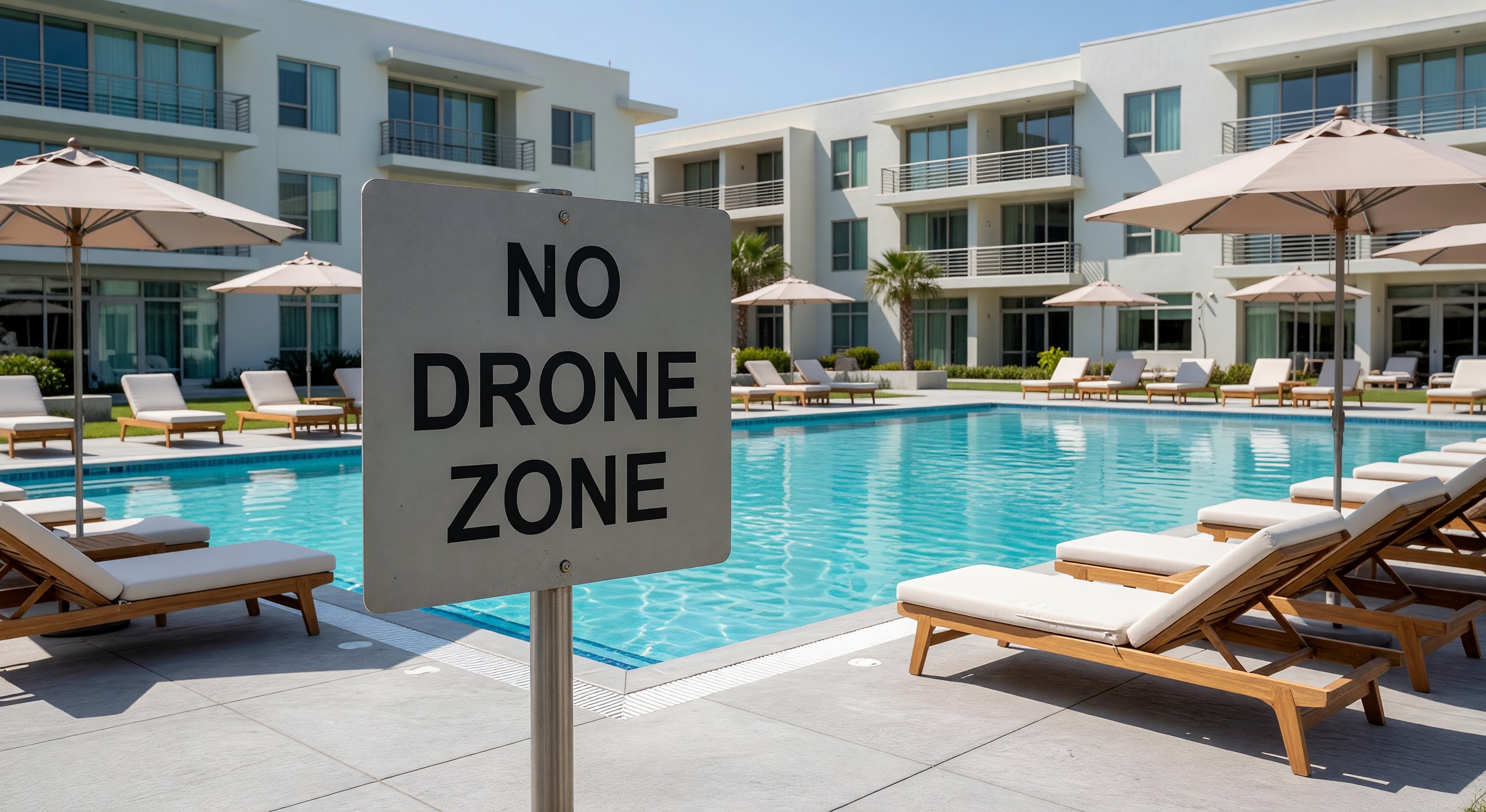
Prohibited areas: Define specific no-fly zones over the hotel property — pool areas, spa, event spaces, guest room balconies — where drone operation is not permitted regardless of operator or purpose.
Commercial photography authorization process: Provide a clear, efficient process for production companies, real estate photographers, and other commercial operators to request authorization for legitimate drone filming on hotel property. A policy that is only restrictive drives professional operators to ask forgiveness rather than permission; one with a workable authorization path maintains control.
Guest communication: Include drone policy in hotel policies (available at check-in and on website), post signage at pool and event areas, and train front desk and security staff to respond to guest drone sightings and complaints.
Security response: Define the security team’s response to unauthorized or concerning drone activity. Do not instruct staff to interfere physically with a drone — this can constitute federal interference with aircraft and creates liability. Staff should document (photograph), report to security supervisor, and if the operation appears to violate FAA regulations, contact local law enforcement or report to the FAA via the aviation safety hotline.
Commercial drone use by the hotel: Hotels that use drones for their own marketing photography and videography should ensure their contractors operate under Part 107, carry appropriate liability insurance, and comply with FAA authorization requirements.
Counter-Drone Considerations
Electronic drone countermeasures (jamming, GPS spoofing, capture systems) are heavily regulated in the US — only federal government agencies are authorized to deploy them. Hotels should not invest in counter-drone equipment advertised for commercial sale; most of these products violate FCC and FAA regulations and their use creates significant legal liability.
Practical non-electronic responses to drone threats:
- Documentation for law enforcement referral
- Physical obstructions (shade structures, pergolas over pool areas) that limit aerial sightlines
- Guest notification protocols for when drone activity is observed near privacy-sensitive areas
- Working with local law enforcement to build awareness of the hotel’s drone policy and their expected response role
Events and Large Gatherings
Hotels hosting large events — outdoor concerts, festivals, wedding receptions — should address drone management as part of event security planning:
- Coordinate with event promoters on whether official photography involves drone operators (licensed and insured under Part 107)
- Brief security staff on drone response protocols for the event
- Consider temporary FAA temporary flight restriction (TFR) requests for very high-security events (available only for events meeting specific FAA criteria)
Frequently Asked Questions
Can hotels legally prohibit drones from flying over their property? Hotels can prohibit drone operations on their property (land they own) and can enforce that through trespass law for ground-level and low-altitude operations. However, FAA-regulated airspace above a certain altitude is not controlled by the property owner. The practical enforcement approach is a combination of clearly posted policies, security response protocols, and engagement with local law enforcement when drone activity appears to violate FAA regulations or state privacy laws.
What should hotel staff do if they observe an unauthorized drone near the property? Document the drone operation (video or photos if possible, noting time, location, direction of flight). Report to security supervisor. Do not attempt to physically interfere with the drone — this is a federal crime. If the drone operation appears to be recording guests in areas where they have reasonable privacy expectations, contact local law enforcement. File a report with the FAA if there is reason to believe FAA regulations are being violated.
How should hotels handle requests from professional filmmakers to fly drones over the property? Establish a clear authorization request process: require Part 107 certification documentation from the drone operator, proof of liability insurance (minimum $1 million), a specific shot plan showing areas to be filmed, confirmation of FAA airspace authorization if required, and a location filming agreement that specifies permitted areas, limitations on guest photography, and the hotel’s right to halt filming. Legitimate professional operators expect these requirements.
Are there airports near my hotel that would restrict drone operations? Check the FAA’s B4UFLY app or DroneZone website — both provide airspace classification for any US location and indicate where authorizations are required or drone operations are prohibited. Properties within 5 miles of many airports are in controlled airspace requiring FAA authorization before any drone flight. Many unauthorized drone operators near hotels are unaware of these requirements.
Further Reading from Authoritative Sources
- AHLA hotel drone policy and guest privacy standards — AHLA provides hospitality industry guidance on guest privacy policies, property use standards, and security program management applicable to hotel drone policy development, guest communication requirements, and security response protocols.
- NIST unmanned aircraft systems security and privacy framework — NIST provides technology security frameworks and privacy guidance applicable to hotel drone security policy development, including assessment of counter-UAS technology regulatory constraints and privacy risk management for aerial surveillance scenarios.