Hotel parking technology has advanced more in the past five years than in the preceding twenty. The convergence of mobile connectivity, AI-driven systems, LPR accuracy improvements, and EV charging infrastructure has fundamentally changed what’s possible in hotel parking management. As we look toward the remainder of 2026 and beyond, several technology trajectories are becoming clear — some already being implemented at leading properties, others approaching commercial viability.
This guide examines the parking technology landscape for hotel operators planning capital investments and operational improvements in 2026.
Frictionless Guest Journey: The Near-Term Standard
The most impactful technology trajectory for hotel parking in 2026 is not a single technology but the integration of several mature technologies into a seamless guest experience:
Pre-arrival parking reservation: Integrated into the hotel booking engine or pre-arrival email, guests reserve and pay for parking before they arrive. The reservation is linked to their license plate.
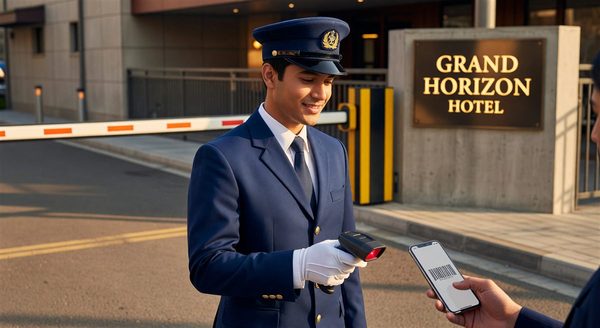
LPR-enabled entry: The guest drives to the entry lane, the camera reads their plate, the system verifies their reservation or hotel guest status, and the gate opens — in under 3 seconds. No ticket, no card swipe, no interaction with equipment.
In-stay communication: EV charging status via the hotel app (for EV-equipped stalls), valet retrieval request via app, and real-time lot availability for guests returning from off-site activities.
Exit without transaction: For pre-paid or folio-posted parking, the guest drives to the exit, plate is read, the system verifies payment status, and the gate opens. No stop required.
This end-to-end friction-free parking experience is achievable today with current technology — the limiting factor is typically the PARC system’s integration capability and the hotel’s willingness to invest in the PMS integration that makes it work.
Modern hotel parking systems are increasingly offering the integration frameworks that make frictionless hotel parking achievable for mid-market properties that previously required enterprise-scale technology budgets.
AI-Driven Revenue Management
Parking revenue management is moving beyond static rates and simple time-of-day pricing toward genuine AI-driven dynamic pricing that accounts for:
- Hotel occupancy forecast (from PMS)
- Local event calendar (sports, concerts, conferences)
- Competitor parking pricing (from third-party data services)
- Weather forecast (weather affects both demand and arrival mode)
- Historical demand patterns at the same date/time in prior years
The output is a recommended rate for each parking product (self-park overnight, self-park day rate, valet overnight, EV charging stall) at each time period — updated as conditions change. Early implementations at urban hotels report 20–30% improvement in parking RevPAS compared to static pricing approaches.
EV Charging Expansion and Management
By 2026, hotel EV charging infrastructure management has matured from “deploy some chargers” to active inventory management:
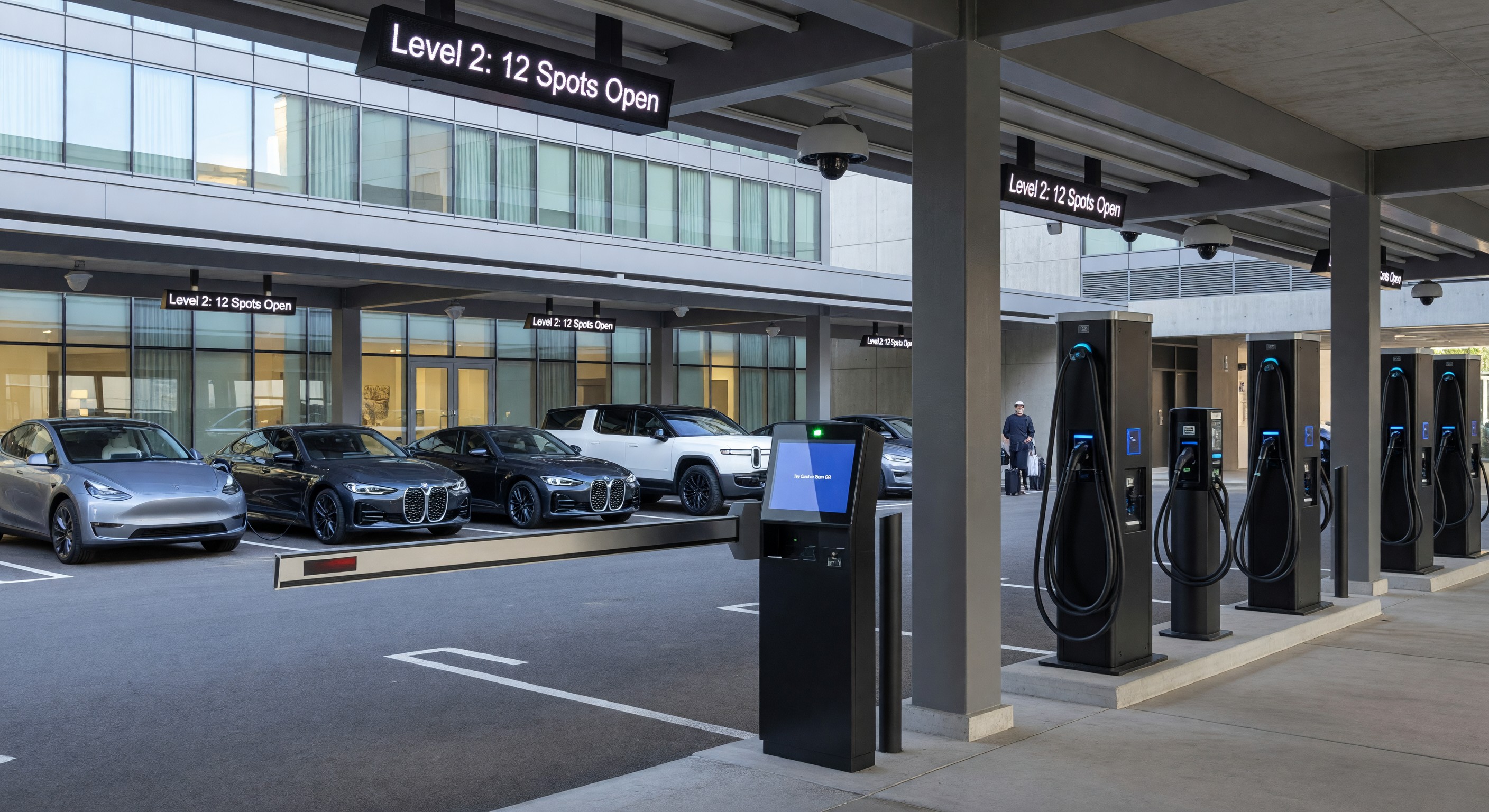
- Reservation for EV stalls: High-demand properties allow guests to reserve specific EV stalls in advance, ensuring charging availability rather than arriving and hoping a stall is open
- Charging time management: Smart charging networks that communicate estimated session completion and manage stall turnover to maximize the number of vehicles served per day
- Multi-network compatibility: Hotel charging stations compatible with both the major charging networks (and NACS/Tesla compatibility) serve more vehicles without requiring network account pre-enrollment
The EV charging market consolidation around fewer, larger networks has simplified operator decisions. The Tesla NACS connector adoption by all major EV manufacturers (announced 2023–2024) means that Universal NACS or NACS+CCS combo units serve virtually all EV guests without connector adapter complications.
Autonomous Parking Concepts
Automated parking structures — robotic systems that take a guest’s car at entry and retrieve it without human valet or self-park navigation — are operational at select hotel properties (particularly in dense urban and Asian markets). These systems:
- Maximize space utilization (vehicles are stacked without drive aisles needed between them — 40–50% more vehicles per square foot than conventional self-park)
- Eliminate the need for valets and the associated labor cost and liability
- Provide precise retrieval time guarantees (car available in exactly 3 minutes from request)
- Protect luxury vehicles from valet damage
At current pricing ($25,000–$50,000 per stall for robotic parking system installation), economics favor new construction in ultra-high-land-value markets. Wider hotel adoption is expected as system costs decrease and land scarcity in urban markets increases.
Parking Data as Hotel Intelligence
The sophisticated parking technology implementation of 2026 generates data that extends beyond parking operations into hotel-wide business intelligence:
Vehicle dwell time and on-property spend correlation: Hotels that can link vehicle residence time (from entry/exit data) with PMS folio data begin to understand which parking guest segments have the highest on-property spend — insights that inform targeted offers and loyalty program design.
Market capture analysis: LPR data revealing what percentage of vehicles in the surrounding area stop at the hotel versus pass by provides a measure of market capture that complements traditional occupancy and RevPAR metrics.
Traffic pattern optimization: Entry and exit timestamp data, correlated with lobby camera analytics, enables parking flow optimization — identifying which lane configurations, signage placements, and staffing positions reduce congestion.
Cross-property portfolio analytics: Hotel management companies with multiple properties can aggregate parking data across the portfolio to identify consistent patterns, compare performance against similar property types, and share pricing insights across the network.
Sustainability-Linked Parking Technology
Sustainability objectives are increasingly integrated into parking technology:
- Carbon accounting for parking: Emissions attributable to vehicles parked on property (from vehicle emissions data, average miles per trip estimates) are reportable by some modern PARC systems — supporting hotel Scope 3 emissions reporting
- Incentive programming for low-emission vehicles: Rate discounts for EVs, hybrids, or car-share vehicles incentivize guests to make lower-emission transportation choices
- Demand management for congestion reduction: Pre-arrival parking reservation with timed arrival windows reduces the circling and idling that occurs when arriving guests search for spaces in high-demand conditions
Frequently Asked Questions
What is the single highest-value parking technology investment a hotel can make in 2026? For properties without LPR, LPR installation with PMS integration is the highest-value single investment — enabling hotel guest recognition, automated folio posting, and pre-paid reservation entry without any other system changes. For properties that have LPR, the highest-value next investment depends on what’s limiting parking performance: if revenue is the gap, revenue management/dynamic pricing capability; if guest experience is the gap, pre-arrival reservation and booking integration; if operational efficiency is the gap, reporting and analytics infrastructure.
How long do hotel parking technology investments typically last before becoming obsolete? Hardware (barrier gates, entry/exit kiosks, LPR cameras) typically has a 10–15 year service life with software updates. Software platforms may need major upgrades every 5–7 years as API standards and integration requirements evolve. EVSE hardware is on a faster cycle — 7–10 years — as charging connector standards and power delivery capabilities advance. Plan technology refreshes by component rather than replacing all parking technology simultaneously.
What is the key barrier to frictionless hotel parking adoption? The primary barrier is PMS integration complexity. When a hotel’s PMS supports direct API integration with its PARC system, the guest recognition, folio posting, and pre-arrival reservation workflows function as designed. When integration requires a middleware layer or is limited to data export/import, the real-time responsiveness that makes truly frictionless parking possible is degraded. PMS upgrade decisions should explicitly evaluate parking (and other ancillary system) integration capability.
How should hotels think about parking technology investment relative to other capital needs? Parking typically receives less capital investment attention than guestroom renovations, lobby upgrades, or restaurant improvements — despite often being one of the first and last guest experiences at the property. Properties where parking is a significant revenue stream (more than 5% of total revenue) should treat parking technology as a revenue-generating investment with quantifiable ROI, not a back-of-house cost center. Even at properties where parking generates less revenue, the guest experience impact of frictionless parking supports broader satisfaction metrics that affect all revenue streams.
Further Reading from Authoritative Sources
- HFTP hotel parking technology standards and integration roadmap — HFTP provides hospitality technology professionals with parking system integration standards, emerging technology evaluation frameworks, and technology roadmap guidance applicable to hotel parking capital planning and technology program development.
- DOE EV charging infrastructure standards and hotel building electrification resources — The DOE Buildings program provides EV charging technology standards, connector compatibility guidance, and building electrification resources applicable to hotel EV charging infrastructure planning and the transition to universal NACS-compatible charging equipment.