Selecting a parking access and revenue control system (PARCS) for a hotel property is a technology decision with a 10+ year operational horizon. The system will touch every parking transaction, every guest interaction with the parking facility, and every dollar of parking revenue. Getting it right matters.
The hotel parking technology market has evolved significantly in the past five years. Legacy on-premises systems that required a server room in the parking structure have given way to cloud-managed platforms. LPR has moved from premium to standard. Mobile payment has become expected. And the integrations with hotel PMS and payment processors have become more sophisticated.
This guide provides a framework for evaluating parking revenue management systems in the current market.
Defining Your Requirements Before You Evaluate
The biggest mistake in PARCS procurement is starting with a vendor demo before defining what you actually need. Every vendor will demo their system doing things impressively — what matters is whether those things match your operational requirements.
Requirements Worksheet
Work through these questions with your operations team before engaging vendors:
Volume and capacity:
- How many parking spaces? (determines system scale requirements)
- Peak hourly transaction rate? (determines lane throughput requirements)
- What percentage of parkers are hotel guests vs. transient?
Access credential types:
- Do we want LPR for guests? For monthly parkers? For all parkers?
- What physical credentials do we need (RFID, keycard, ticket, mobile)?
- Does our hotel keycard system need to serve as a parking credential?
Payment types:
- Credit card (mandatory)
- Mobile payment apps?
- Room charge (requires PMS integration)
- Monthly billing (requires invoicing capability)
- Pre-paid online?
Revenue control requirements:
- What validation types do we need (restaurant, retail, event)?
- What are the revenue control requirements for reconciliation?
- Do we need integration with our accounting system?
PMS integration:
- Which PMS platform are we on?
- What PMS integration functions do we need (folio posting, guest validation, occupancy data)?
- Is the integration pre-built by the vendor or would it need custom development?
Operational model:
- Fully automated or staffed lanes?
- Valet integration required?
- Remote management center or on-site management?
- Hours of operation and after-hours support requirement?
Reporting requirements:
- Daily revenue reconciliation
- Occupancy data
- Transaction-level audit
- Integration with hotel revenue reporting?
System Architecture Options
Cloud-Managed vs. On-Premises
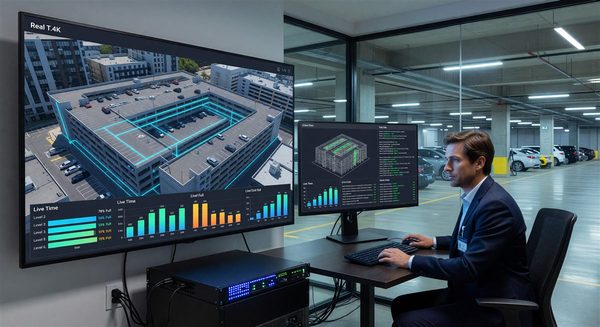
Cloud-managed systems: The intelligence resides in a cloud-hosted management platform. Field equipment (gates, readers, pay stations) is simpler and communicates with the cloud for all decisions. Management, reporting, and configuration all happen through a web interface.
Advantages: No on-premises server to maintain, software always current, remote management from anywhere, better disaster recovery.
Considerations: Internet connectivity dependency (must design for graceful offline operation), ongoing SaaS subscription cost.
On-premises systems: A server in the parking facility (or the hotel’s server room) manages all operations. Cloud connectivity may be available for remote access and reporting but isn’t required for core operation.
Advantages: Operates fully without internet, lower dependency on vendor’s cloud infrastructure.
Considerations: Server maintenance responsibility, software updates require manual intervention, remote management requires VPN setup.
For new installations, cloud-managed systems are the current standard and the direction the industry is moving. On-premises systems are more appropriate for properties with specific security requirements that prohibit cloud connectivity.
Lane Architecture
Ticket-on-entry/pay-on-foot: Parker takes a ticket at entry, pays at a pay station before returning to the vehicle, and presents the validated ticket at exit. Traditional approach; good for high-volume transient parking.
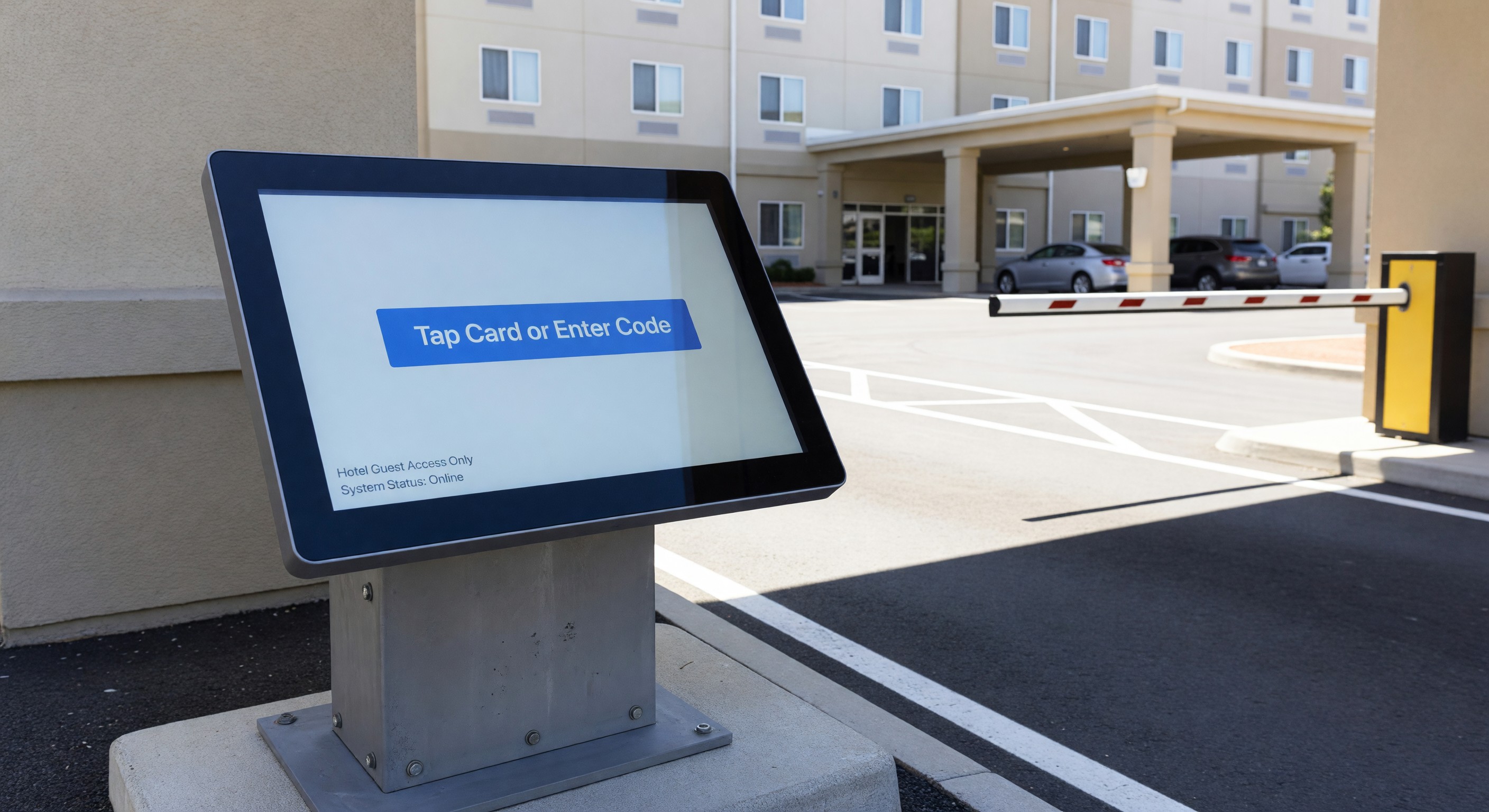
Credential-only (ticketless): Entry is by credential (LPR, RFID, keycard). No ticket issued. Parkers with credentials access and exit without stopping. Non-credentialed visitors may be issued a ticket or directed to a pay station at entry.
Pay-at-entry: Parker pays at entry and receives a timed or unlimited pass. Common for flat-rate lots.
Subscription/monthly: Parkers access using a permanent credential (RFID, LPR) tied to a monthly account. No per-transaction payment.
Most hotel installations use a hybrid approach: credentials (LPR or RFID) for hotel guests and monthly parkers, ticket-on-entry for transient parkers.
Evaluating Vendors
Market Overview
The hotel PARCS market includes both large enterprise vendors (SWARCO, Amano, T2 Systems, HUB Parking Technology, ParkWhiz/Arrive) and specialized hospitality-focused vendors. The right choice depends on your scale, integration requirements, and desired level of vendor support.
Enterprise vendors: Typically offer deeper feature sets, stronger hardware durability, and larger support organizations. May have less flexibility for custom hotel-specific integrations.
Hospitality-focused vendors: May have pre-built integrations with major hotel PMS platforms and deeper understanding of hotel operational requirements.
Cloud-native platforms: Newer entrants built from the ground up as cloud platforms. Often more modern UX and more flexible integration APIs. May have less mature hardware ecosystem.
Demonstration Requirements
Structure vendor demos around your specific requirements:
Scenario 1: Hotel guest arrival — Guest pulls up to entry, LPR reads plate, system queries PMS, gate opens, charge is posted to folio at checkout. Watch the actual process, not a simulated screen recording.
Scenario 2: Transient parker — Parker arrives, takes ticket, pays at pay station, exits. Observe payment processing including contactless and mobile payment options.
Scenario 3: Validation — Restaurant guest validates parking, parker uses validated ticket at exit. Observe how validation limits are enforced and how exceptions are handled.
Scenario 4: Exception handling — LPR fails to read a plate. Parker can’t pay at the pay station. Gate arm is struck by a vehicle. How does the system handle each case? How does staff respond?
Scenario 5: Reporting — Generate a daily revenue report. Pull an audit log for a specific transaction. Show the occupancy trend for the past week. Evaluate the actual reporting interface, not just screenshots.
Integration Testing
Before signing a contract, verify PMS integration specifically:
- Which version of your specific PMS is supported?
- Is the integration production-deployed (not “in development”)?
- Request contact information for 2–3 hotel references on the same PMS platform so you can verify their experience
Do not accept integration assurances without verifying with reference customers. PMS integration failures are the most common source of post-installation dissatisfaction.
Total Cost of Ownership
Evaluate total 10-year cost, not just initial installation cost:
Hardware: Entry lane equipment (gate, camera, reader), exit lane equipment, pay stations, intercom. Replace with expected hardware lifecycle.
Installation: Labor, conduit, electrical work, any required facility modifications.
Software licensing: Annual SaaS subscription or perpetual license with maintenance.
PMS integration: One-time integration setup cost plus ongoing support.
Payment processing: Merchant services fees (typically 2.5–3.5% of card transaction volume).
Hardware maintenance: Annual service contract or time-and-materials maintenance costs.
Technical support: Vendor support agreement cost for after-hours support.
Staff/labor: Any changes to staffing requirements from the system.
Model all of these over 10 years, then compare vendor options on total cost, not just sticker price.
Making the Decision
After completing demos and reference calls, evaluate vendors on a weighted scoring matrix:
- Functional fit (40%): How well does the system meet your defined requirements?
- Integration quality (25%): PMS integration, payment integration, reliability
- Total cost (20%): 10-year TCO comparison
- Vendor stability and support (15%): Financial stability, support organization, track record
Weight the factors based on your specific situation — a property where PMS integration is critical should weight that factor more heavily.
FAQ
Is it worth replacing a working parking system that’s 8 years old? Evaluate on total cost of ownership: what are the annual maintenance costs vs. a new system? Are there integration capabilities you need that the old system can’t support (LPR, mobile payment, PMS integration)? Is the software receiving security updates? If the system is performing well and meeting operational requirements, replacement may not be justified. If any of these factors apply, it’s worth doing the TCO analysis.
How do we handle the transition when switching parking systems? Plan for 30–60 days of parallel operation where possible — the old system processes actual transactions while the new system is validated. Full cutover should be planned for a low-volume period (off-season weekend). Communicate the transition to monthly parkers in advance. Plan for enhanced support in the first two weeks of live operation.
What’s a reasonable warranty and support expectation for parking hardware? 1-year parts and labor warranty on new hardware is standard; 2-year is better and worth negotiating. After warranty, an annual maintenance agreement covering parts and labor is the standard approach. After-hours response time should be specified: for hotel operations, 4-hour response for gate failures is a reasonable requirement.
Should we include EV charging integration in our parking system procurement? Yes, if EV charging is deployed or planned. An integrated platform that manages both standard parking access and EV charging session management (payment, time limits, occupancy) is operationally simpler than two separate systems. Ask vendors specifically about EV charging management capabilities.
Further Reading from Authoritative Sources
- HFTP hotel PARCS vendor evaluation and parking revenue management standards — HFTP provides hospitality technology standards for parking access and revenue control system evaluation, vendor selection criteria, PMS integration specifications, and parking technology procurement guidance applicable to hotel PARCS procurement, total cost analysis, and vendor contract negotiation.
- AHLA hotel parking technology procurement and operational standards — AHLA provides hospitality operations guidance on technology procurement frameworks, parking system investment decisions, and operational standards applicable to hotel PARCS vendor evaluation, contract requirements, and long-term technology planning for parking operations.