License plate recognition (LPR) technology has matured to the point where it’s a practical solution for hotel parking operations of most sizes. Five years ago, reliable LPR required careful conditions and specialized expertise. Today, AI-enhanced LPR systems deliver 95%+ read rates in most environments, integrate with standard parking management platforms, and are priced at levels that work for mid-market hotel properties.
For facility managers evaluating parking system upgrades, understanding how LPR works and what it delivers operationally is essential to making an informed investment decision.
How LPR Works
Image Capture
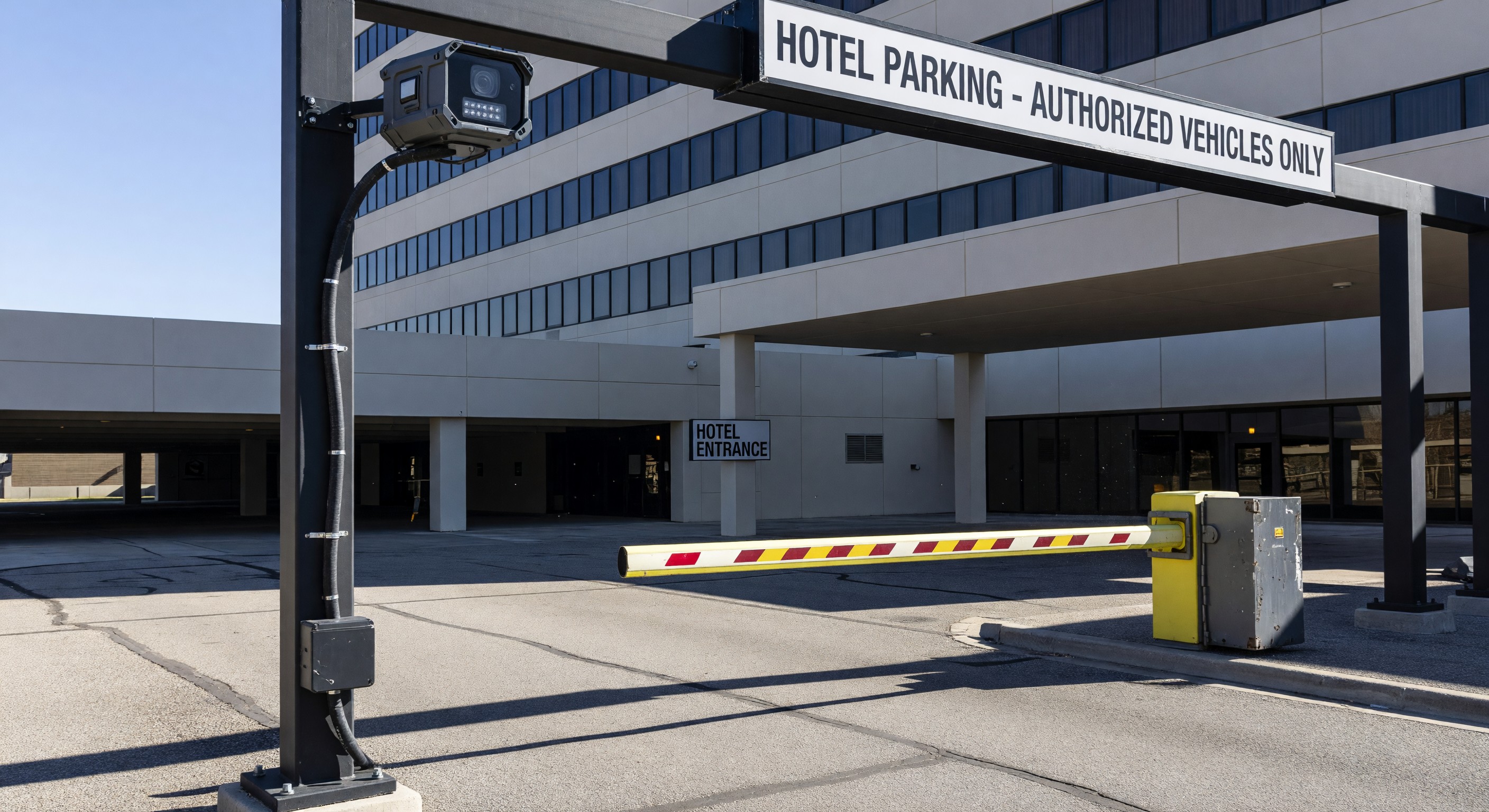
An LPR camera captures an image (or typically a video frame) of a vehicle at the entry or exit point. The camera is positioned to capture a clear image of the license plate as the vehicle approaches, ideally from a slightly forward angle that minimizes reflective glare from plate materials.
LPR cameras are specialized devices — they’re not standard security cameras. They use:
- High frame rates (30+ fps) to capture plates on moving vehicles
- Infrared illumination that works regardless of ambient lighting conditions (critical for reliable 24-hour operation)
- Optimized focal length and depth of field for the specific capture distance
- Narrow aperture to maximize sharpness across the plate distance range
Optical Character Recognition (OCR)
The captured image is processed by OCR software that identifies the alphanumeric characters on the license plate. Modern LPR systems use AI-based character recognition trained on millions of plate images from all US states and Canadian provinces (and other jurisdictions as relevant).
The OCR returns the plate number as a text string along with a confidence score. When confidence is above a threshold (typically 85–90%), the result is used automatically. Low-confidence reads are flagged for human review or result in fallback behavior (open gate, prompt for alternative credential).
Database Matching
The recognized plate number is compared against a database of authorized or registered vehicles:
- Hotel guests who registered their plate at check-in or booking
- Monthly parkers with registered plates
- Known violation or do-not-park lists
A match in the authorized database triggers the appropriate action (open the gate, post a charge, issue a permit). No match typically results in pay-on-foot processing or an attendant notification.
Installation Requirements
Camera Placement
LPR camera placement is the most critical factor in system performance. Improperly placed cameras produce lower accuracy and more exception calls. Key placement requirements:
Distance: The camera should capture plates at a defined distance range — typically 8–20 feet from the camera, depending on the lens specification. Vehicle should be stopped or moving slowly at the capture point (gate arm closed creates the stop).
Angle: 0–30 degrees horizontal from the vehicle’s centerline. Steep angles distort the plate image and reduce OCR accuracy. The camera should be positioned slightly to the side of the lane, not directly in front.
Vertical angle: 15–30 degrees downward from horizontal. This angle captures plates on most vehicle heights. Very low angles create problems with front license plate on pickup trucks and SUVs that are carried high.
Lighting: The IR illumination built into LPR cameras handles most lighting conditions, but extreme conditions (direct sunlight directly behind the vehicle) can affect performance. Design the entry lane orientation with sun angles in mind where possible.
Mounting: LPR cameras require stable mounting — vibration significantly degrades performance. Avoid pole-mounted cameras in exposed locations where wind creates movement.
Multiple Camera Configurations
For improved accuracy and coverage, consider:
- Front and rear cameras at each lane (captures plate regardless of vehicle approach direction)
- Overview camera in addition to the LPR camera (provides context for disputed transactions)
- Secondary angle camera for vehicles with dirty, damaged, or unusual plates
Integration with Hotel Systems
PMS Integration
The highest-value LPR integration connects the license plate database to the property management system. When properly configured:
- Guest makes a reservation through the hotel website, OTA, or PMS
- Guest enters their license plate at booking (increasingly offered as an online field)
- Plate is automatically entered into the parking system’s authorized database
- Guest arrives at the parking entry — camera reads the plate, PMS confirms active reservation, gate opens automatically
- At checkout, parking charge is automatically posted to folio based on entry and exit timestamps
This end-to-end flow is entirely automated — no ticket, no credential, no staff interaction required for the standard case. The guest experience is seamless; the labor savings are meaningful.
What makes this work in practice: the PMS integration must be real-time (not batch-updated) so that plate registrations from same-day bookings are available immediately, and so that plates from early check-outs are deactivated at the correct time.
Walk-Up Guest Registration
Guests who didn’t pre-register their plate (which is most guests until the system is well-established) need an alternative. Options:
- Plate registration at front desk: Staff enters the plate into the PMS/parking system at check-in
- Guest self-registration kiosk: A tablet or kiosk at the entry point or lobby where guests can register their plate
- QR-based registration: A QR code in the welcome email links to a web form for plate registration before arrival
- Hybrid: Register at entry if not pre-registered — guest presses a button at the entry lane, an attendant or remote operator verifies their reservation, and manually enters the plate for the stay
Reporting Integration
LPR systems generate transaction-level data that integrates with parking management reporting:
- Entry and exit timestamps with plate numbers
- Dwell time (length of parking session)
- Authorization events (which plates were matched and how)
- Exception events (low-confidence reads, unmatched plates, manual overrides)
This data feeds parking revenue reports, occupancy analysis, and compliance monitoring.
Accuracy and Exception Handling
What Accuracy to Expect
In optimal conditions (well-placed cameras, clean plates, normal vehicle approach speed), modern AI LPR systems achieve 95–98% read accuracy on US and Canadian plates. In practice, several factors reduce this:
Plate condition: Dirty, damaged, faded, or covered (snow, mud) plates read less reliably. In winter markets, expect higher exception rates after snow events.
Non-standard plates: Specialty, vintage, or certain motorcycle plates may not be in the training database for some systems.
Vehicle speed: Vehicles approaching too quickly (over 10 mph at the gate) don’t give the camera sufficient exposure time. Gate arm position design should encourage vehicles to slow before the capture zone.
Lighting extremes: Very dark environments exceed IR illuminator range; direct sun in the camera field can overexpose the plate.
Exception Management
Exceptions — transactions where the system can’t automatically process the plate — require a human response. The key design question: what is the fallback behavior when a plate can’t be read or matched?
Options for unmatched or unread plates:
- Gate opens and the transaction is marked for later resolution
- Gate stays closed; parker presses intercom for assistance
- Gate opens only if an intercom-reached attendant or remote operator authorizes it
- Pay-on-foot fallback — parker gets a ticket, pays at a kiosk
The right answer depends on the property’s security posture and the volume of expected exceptions. In a hotel parking operation where most parkers are authorized guests, option 1 or 3 is usually appropriate. In a high-security application, option 3 or 4 may be required.
Cost and ROI
System Cost Range
LPR-equipped parking system for a mid-size hotel:
- LPR cameras (entry + exit, single lane): $5,000–$12,000 per lane installed
- Software licensing (if separate from parking management platform): $2,000–$5,000/year
- PMS integration development (if not pre-built): $5,000–$15,000
Total for a simple single-entry, single-exit configuration: $15,000–$35,000.
ROI Sources
Labor savings: Eliminating or reducing the attendant requirement at entry/exit lanes typically saves $25,000–$60,000+ annually depending on market wages and hours.
Revenue improvement: LPR enables accurate billing for every guest parking session, reducing the manual errors and omissions that occur with ticket-based systems. In properties with active revenue leakage, the recovery can be significant.
Guest experience: Seamless, ticketless parking is a documented positive in guest satisfaction surveys. This is harder to quantify but real.
FAQ
How do we handle guests who refuse to register their license plate for privacy reasons? Offer an alternative credential — a keycard, a QR code, or manual validation — and document their preference. Don’t make plate registration mandatory if it creates a friction point that drives guests away from your parking facility. LPR is a convenience enhancement, not a surveillance requirement.
What happens if two different guests have the same plate (rental car, etc.)? This is a rare edge case that needs a defined resolution procedure. If the system detects the same plate presenting for a second entry while one session is already open, flag it for manual review. In practice, the most common cause is a plate mis-read rather than actual duplicate plates.
Can LPR replace the parking gate arm entirely? LPR identifies who the vehicle is; the gate arm enforces the parking control. Some open-lot applications use LPR without a gate arm for access control (using post-event enforcement for violators), but most hotel applications use LPR in conjunction with a barrier gate for positive access control.
How do we handle the transition from our current ticket system to LPR? Plan a 30–60 day parallel operation period where both systems are active. Guests who have registered plates use LPR; others use the ticket fallback. This allows staff and guests to adapt while validating system performance before fully retiring the ticket system.
Further Reading from Authoritative Sources
- HFTP hotel parking technology and LPR integration standards — HFTP provides hospitality technology professionals with parking system integration standards, LPR technology deployment guidance, and PMS connection requirements applicable to hotel license plate recognition system selection, installation, and operations.
- AHLA hotel parking technology and guest experience standards — AHLA provides hospitality industry research on parking technology adoption, guest satisfaction impact of frictionless parking, and technology investment standards applicable to hotel LPR system ROI analysis and program design.