The 2021 collapse of the Champlain Towers South condominium in Surfside, Florida — though not a parking structure — accelerated regulatory attention to the structural condition of concrete buildings nationwide, including the parking garages that are a standard component of full-service and upscale hotel properties. In the years since, building officials in Florida and an increasing number of other states have enacted or proposed mandatory structural inspection programs for aging concrete structures.
For hotel facility managers, parking garage structural condition is both a safety responsibility and a financial one. Deferred maintenance on concrete garage structures accelerates deterioration, increases remediation cost, and creates liability exposure. This guide covers the key elements of hotel parking garage structural management: inspection types, the deterioration mechanisms that threaten concrete structures, remediation options, and the regulatory landscape that is driving inspection requirements.
Why Concrete Parking Structures Deteriorate
Parking garage concrete deteriorates through several distinct mechanisms:
Chloride-induced corrosion: Road salt and de-icing chemicals tracked in by vehicles contain chloride ions that penetrate concrete cover over reinforcing steel. When chloride concentration at the rebar surface reaches a threshold, electrochemical corrosion begins. Corroding steel expands to 4–7 times its original volume, cracking and spalling the concrete cover above it. This is the leading cause of parking structure deterioration in cold-climate markets.
Freeze-thaw damage: Concrete that absorbs water and then freezes experiences internal expansion pressure that progressively deteriorates the concrete matrix. Low-permeability concrete (proper water-cement ratio) and adequate air entrainment reduce but don’t eliminate freeze-thaw susceptibility.
Post-tensioned cable corrosion: Many modern parking structures use post-tensioned concrete construction where high-strength steel cables are tensioned after the concrete is poured. If the grouting around PT cables is inadequate, or if the concrete cover over the PT system fails, corrosion of PT cables is catastrophic — cable failures cause sudden, large-scale structural failure with minimal warning. PT cable failures have caused multiple parking structure collapses.
Joint and drainage failures: Expansion joints between parking deck sections accommodate thermal movement. Failed joint sealant allows water and chloride-laden runoff to penetrate to lower deck levels and the supporting structure below. Blocked drains cause ponding that accelerates concrete chloride uptake. Joint and drainage maintenance are the most cost-effective structural preservation investments available.
Alkali-silica reaction (ASR): A chemical reaction between certain aggregate types and the alkaline pore water in concrete causes progressive expansion and cracking (“map cracking” or “crazing”) over decades. ASR is not reversible — only surface treatment or replacement addresses it once established.
Inspection Types
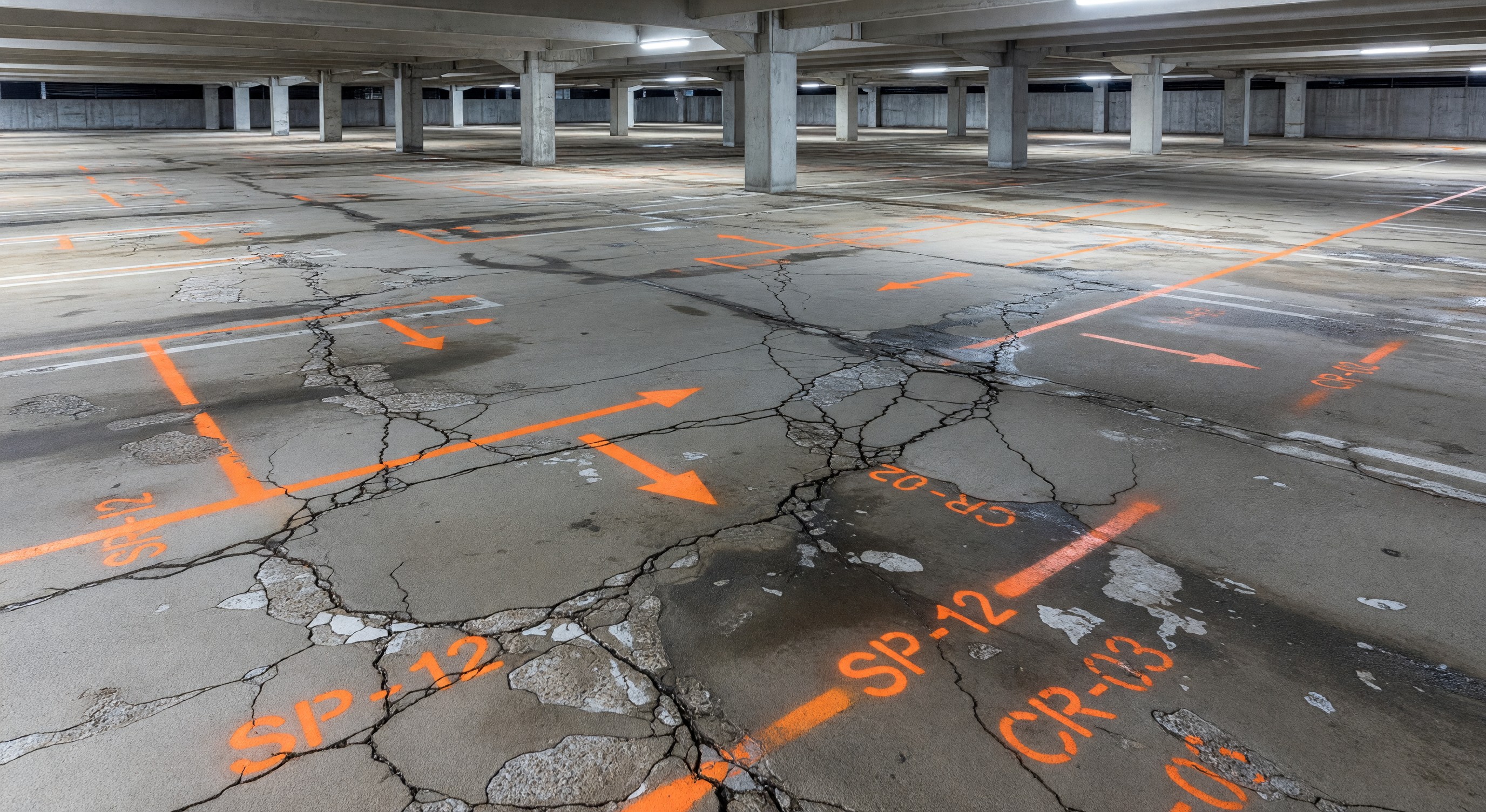
Visual inspection: Performed by an engineer or trained technician walking all deck and structure surfaces. Documents visible deterioration (cracks, spalling, staining, efflorescence), drainage problems, and joint conditions. Provides a condition snapshot but cannot detect sub-surface deterioration.
Sounding and delamination survey: Tapping the concrete surface (manually with a hammer or mechanically with a chain drag or automated sounding device) identifies delaminations — areas where the concrete has separated from the underlying substrate or rebar surface. Delaminated concrete sounds hollow versus the solid ring of intact concrete. Sounding surveys locate deterioration that visual inspection misses.
Half-cell potential survey: Electrochemical testing that measures the electrical potential at the concrete surface, indicating the probability that embedded reinforcing steel is actively corroding. Half-cell surveys identify areas of active corrosion before visible spalling occurs — enabling earlier, less expensive remediation.
Ground-penetrating radar (GPR): Radar imaging that reveals rebar location, concrete cover depth, voids, and in some configurations, moisture accumulation. GPR is non-destructive and provides subsurface condition information not available through surface surveys.
Core sampling: Physical extraction of concrete core samples for laboratory testing of compressive strength, chloride content at depth, carbonation depth, and aggregate characteristics. Core sampling is destructive (requires patching) but provides definitive material condition data.
PT system inspection: Post-tensioned structures require specialized inspection of anchorages, PT pockets, and — where accessible — grouting condition around cables. Any concrete spall or crack near a PT anchor zone warrants immediate structural engineering evaluation.
Regulatory Requirements
Following the Surfside collapse, Florida enacted Senate Bill 4D (2022) requiring mandatory recertification inspections for condominiums and cooperative buildings over three stories at 25 years from original certificate of occupancy, and every 10 years thereafter. Milestone inspection reports require structural engineering review.
Other jurisdictions with parking-specific inspection requirements:
- New York City requires facade and parking structure inspections under Local Law 11/Facade Inspection Safety Program
- Chicago requires parking structure inspections every 5 years
- New Jersey has enacted parking structure inspection requirements following multiple collapses
- Several states are actively developing inspection requirements
Hotels should confirm applicable inspection requirements with their local authority having jurisdiction and engage a structural engineer familiar with current local law.
Remediation Options
Remediation scope depends on the extent and type of deterioration:
Crack injection: Epoxy or polyurethane injection seals cracks, restores structural continuity, and prevents water penetration. Most appropriate for non-active (stable) cracks.
Spall repair: Removal of delaminated and deteriorated concrete to a sound substrate, followed by corrosion inhibitor treatment of exposed rebar and patching with cementitious repair mortar. Spall repair is the most common hotel parking garage remediation activity.
Waterproofing membrane: Application of a vehicular-traffic-rated waterproofing membrane (polyurethane, polyurea, or traffic-bearing coating) over the driving deck surface reduces water and chloride penetration. Most appropriate for decks in moderate condition before significant reinforcing corrosion has begun — waterproofing after corrosion is established slows but doesn’t stop ongoing deterioration.
Cathodic protection: Impressed current cathodic protection systems permanently prevent reinforcing steel corrosion by maintaining a protective electrical potential across the concrete. Appropriate for structures with established corrosion that warrants a long-term preservation approach over a structurally sound deck system.
Partial deck replacement: When deterioration is extensive enough that repair of individual spalls is uneconomical versus replacement, saw-cutting and replacing concrete deck sections provides a longer-term solution than patch repairs.
Budget Planning
Parking structure remediation is expensive and often underfunded in hotel capital reserves. Planning benchmarks:
- Basic surface repair and sealant: $3–$8/sq ft
- Comprehensive waterproofing membrane: $8–$18/sq ft
- Significant spall repair and deck rehabilitation: $20–$50/sq ft
- Major structural remediation or partial deck replacement: $50–$150/sq ft
Budget based on structure age, prior maintenance history, and most recent inspection findings. Properties with no documented inspection in the prior 10 years should commission a current engineering assessment before establishing capital reserves for structural work.
Frequently Asked Questions
How often should hotel parking garages be structurally inspected? Industry guidance (International Concrete Repair Institute) recommends a comprehensive engineering inspection every 5 years for most parking structures, with annual visual inspections by facility staff between engineering inspections. Structures in aggressive environments (heavy de-icing chemical use, coastal salt exposure) benefit from 3-year engineering inspection cycles. Post-tensioned structures warrant particular vigilance — annual visual inspection of anchor zones and any deterioration near PT elements warrants immediate structural engineering consultation.
What are the most visible signs that a parking garage needs inspection? Warning signs requiring immediate structural engineering consultation: concrete spalling that exposes reinforcing steel or PT anchorage, map cracking on horizontal surfaces that was not present in prior inspections, new vertical cracks wider than 1/16 inch in walls or beams, rust staining on concrete surfaces (indicates active corrosion of embedded steel), water staining or calcium deposits below expansion joints (indicates joint failure and water penetration), and any sudden or unexpected concrete fall.
Does a parking garage need to be closed during structural inspection? Visual inspections, chain drag surveys, and most non-destructive testing can be performed with normal parking operations ongoing in unaffected sections. Areas requiring worker access to the driving surface (chain drag, core sampling, sounding) may require temporary lane closures or section closures. A pre-inspection planning meeting with the engineering firm should identify what access is required for each test method.
How does de-icing chemical use affect parking structure service life? Chloride-based de-icing chemicals (rock salt, calcium chloride, magnesium chloride) are highly aggressive to concrete parking structures. A single winter’s de-icing chemical application can deliver more chloride to the concrete surface than several years of natural exposure. Properties in cold climates should evaluate de-icing chemical alternatives (sand, non-chloride melting products such as calcium magnesium acetate or potassium formate) in critical parking areas, and ensure robust floor drain maintenance to rapidly discharge chloride-laden water from the deck.
Further Reading from Authoritative Sources
- IFMA hotel parking structure inspection and capital planning standards — IFMA provides facility management standards for parking structure inspection programs, structural capital planning frameworks, and asset lifecycle management applicable to hotel parking garage inspection scheduling, condition assessment documentation, and remediation capital budgeting.
- OSHA hotel parking structure structural safety and inspection compliance — OSHA provides workplace structural safety standards, inspection compliance requirements, and employer liability guidance applicable to hotel parking structure safety management, structural deficiency response protocols, and the general duty to maintain safe conditions in occupied structures.