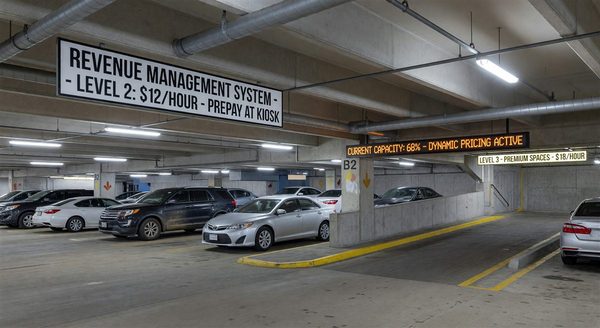
Hotel room rates change dynamically based on demand, events, and competitive market conditions — this is well-established revenue management practice. Hotel parking rates at most properties, however, remain fixed year-round at a single published rate that doesn’t change for major events, peak weekend periods, or holiday weekends when parking demand significantly exceeds typical levels.
This gap represents revenue that hotels leave on the table every time demand for parking exceeds what a static rate would capture. Dynamic pricing for hotel parking applies the same revenue management logic that drives room rate optimization: charge more when demand is high and supply is constrained; offer incentives when demand is low to stimulate utilization.
The Case for Parking Dynamic Pricing
A hotel with 150 self-park spaces and consistent Saturday night full occupancy could theoretically raise its Saturday overnight rate by 20–40% without meaningfully reducing utilization. If the normal overnight rate is $20, a Saturday peak rate of $25–$28 generates an additional $750–$1,200 per Saturday night — $39,000–$62,400 annually — with no incremental cost.
Conversely, on low-occupancy Tuesday nights when only 30% of parking spaces are used by hotel guests, transient parking pricing incentives (time-limited discount, neighbor-business validation program) could improve utilization from 30% to 50–60%, adding incremental revenue that wouldn’t otherwise exist.
The total revenue improvement potential from systematic dynamic pricing varies widely by property, but studies of parking systems that have implemented demand-based pricing report 15–30% improvement in parking RevPAS (Revenue per Available Space) over static pricing.
Data Requirements for Dynamic Pricing
Effective dynamic pricing requires the data infrastructure to make informed rate decisions:
Historical occupancy data by day and time: Understanding the property’s parking demand curve — when spaces are consistently full versus consistently underutilized — is the foundation. If your parking system doesn’t currently generate occupancy reports at hourly or daily intervals, this is the first infrastructure gap to address.
Competitive intelligence: What are nearby hotels, municipal parking garages, and commercial lots charging? Your pricing should reflect market positioning — typically at or above comparable nearby options when demand is strong, potentially at or below during demand valleys to stimulate utilization.
Event calendar: Major events (conferences, concerts, sporting events, tradeshows) create predictable parking demand spikes. Integrating the local event calendar with parking pricing allows proactive rate adjustments rather than reactive responses to unexpected high demand.
Hotel occupancy correlation: Hotel parking occupancy correlates strongly with room occupancy. When the hotel is at 95%+ room occupancy, parking demand is typically near capacity. Room occupancy data (available from the PMS) can trigger automatic parking rate adjustments.
Implementation Approaches
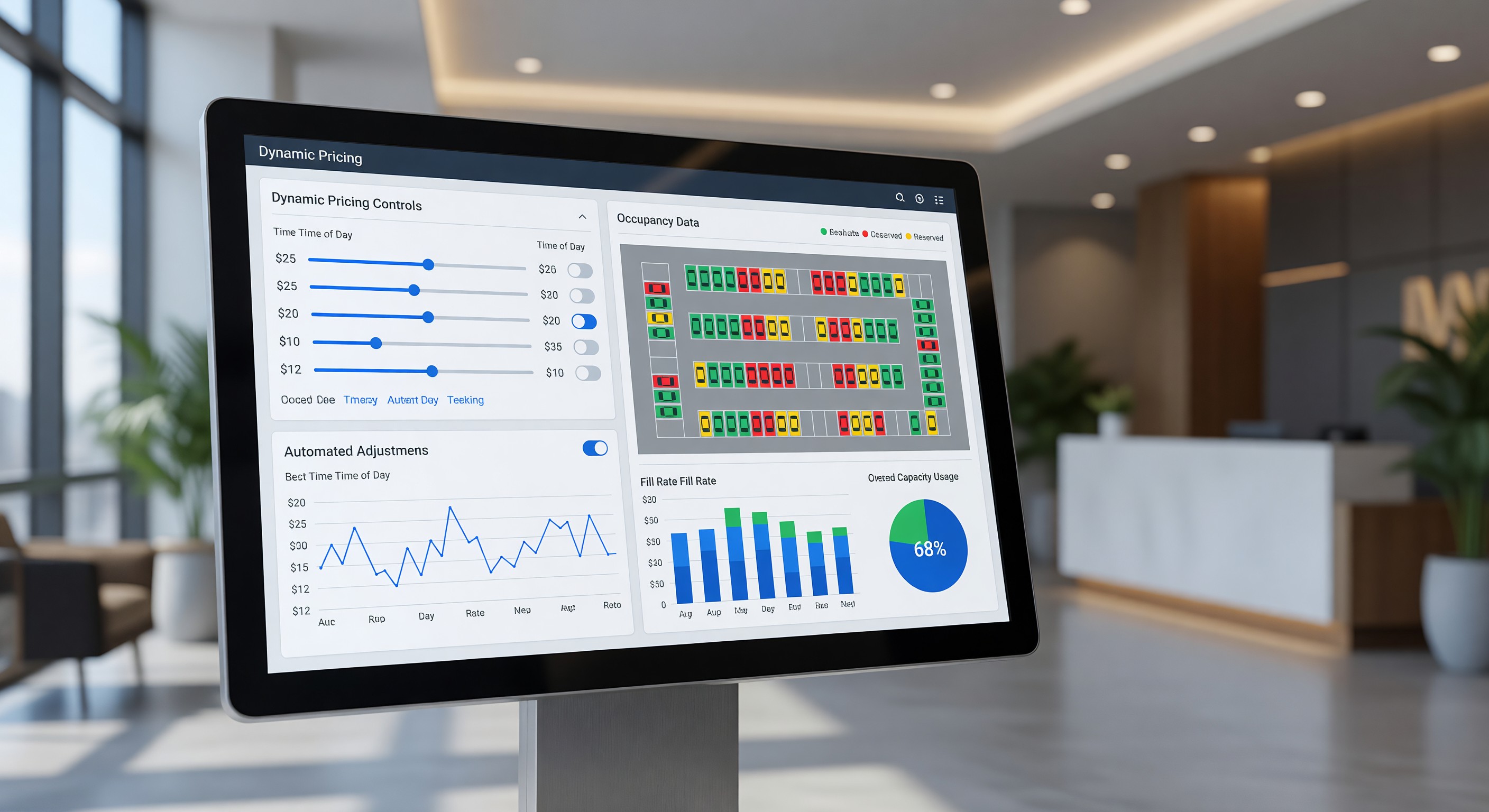
Manual dynamic pricing: The simplest implementation — a staff member reviews occupancy forecast and adjusts the displayed parking rate through the parking management system’s admin interface. Labor-intensive but requires no technology integration; appropriate as a first step while evaluating more automated approaches.
Rule-based automated pricing: The parking management system applies pricing rules automatically based on defined triggers:
- Friday-Saturday: rate +$5 over weekday rate
- Hotel occupancy > 85%: rate +$3 over base rate
- Upcoming event within 1 mile: rate +$8 over base rate
- Hotel occupancy < 40%: transient parking -$3 promotional rate
Most modern parking access and revenue control systems support rate schedule programming. The sophistication of available rules varies by system.
API-connected revenue management: The most sophisticated approach connects parking pricing to a revenue management engine that adjusts rates in real time based on occupancy, competitor data feeds, and demand forecasts. This integration typically requires a modern PARC system with open API capability and either a dedicated parking revenue management platform or custom integration with the hotel’s existing revenue management system.
Pricing Strategy by Customer Segment
Different parking customer segments have different price sensitivities:
Hotel guests (overnight parking): Hotel guests who have already committed to a $200+ room night are price-insensitive to $5–$10 variations in parking rates, particularly when parking is presented as a simple add-on at booking or check-in. Pre-book overnight rates can be maintained or slightly elevated; reactive rate increases at entry lane are less guest-friendly but still appropriate for peak periods.
Day visitors and transient parkers: These customers have alternatives — other lots, street parking, transit. Price sensitivity is higher. Dynamic pricing for day parkers should be calibrated against local alternatives; pricing significantly above nearby competitive options will drive customers away.
Monthly permit holders: Monthly contract parkers represent stable, predictable revenue. Rate changes for monthly parkers should follow longer cycles (annual or semi-annual adjustments), not be subject to day-to-day dynamic changes that would undermine the contract relationship.
Event parkers: Event-driven demand is highly inelastic — someone attending a $200 concert is willing to pay $30 for convenient parking versus $20. Event pricing can be aggressive relative to non-event rates.
Booking Channel Strategy
Dynamic pricing is most effectively paired with advance booking capability. When guests can reserve parking in advance (on the hotel website, via pre-arrival email, or through the hotel app), the pricing architecture becomes:
- Advance booking rate: Standard or slightly discounted rate available 3–14 days in advance — rewarding planning behavior
- Standard rate: The day-of or arrival rate — the basis from which dynamic adjustments are made
- Peak event rate: Applied automatically when event calendar triggers or hotel occupancy crosses defined thresholds
This structure encourages early reservation (improving revenue predictability) while capturing price premiums from last-minute arrivals during high-demand periods.
Modern parking access and revenue control systems integrate with web booking tools that support this advance-booking rate architecture alongside the access control technology (barrier gates, LPR) that enables seamless arrival for pre-booked guests.
Communicating Dynamic Rates to Guests
Rate transparency is important — guests who discover a higher rate than expected at the entry lane have a negative experience. Best practices:
- Publish rate schedules that show peak and standard rates clearly, or update the displayed rate on the parking page before the rate change takes effect
- Confirm the parking rate in booking confirmation and pre-arrival emails
- If rates are adjusted from the rate at time of booking, honor the original quoted rate for guests who pre-booked
- Train front desk staff on the dynamic pricing rationale so they can explain rate variation confidently
Frequently Asked Questions
Do guests react negatively to dynamic parking pricing at hotels? Guest reaction to dynamic parking pricing is generally neutral when it is transparent and consistent. Guests who paid a higher rate because they arrived on a Friday night during a conference generally accept it as normal pricing variation — analogous to airline or hotel room rate dynamics they’re already familiar with. The negative experiences come from surprises: discovering a higher rate than expected without advance notice, or paying a high rate when competitors nearby are lower.
What is the simplest first step toward parking dynamic pricing for a hotel that currently uses a fixed rate? Start with a limited premium event rate. Identify 10–15 dates in the coming year when the hotel is forecasted at >90% room occupancy (major events, holiday weekends, conference dates). Set a $5–$10 premium rate for those dates specifically. Track actual parking occupancy and revenue against comparable baseline dates. If occupancy doesn’t decline materially but rate improved, you have your first proof point for expanded dynamic pricing.
Can dynamic pricing be implemented without a full PARC system upgrade? In a limited sense, yes. If your current parking system allows rate schedule programming (different rates by day of week or date range), you can implement basic rules-based dynamic pricing without a system upgrade. Full demand-responsive pricing with real-time rate adjustment based on occupancy data and external triggers requires either a modern system with that capability or API integration between your existing system and external pricing tools.
What is the relationship between parking dynamic pricing and brand standards at franchise hotels? Most hotel brand standards specify the process for parking rate transparency (how rates must be communicated to guests) but do not prohibit dynamic pricing. Some brands specify that parking must be disclosed as a separate charge (not bundled in the room rate without disclosure) and that the rate must be communicated clearly at booking or check-in. Review your specific brand’s standards documentation — some brands require parking rate disclosure in their approved room descriptions.
Further Reading from Authoritative Sources
- HFTP hotel parking revenue management and dynamic pricing standards — HFTP provides hospitality technology professionals with parking revenue management standards, dynamic pricing frameworks, and technology integration guidance applicable to hotel parking dynamic pricing program design and implementation.
- AHLA hotel parking revenue strategy and guest communication standards — AHLA provides hospitality industry research on parking revenue strategies, guest pricing perception, and revenue management communication standards applicable to hotel parking dynamic pricing program design and guest experience management.