The hotel guest app has become one of the primary channels for pre-arrival engagement, ancillary revenue capture, and loyalty program interaction. Food and beverage ordering, spa reservations, room upgrades, and digital check-in are all now offered through branded hotel apps at major flag properties and increasingly at well-run independents.
Parking remains one of the last significant ancillary revenue streams that most hotels have not yet integrated into their digital guest journey. Guests drive to the property, discover the parking rate at the entry lane or front desk, and pay on exit — a transactional experience that leaves substantial revenue on the table and creates a friction point that guests remember negatively.
This guide examines the practical mechanics of connecting hotel parking systems to mobile apps, booking engines, and loyalty programs — and how that integration creates measurable improvements in both revenue and guest satisfaction.
Why Parking Belongs in the Digital Guest Journey
Hotels that have integrated parking into their pre-arrival digital workflow report three consistent benefits:
Earlier revenue capture: Guests who book parking in advance typically pay full published rates without the last-minute negotiation or rate confusion that happens at the entry lane. Pre-paid parking reservations also reduce exit lane transaction time and the operational complexity of collecting payment from departing guests.
Higher conversion rates: Research on ancillary upsell shows that parking offered at booking or pre-arrival email converts at significantly higher rates than parking offered at check-in. The guest is in a purchasing mindset when booking the room; at check-in, they’re focused on getting to the room.
Better guest experience: Guests who arrive knowing their parking is arranged, have a confirmed space, and can self-serve the transaction without staff assistance score the arrival experience higher than those who encounter unexpected rates or friction at the parking entry.
Integration Architecture
Connecting hotel parking systems to guest-facing digital channels requires integration between the parking access and revenue control (PARC) system and one or more of:
The Property Management System (PMS): The foundational integration. When parking is linked to the PMS, charges post automatically to room folios, hotel guest vehicles can be recognized at entry without manual intervention (via LPR matching to reservation records), and occupancy data can inform parking inventory management.
The Central Reservation System (CRS) or booking engine: Parking offered at booking requires connection to the CRS or booking engine so that parking inventory (available spaces, rate types) is visible and purchasable during the room booking flow. This may be a direct integration or via a middleware booking ancillary platform.
The hotel’s mobile app or loyalty platform: For brand hotels with proprietary apps (Marriott Bonvoy, Hilton Honors, IHG One Rewards), parking integration is managed by the brand’s technology team. For independent properties, third-party hotel app platforms (Nonius, Cendyn, Impala) can include parking modules.
Payment processing: Pre-paid parking requires PCI-compliant payment processing integrated with the parking reservation system. This is typically handled by the PARC system’s native payment processing capability.
What Guests Experience with Integrated Parking
A well-designed integrated parking journey looks like this:
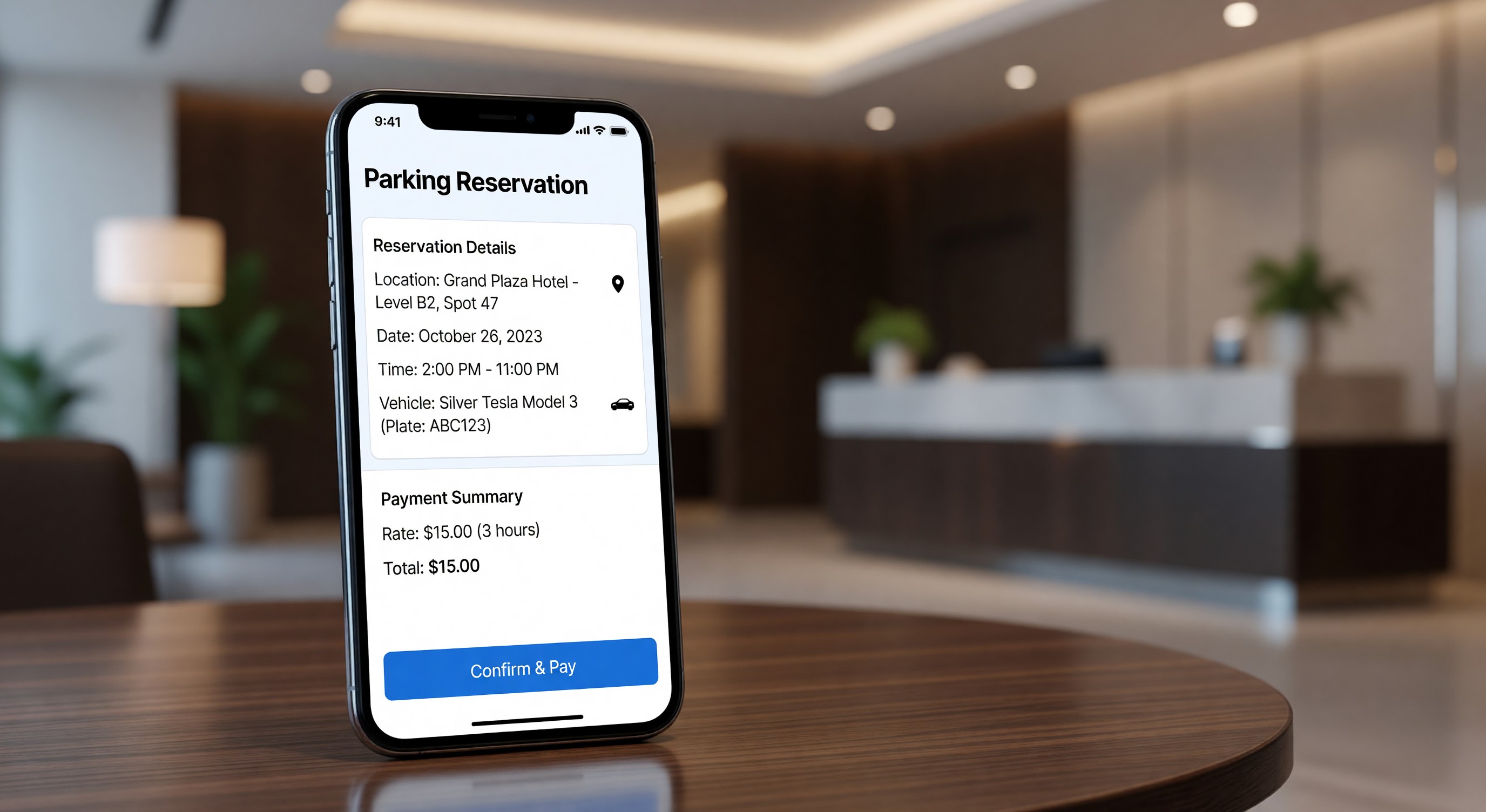
At booking: Guest selects overnight self-park or valet as an add-on, with clear pricing and the ability to modify or cancel before arrival. Confirmation email includes parking details.
Pre-arrival email (48–72 hours before check-in): Personalized email includes parking confirmation, entry lane instructions (“Use the right lane — your plate [XXX-XXXX] is pre-registered”), and any special instructions (EV charging availability, oversized vehicle guidance).
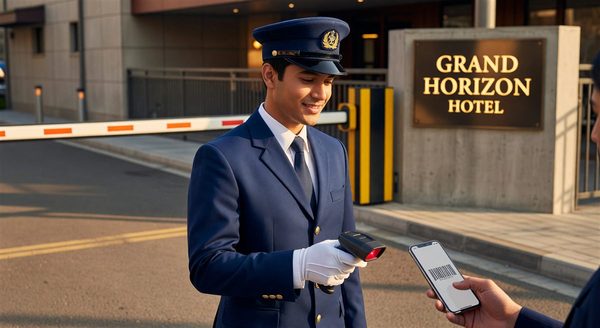
Arrival: Guest drives into the preferred lane. LPR camera recognizes the plate, verifies the reservation, and opens the gate without a ticket, card swipe, or interaction. For valet: guest is greeted by name (“Welcome back, Ms. Chen — your reservation is confirmed”).
During stay: Guest can view parking status and request valet retrieval from the hotel app. EV charging status visible in-app for properties with integrated charging systems.
Departure: For self-park with LPR exit, the gate opens automatically on verified reservation or posted folio charge. No exit transaction required.
Modern parking access and revenue control platforms increasingly offer API connectivity that enables these integrations without requiring custom development from scratch.
Loyalty Program Integration
Brand loyalty programs offer an opportunity to differentiate parking for high-value members:
- Complimentary parking as a benefit tier: Elite members receive complimentary parking as a loyalty benefit, improving satisfaction and retention among the most valuable guests
- Parking points: Members earn loyalty points on parking charges in the same way they earn on room charges — encouraging them to pay for parking versus claiming a discount or going to a nearby off-property facility
- Recognition: System can trigger name recognition and personalized welcome at the entry lane or valet stand for loyalty members whose vehicles are on file from prior stays
The economic case for complimentary parking for elite loyalty members should be evaluated carefully. At $20–$30/night parking rates, the cost of complimentary parking for all top-tier members can be significant at high-occupancy properties. Most programs mitigate this by limiting complimentary parking to specific tiers or by selecting properties where parking demand is not supply-constrained.
Independent Hotel Digital Parking Solutions
Independent hotels without brand technology infrastructure can deploy parking digitization through:
- Third-party booking widgets: Several parking software providers offer embeddable booking widgets that allow parking reservation directly from a hotel’s website without full CRS integration.
- Pre-arrival email links: Simple parking reservation links in pre-arrival emails allow guests to book parking without a native app — the transaction is handled by the parking software’s web interface.
- Stripe or Square integrated payment: For properties without full PARC system integration, a payment-linked QR code at the entry lane allows mobile payment without hardware replacement.
Measuring Success
Track these metrics before and after implementing parking digital integration:
- Parking capture rate: What percentage of hotel guests who park actually pay for parking (versus using complimentary benefits or bypassing the system)? Integration typically improves capture rate.
- Pre-arrival booking rate: What percentage of parking revenue is collected before the guest arrives? Higher pre-arrival rates improve cash flow and reduce exit lane congestion.
- Parking satisfaction score: If your guest satisfaction survey includes parking, track the score trend after digital integration. Friction reduction typically improves scores by 0.3–0.7 points on a 5-point scale.
- Average parking revenue per occupied room: The ultimate measure of parking revenue optimization.
Frequently Asked Questions
Does parking integration require replacing the existing parking equipment? Not necessarily. Many modern PARC systems offer API-based integration that allows digital parking reservation without replacing hardware. The key requirement is that your parking system has an API that can receive reservation records and link them to LPR or ticket data. Older systems without API capability may require hardware upgrades to participate in full integration.
How do hotels handle guests who booked parking online but need to cancel? Pre-paid parking reservations should follow the hotel’s general cancellation policy — typically free cancellation up to 24 hours before arrival. The parking reservation system should include automated cancellation processing that refunds the guest’s payment card and releases the inventory. Manual cancellation handling is a significant source of service failures in early parking integration programs.
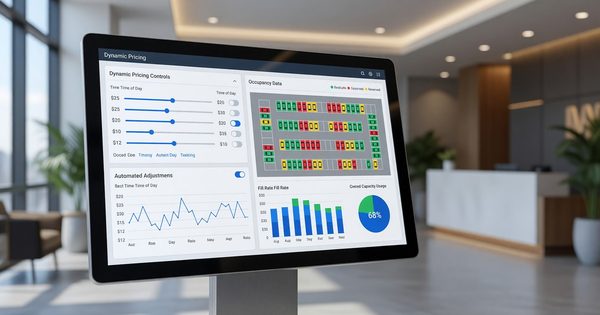
Can hotels dynamically price parking through their app? Yes — this is one of the more sophisticated capabilities of modern hotel parking platforms. Dynamic pricing rules can set parking rates based on occupancy (raise rates when parking demand is high), day of week, event calendar, or time of purchase (higher rates purchased day-of versus 7 days in advance). This approach, borrowed from hotel room revenue management, can increase parking RevPAS by 15–30% when implemented thoughtfully.
What is the ROI timeline for investing in hotel parking app integration? ROI depends on property size, current parking capture rates, and how much pre-arrival conversion improves. Typical ROI timelines of 12–24 months are reported for full integration projects at mid-size hotels. Simpler implementations (pre-arrival email links to a parking booking widget) have much lower upfront cost and can show positive ROI within the first 60–90 days.
Further Reading from Authoritative Sources
- AHLA hotel parking revenue and guest experience resources — AHLA provides hospitality industry research on parking revenue optimization, guest satisfaction drivers, and technology integration practices applicable to hotel parking app deployment and channel management.
- HFTP hospitality technology and parking integration standards — HFTP provides hospitality technology professionals with integration standards, API governance guidance, and technology ROI frameworks applicable to hotel parking app and loyalty platform integrations.