Parking access control is the mechanism that determines who enters and exits a hotel parking facility and on what terms. At its simplest, it’s a gate arm that opens for paying customers and closes behind them. At its most sophisticated, it’s an integrated system that recognizes guests by their license plate, validates their reservation status in real time, and posts parking charges to their folio automatically.
The spectrum of solutions between those extremes is wide, and choosing the right point on that spectrum requires understanding your property’s operational model, guest experience goals, and the value of different integration capabilities.
The Components of a Parking Access System
A complete hotel parking access control system consists of:
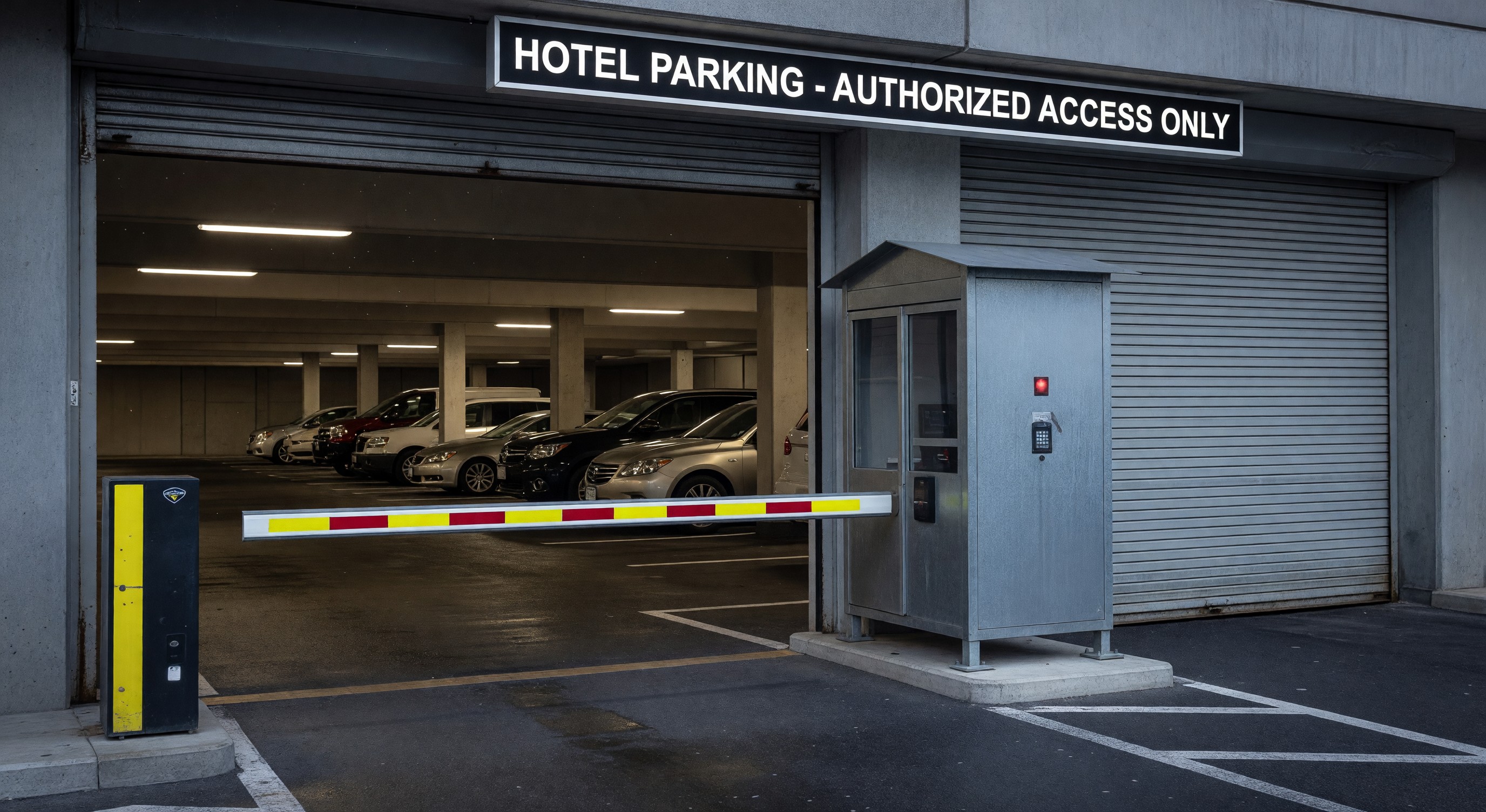
Entry lane equipment: Ticket dispenser, card reader, license plate recognition camera, intercom, and the barrier gate itself. The entry lane is where the parker establishes their credential and initiates their parking transaction.
Exit lane equipment: Payment kiosk or card reader, license plate camera, intercom, and the gate. The exit lane validates the payment or credential and releases the vehicle.
Pay stations: Pay-on-foot kiosks located inside the parking structure or in the lobby where parkers pay before returning to their vehicle. Dramatically reduces exit lane congestion compared to pay-at-exit models.
Central management software: The software platform that ties all hardware together, manages credentials, processes transactions, produces reports, and provides the management interface.
Integrations: Connections to the property management system (PMS), key card system, payment processor, and other relevant platforms.
Credential Types
What a parker presents to gain access determines the system architecture and guest experience:
Magnetic stripe ticket: Issued at entry, retained by the parker, inserted at exit or pay station. Simple and widely understood; the traditional hotel parking model. No frills, no integration complexity.
RFID credential: A hangtag, keycard, or sticker with an embedded RFID chip. Presented to a reader at entry and exit. Common for monthly parkers, hotel employees, and loyalty guests who are issued RFID passes at registration.
Guest room key: If the parking system integrates with the hotel’s key card system, the guest’s room key can serve as their parking credential. The guest taps their key at the parking gate and they’re in. This is the cleanest guest experience — one card for everything — but requires a meaningful integration.
License plate recognition (LPR): Cameras capture the vehicle’s license plate at entry and exit. The plate is matched against a database of authorized vehicles (registered hotel guests, monthly parkers). No physical credential required — the car itself is the credential. Provides the most frictionless experience.
Mobile/app credential: A QR code or barcode in the guest’s smartphone app opens the gate. Common in properties that have deployed a hotel app with parking integration.
QR code from reservation: An emailed or digital key code that the guest presents at a reader. Simple to implement without a full app integration.
PMS Integration
The most valuable integration in a hotel parking system is the connection to the property management system. This integration enables:
Automatic guest validation: When the system recognizes a guest’s credential (key card or license plate), it verifies their reservation status in real time. Active reservation = authorized access. No reservation = pay-at-exit.
Folio posting: Parking charges are automatically posted to the guest’s room folio at checkout (for nightly charges) or at the parking session’s close. No manual posting, no reconciliation errors.
Complimentary parking management: Package deals or loyalty tier benefits that include parking are automatically honored without staff intervention.
Extended-stay and early-departure handling: When a guest’s reservation status changes (early checkout, extension), the parking system reflects the change automatically.
PMS integration quality varies significantly between parking system vendors and PMS platforms. Before selecting a parking access system, verify specifically that:
- The integration is certified and production-deployed (not just “available”)
- The specific version of your PMS is supported
- All the functions you need (folio posting, validation, early departure) are actually implemented in the integration
Many parking vendors will claim PMS integration broadly, but the actual integration may only handle validation without folio posting, or may require manual intervention for edge cases.
Barrier Gate Technology
The barrier gate is the physical enforcer of the access control system — it’s what actually stops unauthorized vehicles from entering or exiting. Modern barrier gates for hotel applications come in several configurations:
Standard arm gates: A horizontal arm extends across the lane. Opens when a valid credential is presented. Typical arm length is 12–20 feet for standard lanes. Opening time is typically 1–3 seconds.
Full-height gates (turnstile-style): Rare in hotel parking applications; more common in pedestrian access or high-security applications.
Bollards (retractable): Post-style barriers that rise from the ground surface. Higher security than arm gates; higher installation cost. Used in properties with security-sensitive perimeters.
Speed gates (for pedestrian): For pedestrian parking access points in garages with elevator lobbies separate from vehicle lanes.
Gate reliability is critical — a gate that’s often stuck, broken, or bypassed destroys the value of the entire access control system. The right barrier gate systems for hotel applications combine reliable operation with sufficient durability for high-cycle environments. Hotel parking gates in active properties cycle thousands of times per day.
Loop Detectors and Safety Systems
Every lane requires inductive loop detectors embedded in the pavement — sensors that detect the presence of a vehicle. These serve two functions:
- Safety: Prevent the gate from closing on a vehicle that hasn’t cleared the lane
- Presence detection: Trigger the system to present a payment option or prompt when a vehicle is detected at the gate
Loop detectors are a maintenance item — they deteriorate over time and eventually need replacement. Include loop detector testing in the quarterly parking equipment PM schedule.
Design Considerations
Lane Configuration
One-lane bidirectional: A single lane serves both entry and exit. Inexpensive but creates potential conflicts if vehicles arrive and depart simultaneously. Only appropriate for very low-volume applications.
Separate entry and exit lanes: Standard for properties with significant parking volume. Allows independent control of entry and exit operations.
Multiple lanes: Properties with high peak volumes (resort hotels at checkout time, convention hotels at event end) may need 2+ entry and exit lanes to prevent backup onto public streets.
Queuing Space
Insufficient queuing space before the entry gate is one of the most common parking facility design failures. The standard recommendation is space for at least 4–6 vehicles to queue before the entry gate, measured from the property line or public street. Less than this and peak arrival periods back up onto the street, creating both operational problems and potential liability.
Intercom and Remote Support
Even in a fully automated parking facility, there will be situations where parkers need assistance — a damaged ticket, a payment failure, a medical emergency. Every entry and exit lane should have an intercom that connects to a staffed location (front desk, engineering, security) with 24/7 coverage.
Performance Metrics
Track these metrics monthly for parking access control operations:
- Lane throughput: Vehicles processed per lane per hour during peak periods
- Average transaction time: From arrival at gate to gate opening (target: <30 seconds)
- Exception rate: Percentage of transactions requiring staff intervention
- Gate uptime: Total uptime as percentage of operating hours (target: >99.5%)
- Intercom call volume: Number of intercom calls per 1,000 transactions
FAQ
What is the typical cost range for a hotel parking access control system? Basic systems for a small property start around $15,000–$25,000 installed. Mid-range systems with LPR and PMS integration for a medium-size property run $40,000–$80,000. High-end full-featured systems for large or complex properties can exceed $150,000. Annual maintenance and software subscription costs typically add 10–15% of capital cost per year.
How does LPR work for hotel guests who didn’t register their license plate? With LPR systems, guests who didn’t pre-register a plate can still be validated by presenting their room key or folio number at a pay station. The LPR captures their plate at entry; the validation links that plate to their reservation. Future entries during the stay are then automatic.
How do we prevent tailgating (unauthorized vehicles following authorized vehicles through the gate)? Multiple strategies work in combination: overhead cameras at the gate that flag multiple vehicles per gate opening, anti-passback logic in the software, a physical lane design that makes tailgating difficult (chicanes, lane width restrictions), and periodic attendant presence during peak hours.
Should we integrate parking access control with building security access control? In properties where parking structure access is separate from the building, yes — a guest credential should work for both the parking gate and building entry without requiring separate credentials. The integration requires the parking and building access systems to share a common credential database or have a real-time synchronization.
Further Reading from Authoritative Sources
- AHLA hotel operations and parking management resources — AHLA provides hospitality industry research on parking operations, guest experience integration, and revenue management practices applicable to hotel parking access control system selection and PMS integration.
- IFMA parking facility management and access control standards — IFMA provides facility management professionals with parking access control standards, vendor contract guidance, and system performance benchmarking applicable to hotel parking facility operations.