Electric vehicle adoption has been growing steadily, and hotels are increasingly fielding requests for charging from guests who own EVs. While EV penetration as a percentage of the overall vehicle fleet is still modest in most markets, the guests who own EVs often fall into high-value demographic categories — frequent travelers, business travelers, and loyalty program members — that hotels have strong reason to serve well.
The practical question for hotel facility managers: how much charging infrastructure do you need, where should it go, and how do you build it so it scales as demand grows?
Understanding Charging Level Basics
Electric vehicle charging is categorized into levels that reflect the power delivery rate and the corresponding charging speed.
Level 1 (120V AC): Standard household outlet. Delivers approximately 1.2–1.4 kW, adding roughly 4–5 miles of range per hour of charging. Almost no hotel installs Level 1 intentionally — it’s far too slow for overnight charging to meaningfully help a guest.
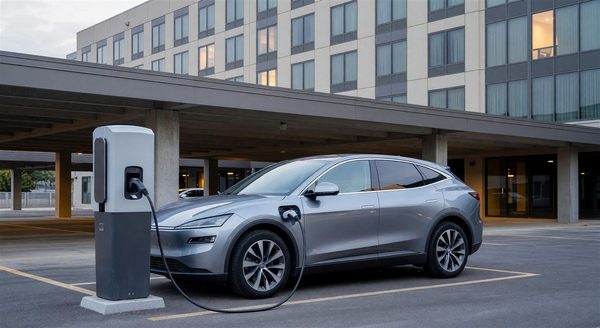
Level 2 (208–240V AC): The standard for hotel EV charging installations. A typical EVSE (Electric Vehicle Supply Equipment) unit delivers 7–19 kW depending on the circuit amperage and the vehicle’s onboard charger. At 7 kW, a guest can add 20–25 miles per hour of charging; at 19 kW, up to 60 miles per hour. For a hotel guest staying overnight (8–10 hours), Level 2 provides a full charge for the vast majority of vehicles.
DC Fast Charging (Level 3): Delivers 50–350 kW directly to the battery, bypassing the vehicle’s onboard charger. Charges most EVs to 80% in 20–45 minutes. Infrastructure cost is significantly higher — typically $50,000–$150,000 per station vs. $3,000–$15,000 for Level 2. Most hotels don’t need DC fast charging; it’s more appropriate for service stations and high-volume transit locations.
Demand Assessment
How Many Stations?
Demand for EV charging at hotels varies significantly by property type, location, and guest demographic. Benchmarks from properties with EV charging installed show:
- Select-service properties in suburban/drive-to markets: 2–4 stations serving 100–200 rooms
- Full-service urban properties: 4–10 stations for similar room count
- Resort properties with high-value leisure guests: 8–20 stations
- High-end urban boutique properties: 2 stations per 10 rooms or more
The honest answer is that demand data from your specific property type and market is more valuable than any general benchmark. If you’re in an early-adoption market, start smaller and plan for expansion. If you’re a brand with loyalty members who communicate their EV status, that data can inform initial sizing.
EV Readiness vs. EV Ready
A useful planning concept: the difference between providing EV charging now vs. making infrastructure ready for future charging installation.
EV Charging Now: Install EVSE units and make them operational immediately.
EV Ready (conduit only): Run conduit and pull wire to parking stalls now, leave space in the electrical panel, but don’t install EVSE units. When demand develops, adding chargers is straightforward and low-cost because the infrastructure is in place.
EV Capable (conduit only, no wire): Run conduit to parking stalls but don’t pull wire. The lowest upfront cost, but requires additional work when upgrading.
Building in conduit to future EV stalls during parking structure construction or renovation is almost always cost-effective — adding it later requires significant disruption and cost.
Electrical Infrastructure Considerations
Load Management
The primary engineering challenge with large-scale EV charging is electrical load. A 50-station Level 2 charging installation operating at full capacity requires 350–950 kW of power — a significant addition to a hotel’s electrical load profile.
Dynamic load management (also called smart charging or load sharing) is the solution. An intelligent charging management system limits total charging power draw and distributes available capacity among connected vehicles. When the facility load is high (dinner service, peak occupancy), charging rates are reduced; when overall load is low (late night), full charging speed is available.
Load management systems allow you to install more EVSE units than your electrical infrastructure could support at simultaneous full charge — because simultaneous full demand is uncommon.
Electrical Panel Capacity
Before specifying EVSE quantity and power levels, assess your electrical infrastructure:
- Capacity of the main service entrance (amps at the utility meter)
- Capacity of the subpanels in or serving the parking area
- Available circuit capacity for new loads
In many existing properties, the electrical infrastructure will need upgrades to support meaningful EV charging. These upgrades — new panels, increased service, new conduit runs — are often the dominant cost in an EV charging project, exceeding the EVSE unit costs for larger installations.
EVSE Unit Selection
Networked vs. Non-Networked
Networked EVSE units connect to a cloud-based management platform that provides:
- Real-time status monitoring (which units are in use, available, or faulted)
- Usage data and reporting
- Remote management and software updates
- Guest payment processing
- Load management integration
Non-networked units are simpler and less expensive but provide no visibility into usage and can’t support payment processing. For hotel applications, networked units are almost always the right choice.
Payment and Guest Integration
How guests access and pay for EV charging is an important operational decision:
Free for hotel guests: Offered as an amenity, no payment required. Simple to manage, but foregoes revenue and may leave chargers occupied by non-guests.
Fee-based via charging network app: Guest registers with the EVSE network (ChargePoint, Blink, etc.) and pays via the app. Revenue is shared between the hotel and the network operator.
Room charge: Guest’s charging session is billed to their folio via PMS integration. Ideal guest experience, requires PMS integration that not all EVSE systems support.
Fixed nightly fee: A flat fee charged at check-in or included in a parking fee that covers overnight charging. Simple, predictable, easy to communicate.
Placement and Design
Space Identification
EV charging stalls should be:
- Near the elevator lobby or stairwell (visible, preferred location)
- On the ground level where possible (easiest for electrical infrastructure)
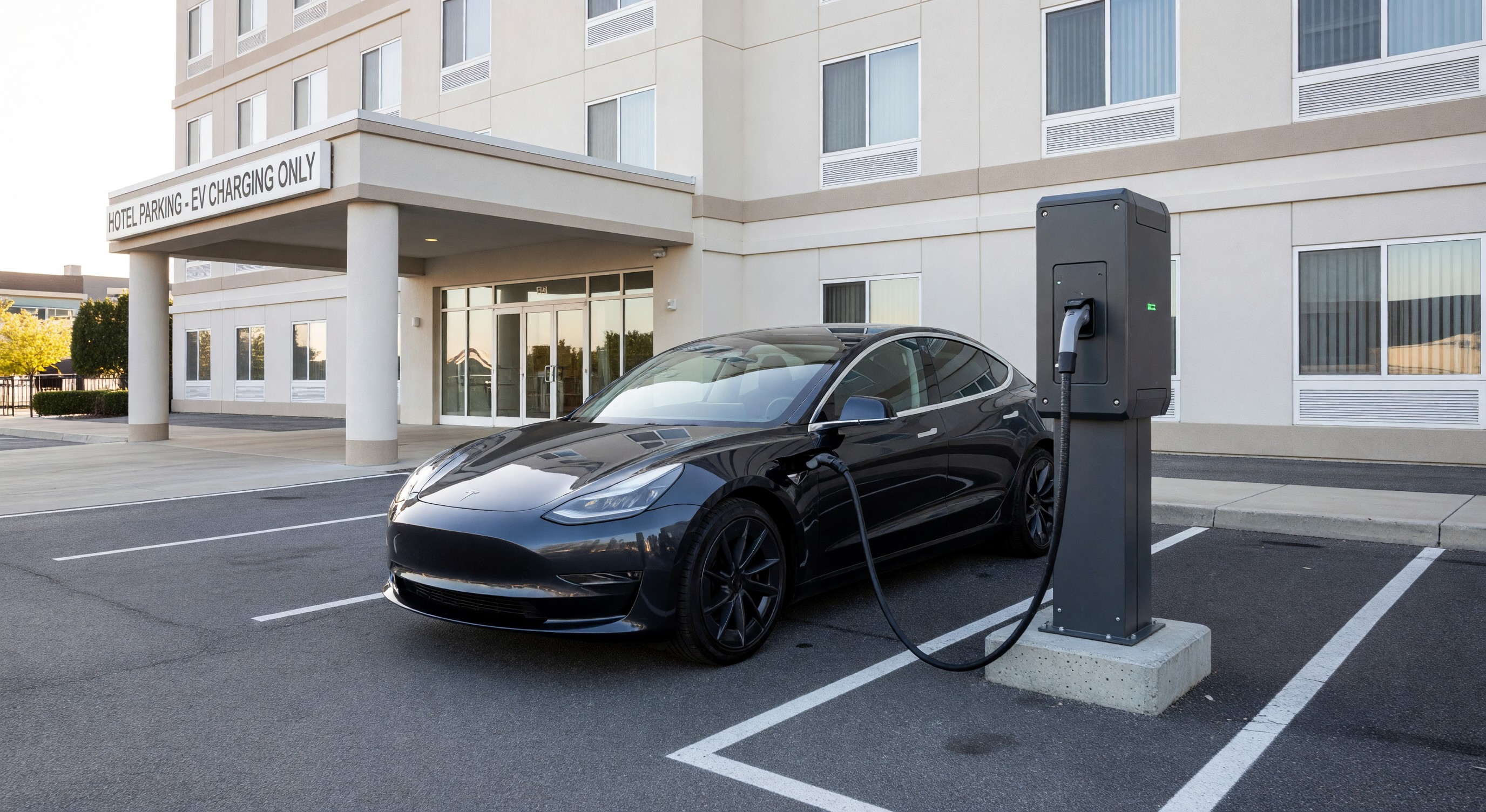
- Clearly marked with EV-only signage
- Accessible to mobility-impaired guests where applicable
Stall width: EV charging stalls should be minimum 9 feet wide. Many EV owners have larger vehicles and need more space to reach the charging port.
Charging Cable Management
Cable management is an often-neglected design element. Charging cables are a trip hazard and get damaged quickly if dragged across pavement. Design the stall layout and EVSE placement so cables reach the vehicle’s charging port without dragging on the ground.
Operational Considerations
Enforcement
If EV charging stalls are designated, they need enforcement. An ICE (internal combustion engine) vehicle parked in a charging stall doesn’t just inconvenience EV drivers — it generates guest complaints. For properties where parking enforcement is a function of the parking operation, adding EV stall monitoring is straightforward. For self-parking with no attendants, consider camera-based monitoring or periodic parking attendant sweeps.
Maintenance
EVSE units require periodic maintenance:
- Monthly cable inspection (charging cables take significant wear)
- Connector cleaning and inspection
- Monthly test charge to verify functionality
- Annual inspection by a licensed electrician
Networked EVSE units typically report faults automatically, but don’t rely entirely on automated monitoring — include a physical inspection in the monthly parking lot maintenance walk.
FAQ
Are there government incentives for hotel EV charging installation? Yes — the landscape changes frequently, but multiple federal and state programs have supported EV infrastructure installation, including the Alternative Fuel Infrastructure Tax Credit (federal), various state grants, and utility company rebate programs. Consult with an EV infrastructure consultant or your utility company before finalizing the project budget.
How much should hotels charge guests for EV charging? Market rates for Level 2 hotel charging vary from complimentary to $30/night or per-kWh pricing. At a minimum, recover your electricity cost. If you’re in a high-demand area, market rate pricing ($0.20–$0.35/kWh or equivalent flat rate) is appropriate. Benchmark against nearby hotels and public charging stations.
What brands of EVSE are most common in hotels? ChargePoint, Blink, and Eaton are among the more common brands in hotel applications. Brand-specific installations are common when hotel brands have negotiated preferred vendor agreements. Evaluate vendors on network reliability, ease of management, and quality of PMS integration.
How do we future-proof our EV infrastructure investment? Run conduit to more stalls than you plan to immediately activate, ensure your electrical panel has spare capacity, and choose an EVSE network that has been stable and is likely to remain relevant. The technology is evolving rapidly — avoid locking yourself into proprietary systems that limit future flexibility.
Further Reading from Authoritative Sources
- DOE EV charging infrastructure and building electrical standards — The DOE Buildings program provides EV charging infrastructure guidance, EVSE technology standards, and building electrical capacity planning resources applicable to hotel EV charging system design, load management configuration, and infrastructure investment planning.
- EPA electric vehicle infrastructure and sustainable transportation resources — EPA provides environmental and transportation electrification guidance applicable to hotel EV charging program design, sustainability reporting for on-property EV infrastructure, and regulatory context for federal incentive programs supporting hotel charging installations.