Electric vehicle charging is transitioning from an optional amenity to a regulatory requirement in a growing number of jurisdictions. California, New York, Colorado, and several other states have enacted or are implementing requirements for EV charging infrastructure in commercial properties, including hotels. For facility managers who may not have been tracking legislative developments, the mandates coming into effect in 2023–2025 represent compliance deadlines that require capital planning attention now.
This article covers the regulatory landscape as of early 2023, compliance planning approaches, and the operational implications for hotel parking operations.
The Regulatory Landscape
California
California has been the most aggressive state in mandating EV infrastructure. Relevant requirements for hotels:
Building Code (Title 24): California’s updated building code now requires that new commercial construction and significant renovations include EV-Ready (conduit installed, wiring pulled, panel capacity reserved) spaces for a percentage of parking spaces. For hotels, this applies to permits submitted after January 1, 2023.
Assembly Bill 2127: Established the framework for state fleet electrification and has influenced commercial property requirements.
Local ordinances: Many California municipalities have EV requirements that exceed state minimums. Los Angeles, San Francisco, San Jose, and others have their own requirements.
Practical implication: Any hotel in California undergoing a renovation that triggers building permit review should consult with a California-licensed engineer or code consultant about EV infrastructure requirements for the project.
New York
New York enacted legislation requiring EV infrastructure planning in commercial parking facilities as part of its climate action agenda:
Climate Leadership and Community Protection Act (CLCPA): Establishes broad targets that include electrification of transportation, which downstream affects commercial parking requirements.
Local Law requirements in NYC: New York City has its own Local Law 97 on building emissions, and the city’s PlaNYC document includes EV infrastructure goals that are translating into commercial property requirements.
New York State Building Code updates: Adoption of the International Building Code’s EV provisions is underway.
Colorado, Washington, Oregon, and Others
Multiple western states have adopted or are in the process of adopting commercial EV charging requirements linked to the model codes and their own clean transportation legislation. The specific requirements, timelines, and thresholds vary by state and are evolving rapidly.
Brand Requirements
Beyond regulatory mandates, hotel brands are increasingly incorporating EV charging into their brand standards. Marriott, Hilton, IHG, and others have established EV charging requirements or targets as part of their sustainability programs. For franchised properties, brand standards may impose earlier deadlines than local regulatory requirements.
EV-Ready vs. EV-Installed
The distinction between EV-Ready and EV-Installed parking is important for compliance planning:
EV-Capable: Conduit installed to parking spaces, but no wiring or equipment. The least costly preparation, but requires the most future work when chargers are installed.
EV-Ready: Conduit installed AND wiring pulled to each space, panel capacity reserved, and circuit breakers in place. Charger installation requires only mounting the EVSE unit and connecting it — typically 1–4 hours of labor per space.
EV-Installed: Operational chargers in place and ready for use.
Most current regulatory requirements are phased — requiring a percentage of spaces to be EV-Ready now and a percentage of those to be EV-Installed within a defined timeframe. The specific percentages and timelines vary by jurisdiction and are often indexed to permit date, occupancy level, or total parking space count.
Planning for Compliance
Audit Your Current State
Before planning compliance investments, assess the current state of your electrical infrastructure:
- How many parking spaces does the property have?
- What percentage already has EV capability in any form?
- What is the available electrical capacity at the parking structure’s electrical panels?
- What conduit runs (if any) already exist toward parking areas?
This baseline determines both the regulatory gap (how far from compliance) and the cost estimate (what infrastructure investment is needed).
Phased Approach
For properties not yet facing immediate compliance deadlines, a phased approach maximizes the efficiency of capital deployment:
Phase 1 (immediate): Install conduit from the main electrical panel to the parking structure, sized for future expansion. This is the infrastructure investment that’s most disruptive to install later and least expensive to do now when other work may be happening.
Phase 2 (1–3 years): Pull wiring and install panel capacity for the required number of EV-Ready spaces. Leave EVSE installation for phase 3.
Phase 3 (triggered by demand or mandate deadline): Install EVSE units on the pre-wired spaces. This is relatively fast and low-disruption.
Working with Utilities
The local utility company is a critical partner in hotel EV charging compliance:
- Rate tariffs: Many utilities have specific commercial EV charging tariffs with demand charge structures that affect operating economics
- Service upgrades: If the property’s electrical service needs upgrading to support EV charging loads, the utility must approve and often fund a portion of the infrastructure
- Incentive programs: Most utilities offer rebates for commercial EV charger installation and sometimes for EV-Ready infrastructure
- Interconnection timeline: Service upgrades and new connections can take 6–18 months to complete — start early
The 30C Tax Credit
The Inflation Reduction Act (2022) extended and modified the Alternative Fuel Vehicle Refueling Property Credit (30C) to provide a 30% tax credit for EV charging infrastructure installed in eligible locations. The maximum credit is $100,000 per item of property for business installations. Consult with a tax advisor to understand eligibility and documentation requirements for your property.
Operational Considerations for Compliance-Driven Installations
Properties installing EV charging to meet regulatory requirements rather than in response to organic guest demand face some specific operational questions:
How Much Charging to Make Available
Mandates specify minimums — they don’t prevent you from installing more. Use the compliance minimum as a floor and assess guest demand to determine whether more capacity is warranted. In most markets as of 2023, demand is still modest relative to the total parking capacity, but it’s growing rapidly.
Pricing for Mandatory EV Charging
If EV charging is a regulatory requirement, pricing should recover at minimum the electricity cost. There is no regulatory reason to provide EV charging for free — and providing it for free sets a precedent that may be difficult to change as costs and demand grow. Establish pricing at installation.
Enforcement of EV-Only Spaces
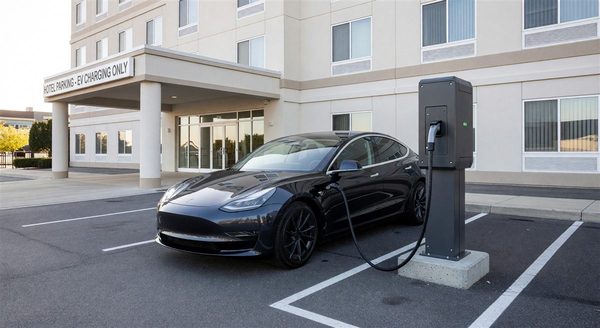
EV charging spaces need to be exclusive to charging vehicles, or the investment is wasted. Non-EV vehicles parked in charging spaces (“ICEing”) require active management. For properties in jurisdictions with EV parking enforcement laws, this may involve calling a parking enforcement officer. For properties without specific enforcement authority, policy signage and proactive management are the primary tools.
FAQ
How do we find out if our property is subject to EV charging requirements? Start with a consultation with a code consultant or local building department. State building codes (particularly in California) and local ordinances are the primary sources. Your hotel brand’s facilities engineering team is also a resource if you’re operating under a franchise agreement.
If we’re not in a state with current EV mandates, should we still plan for EV infrastructure? Yes — the direction of travel is clear. EV mandates will expand to more states over the next 5 years. Building in conduit and electrical panel capacity now (particularly during any renovation project) costs a fraction of adding it later. This is an “EV-Capable” investment that future-proofs the property without committing to EVSE installation costs yet.
What liability exposure do we have if we’re not compliant with EV charging requirements? Non-compliance with building code requirements can result in compliance orders, fines, and — at the most severe — occupancy limitations in some jurisdictions. The risk varies by jurisdiction and the severity of the requirement gap. Consult with local counsel for your specific situation.
How does the 30C tax credit interact with utility rebates? The tax credit and utility rebates are generally compatible — you can claim both on the same installation. However, the tax credit is calculated on the basis of net cost after rebates in some interpretations. Confirm the current rules with a tax advisor familiar with the specific credit.
Further Reading from Authoritative Sources
- DOE hotel EV charging infrastructure requirements and incentive programs — The DOE Buildings program provides EV charging infrastructure standards, federal incentive program information including the 30C tax credit, and utility interconnection guidance applicable to hotel EV charging compliance planning, phased installation approaches, and financial analysis.
- EPA hotel EV charging environmental compliance and clean transportation standards — EPA provides clean transportation guidance, EV infrastructure environmental compliance standards, and emission reduction framework guidance applicable to hotel EV charging regulatory context, brand sustainability requirements, and EV charging program planning.