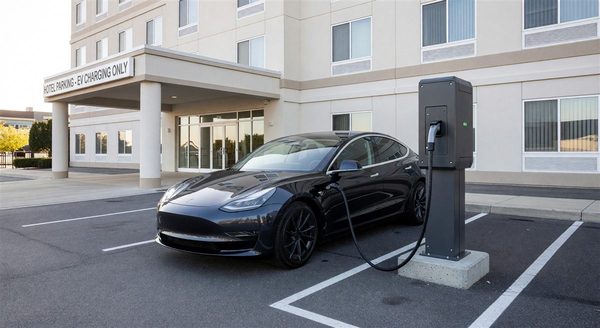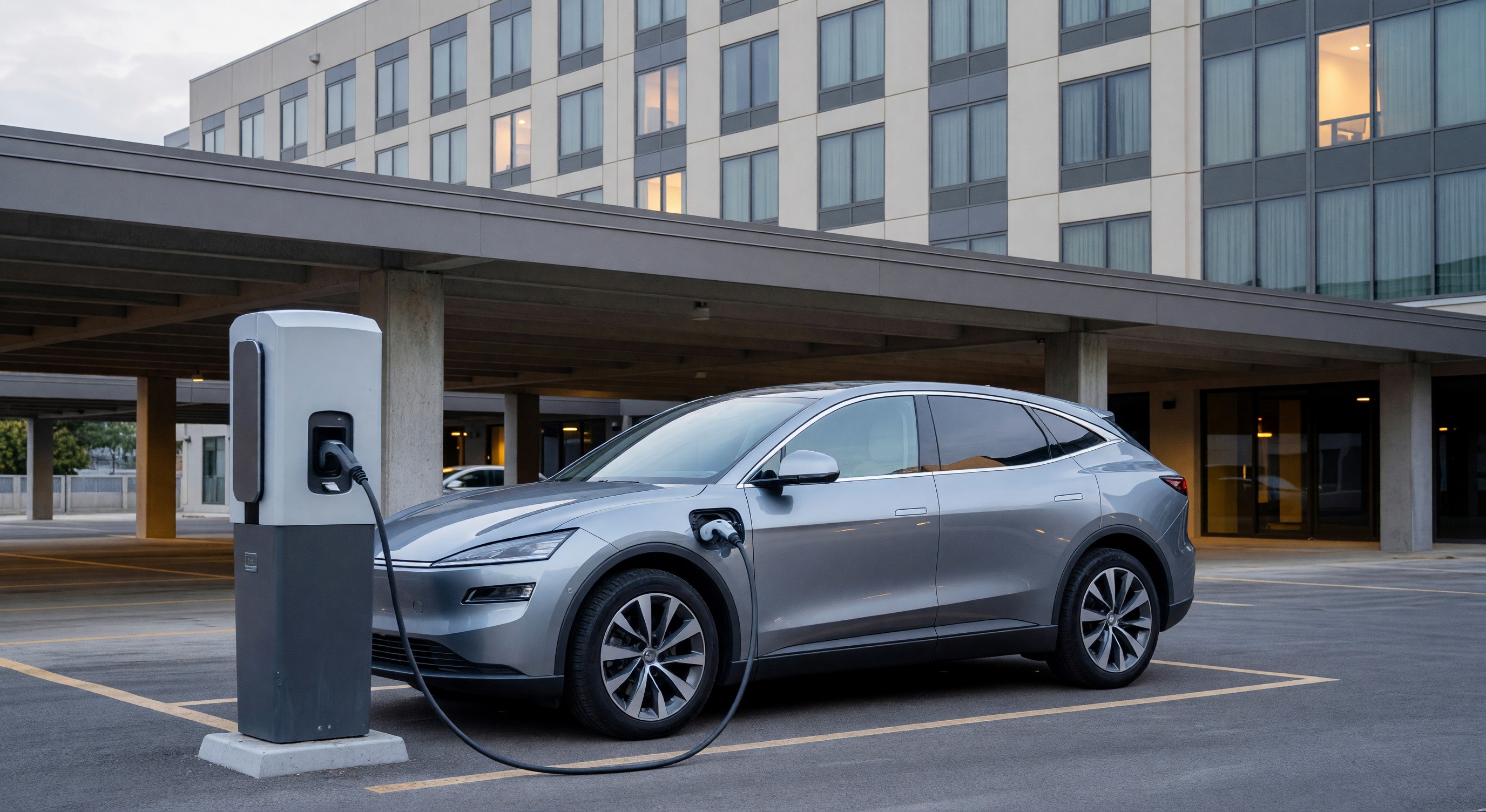
Electric vehicle adoption among leisure and business travelers has outpaced charging infrastructure investment at most hotel properties. In 2021, EV sales in the United States reached 4.2% of all new vehicle sales — up from 2.4% the prior year — and the trend line was unmistakably upward. For hotel guests arriving in EVs, available charging is no longer a nice-to-have amenity; it is a booking decision factor.
This guide addresses EV charging from the guest technology and amenity perspective: how to plan, deploy, and manage charging infrastructure that enhances the guest experience, generates ancillary revenue, and positions the property competitively for the growing EV traveler segment.
Understanding Guest Charging Needs
Hotel guests are not the same as highway travelers. The typical hotel guest arrives, parks for one to three nights, and departs with a full overnight charging window available. This behavioral pattern has significant implications for infrastructure design:
Level 2 charging (240V, 3.3–19.2 kW) is typically sufficient for hotel applications. A Level 2 charger delivering 25 miles of range per hour will fully charge most current-generation EVs with 250–350 miles of range in 8–14 hours — easily accomplished overnight. This is fundamentally different from the highway travel use case where guests need DC fast charging (DCFC) to recharge in 20–30 minutes.
DCFC (DC fast charging, 50–350 kW) can be justified at high-traffic hotel locations — particularly highway-adjacent properties, airport hotels, and resort destinations where guests may arrive with depleted batteries. However, DCFC requires substantially more electrical infrastructure investment and higher demand charges on utility bills.
Charging demand estimates: Survey data suggests 3–5% of hotel guests arrived in EVs in 2021; forecasts project 15–25% by 2030 in major metro markets. Plan infrastructure to serve current demand while ensuring electrical infrastructure is “EV-ready” to support future expansion without major electrical service upgrades.
Electrical Infrastructure Planning
EV charging infrastructure decisions must begin with an electrical capacity assessment. Questions to answer before specifying equipment:
- What is the current electrical service capacity (amps, voltage) at the parking facility?
- What panel space exists for additional circuits?
- Where are utility power entry points relative to the parking area? (Underground conduit runs are the primary cost driver)
- What is the path from main switchgear to parking distribution panels?
Retrofitting charging to a parking garage with remote electrical service can cost $5,000–$30,000 per stall in conduit and wiring costs alone. Properties planning significant future EV expansion should install conduit “home runs” and junction boxes in all stalls during initial construction or major renovation — adding $500–$1,500 per future stall versus $5,000–$25,000 after the fact.
Load management is essential for properties deploying 10+ charging stalls. Without load management, simultaneous peak charging demand can exceed electrical capacity or trigger utility demand charges that significantly increase energy costs. Smart EVSE (electric vehicle supply equipment) networks use dynamic load sharing to allocate available amperage across active sessions, preventing overload while maximizing charger utilization.
Equipment Selection and Network Providers
The commercial hotel EVSE market has consolidated significantly since 2019. Leading network providers for hotel applications include ChargePoint, Blink, EV Connect, Semacharge, and Enel X (formerly Juicebox). Key evaluation criteria:
Network reliability: Charger downtime is the most common guest complaint about hotel charging. Evaluate provider uptime guarantees (95%+ is industry standard, 99%+ is achievable) and remote diagnostics capabilities. Can the provider identify and resolve soft faults remotely without a technician dispatch?
Billing and payment options: Hotels can offer charging as a complimentary amenity, include it in parking fees, or charge separately via the EVSE network app or credit card reader. Properties with paid parking should evaluate whether bundling charging into parking rates simplifies guest experience versus itemized billing.
PMS integration: Some EVSE networks offer PMS integration that allows charging costs to be posted directly to the guest folio — eliminating the need for guests to manage a separate charging account. This significantly improves the guest experience for one-time or infrequent hotel guests who don’t have network accounts.
Reporting and management: Fleet-level dashboards showing utilization, energy consumption, revenue, and station status are essential for managing a multi-station deployment.
Incentives and Grants
Federal tax incentives (Alternative Fuel Vehicle Refueling Property Credit, Section 30C) provided a 30% tax credit (up to $30,000 per property under previous law; enhanced under the Inflation Reduction Act of 2022) for qualified EVSE installation. State and utility programs further reduce net cost — in many states, combined incentives can cover 50–80% of Level 2 installation costs.
Many utilities also offer “make-ready” programs that install the primary electrical infrastructure to the parking area at no cost to the property, requiring the hotel only to purchase and install the EVSE hardware. These programs vary significantly by utility and region.
Guest Experience Design
Physical location, signage, and service design determine whether EV charging becomes a positive amenity or a source of friction:
- Dedicated EV stalls: Mark stalls with permanent signage and pavement markings. ICE (non-EV) blocking is the most common guest complaint — enforce dedicated stall policies.
- Proximity to entry/exit: EV guests often check charging status on arrival and departure. Stalls near the parking entry point or lobby provide convenient access.
- Cable management: Charging cables should reach all charging port locations on the vehicle without stress. Cable holsters or wall mounts prevent tripping hazards.
- Charging status communication: Display panels or app notifications allow guests to monitor charging progress from their room — a significant guest experience improvement over requiring physical check-in at the charger.
Measuring ROI
EV charging ROI derives from multiple sources: direct charging revenue, premium room rates for EV-amenity bookings, reduced booking loss to competitor properties with charging, and brand affiliation benefits from sustainability marketing. Survey research consistently shows that EV drivers are more likely to book hotels with charging and demonstrate higher brand loyalty to properties that serve their needs well.
Frequently Asked Questions
How many EV charging stalls does a hotel need? A common starting point is 2–5% of total parking inventory, with electrical infrastructure designed for 15–20% future expansion. A 200-stall parking facility might install 4–8 Level 2 chargers initially, with conduit home runs to support future growth. High-end leisure properties and urban hotels in EV-adoption-leading markets (California, Pacific Northwest, Northeast) should start at the higher end.
Should hotels offer EV charging as a free amenity or charge for it? Both models work. Complimentary charging is a strong marketing differentiator and generates significant loyalty. Paid charging (typically $0.25–0.45/kWh or $5–15/session) recovers energy costs and can generate modest revenue. Many properties offer complimentary Level 2 charging while charging premium rates for any DCFC stalls.
What is the typical cost to install hotel EV charging? Level 2 EVSE hardware costs $500–$2,500 per unit. Installation costs depend heavily on distance from electrical service — in favorable conditions (nearby panels, short conduit runs), installation may add $1,000–$3,000 per station. In challenging retrofit situations (remote surface lots, underground garages), electrical work can exceed $10,000–$30,000 per station before federal and state incentives.
Do EV charging stations require much ongoing maintenance? Modern networked EVSE is generally reliable with minimal routine maintenance. Most issues (software faults, connectivity errors) are resolvable remotely by the network provider. Physical maintenance includes periodic inspection of cables and connectors for wear, cleaning of display screens, and verification of mounting hardware. Expect one vendor service call per 5–10 stations per year for hardware issues.
Further Reading from Authoritative Sources
- DOE EV charging infrastructure and hotel parking resources — The DOE Buildings program provides EV charging infrastructure guidance, load management standards, and utility incentive program information applicable to hotel EV charging installation planning and guest amenity program development.
- EPA electric vehicle charging and sustainable transportation resources — The EPA provides EV adoption statistics, charging infrastructure program guidance, and sustainable transportation resources applicable to hotel EV charging demand forecasting and amenity investment justification.