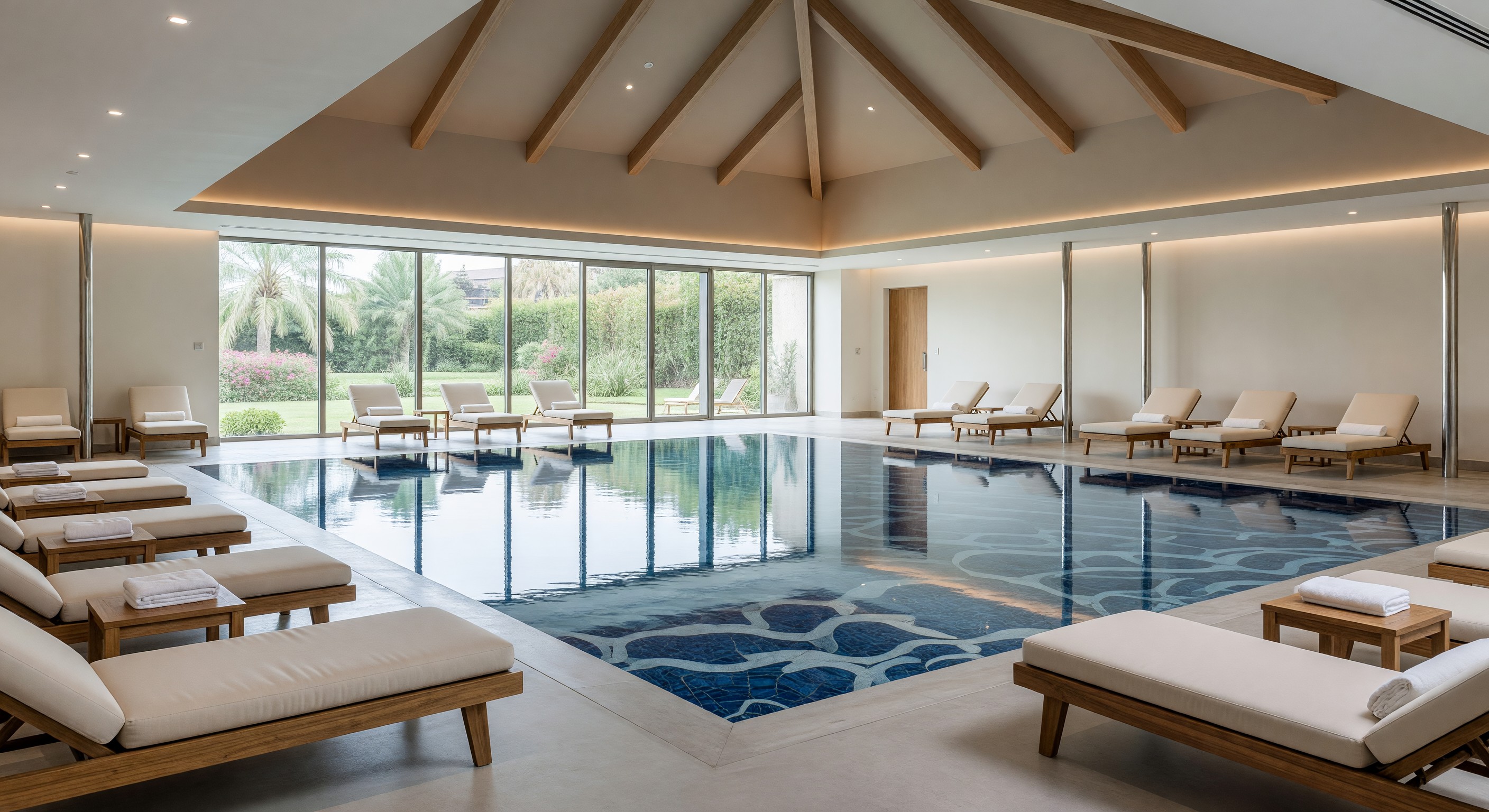
Hotel pools and spas rank among the highest-maintenance amenities in the lodging inventory. They are simultaneously major guest satisfaction drivers — often cited as a top booking factor for leisure travelers — and significant operational liabilities if chemistry, mechanical systems, or compliance protocols are mismanaged. A single health department closure can damage a property’s reputation for months.
This guide covers the full scope of hotel aquatic facility maintenance: water chemistry management, mechanical systems, regulatory compliance, preventive maintenance scheduling, and the operational decisions facility teams face daily.
Water Chemistry Fundamentals
Properly balanced water chemistry serves three functions: protecting guests from waterborne illness, protecting the facility’s surfaces and equipment from corrosion or scaling, and maintaining the aesthetic clarity that guests expect. The key parameters:
pH (7.4–7.6 for pools; 7.2–7.8 for spas): pH affects the effectiveness of chlorine disinfection, bather comfort, and surface protection. At pH above 7.8, chlorine efficacy drops dramatically — up to 60% at pH 8.0. Below 7.2, water becomes corrosive to plaster, grout, and metal equipment. Check pH every 4 hours during peak usage.
Free chlorine (1.0–3.0 ppm pools; 3.0–5.0 ppm spas): Spas require higher chlorine residuals because elevated water temperatures accelerate chlorine consumption. Bather load and sunlight (outdoor pools) also consume chlorine rapidly. Automated chemical feed systems maintain more consistent residuals than manual dosing.
Total alkalinity (80–120 ppm): Alkalinity acts as a pH buffer, preventing large swings. Low alkalinity causes pH to fluctuate widely; high alkalinity makes pH difficult to adjust and can cause cloudiness.
Calcium hardness (200–400 ppm pools; 150–250 ppm spas): Low calcium causes water to leach minerals from surfaces (plaster pitting, grout erosion). High calcium causes scaling on surfaces, heaters, and equipment. Test monthly; adjust seasonally.
Cyanuric acid (30–50 ppm, outdoor pools only): Stabilizer protects chlorine from UV degradation in outdoor pools. Avoid use in indoor pools or spas — CYA reduces chlorine efficacy even indoors and is unnecessary without sunlight.
Total dissolved solids (below 1,500 ppm above starting water): High TDS indicates accumulated minerals, bather contamination, and chemical residues that reduce water quality. Partially drain and refill when TDS becomes problematic — spas typically require complete drain and refill every 90 days, pools every 2–5 years depending on load.
Mechanical Systems
Circulation pumps are the heart of the system. Undersized or failing pumps compromise turnover rates, chemical distribution, and filter performance. Most health codes require pools to turn over the entire water volume every 6–8 hours (spas: 30 minutes). Verify flow rates annually with a pitot tube or flow meter and compare against code requirements.
Filtration — whether sand, diatomaceous earth (DE), or cartridge — must be maintained at manufacturer-specified differential pressure limits. Sand filters backwash when pressure rises 8–10 psi above clean; DE filters require disassembly and media replacement; cartridge filters need periodic cleaning and annual replacement. Never operate above maximum differential — it forces unfiltered water through the media.
Heaters (gas or heat pump) require annual inspection of heat exchanger, burner assembly, and safety controls. Scale buildup in heat exchangers reduces efficiency and can cause premature failure. Acid flush treatments or physical cleaning prevent major heat exchanger repairs.
Automated chemical controllers measure pH and ORP (oxidation-reduction potential, a surrogate for sanitizer effectiveness) continuously and dose chemicals automatically. These systems reduce staff labor, improve consistency, and provide data logs for compliance records. CO2-based pH control systems eliminate the safety hazards of muriatic acid handling and provide more precise pH management than manual acid addition.
Regulatory Compliance
Hotel aquatic facilities are regulated by state and local health departments. Requirements vary by jurisdiction but commonly include:
- Minimum and maximum water temperature limits (spas typically capped at 104°F)
- Turnover rate requirements (circulation)
- Minimum sanitizer residuals
- Bather load limits
- Signage requirements (depth markers, no diving, shower before entering)
- Safety equipment (life rings, reaching poles, first aid kits)
- Inspection frequency and record-keeping
- Certified pool operator (CPO) on staff or on contract
Maintain a chemical log showing date, time, chemical readings, chemical additions, and initials. Health inspectors review these logs during inspections; gaps or anomalies generate violations. Many properties use digital log platforms that timestamp entries and flag readings outside normal ranges.
The Model Aquatic Health Code (MAHC), developed by the CDC, serves as the basis for many state regulations. Review your state’s specific code and update operating procedures when regulations change.
Seasonal Operations and Shutdown
Outdoor pools require winterization in cold climates. Proper winterization prevents freeze damage to pipes, equipment, and surfaces:
- Lower water level below skimmer and return lines
- Blow out all lines with compressed air and plug returns
- Add winterizing chemicals (algaecide, chlorine floater)
- Install winter cover (safety cover for liability protection)
- Remove and store equipment vulnerable to freeze damage (pump lids, chlorinator equipment, automation probes)
Spring opening requires draining, cleaning, surface inspection for cracks or spalling, re-balancing chemistry, and equipment service before the health department inspection that most jurisdictions require before the first bather.
Preventive Maintenance Schedule
Daily:
- Test and record water chemistry (pH, chlorine, alkalinity)
- Skim surface and vacuum as needed
- Clean skimmer baskets and pump strainer baskets
- Inspect safety equipment and signage
- Check heater and chemical controller operation
- Log all readings and chemical additions
Weekly:
- Shock treat pool (super-chlorinate) — typically Sunday night or Monday morning
- Brush walls, steps, and floor
- Backwash or clean filters per differential pressure readings
- Check all fittings, drains, and suction entrapment covers (anti-entrapment drain covers are required by the Virginia Graeme Baker Act)
- Test and record calcium hardness and TDS
Monthly:
- Lubricate O-rings (pump lids, filter elements, valve stems)
- Inspect all chemical feed equipment
- Test and calibrate chemical controller probes
- Check pump motor amps and compare to nameplate
- Inspect heater operation and flue (gas units)
Annually:
- Drain and inspect pool shell for cracks, spalling, or delamination
- Service circulation pumps (mechanical seal, bearings, impeller inspection)
- Full heater service
- Replace or clean filter media as needed
- Pressure test all underground lines for leaks
- Inspect and test all safety systems
- Update chemical logs and CPO certification
Frequently Asked Questions
How often should hotel pools be drained and refilled? Outdoor pools in heavy-use climates typically require full drainage every 2–5 years depending on TDS accumulation. Spas should be drained and refilled every 90 days due to higher bather load, elevated temperatures, and faster chemistry depletion. Indoor pools may go 3–7 years between full drains with proper dilution practices.
What causes cloudy pool water and how is it corrected? Cloudy water typically results from poor filtration (dirty or bypassed filter), low sanitizer levels allowing algae or bacterial growth, high pH reducing chlorine efficacy, or chemical imbalance (high calcium, TDS, or phosphates). Correct by shock treating, adjusting chemistry, and running filtration 24 hours until clarity returns. If cloudiness persists after 48 hours, drain partially and refill.
Are there specific liability concerns for hotel pools? Yes. Drowning, drain entrapment, slip-and-fall injuries, and waterborne illness outbreaks all generate significant liability. Virginia Graeme Baker Pool and Spa Safety Act requires anti-entrapment drain covers on all commercial pools. Inadequate depth marking, missing safety equipment, or improperly maintained chemistry can establish negligence in injury or illness claims. Maintain complete chemical logs and inspection records.
What certification do hotel pool staff need? Most jurisdictions require at least one Certified Pool Operator (CPO — National Swimming Pool Foundation) or Aquatic Facility Operator (AFO — National Recreation and Park Association) on staff or under contract. CPO and AFO certifications require renewal every 5 years. Some states have additional state-specific certification requirements.
Further Reading from Authoritative Sources
- CDC Model Aquatic Health Code and hotel pool water chemistry standards — CDC provides the Model Aquatic Health Code framework establishing water chemistry standards, turnover rate requirements, safety equipment specifications, and regulatory compliance guidelines applicable to hotel pool and spa maintenance programs, health inspection preparation, and waterborne illness prevention.
- OSHA hotel pool chemical handling and aquatic facility safety standards — OSHA provides workplace safety standards for commercial aquatic facility chemical handling, safety equipment requirements, and worker protection applicable to hotel pool staff safety training, chemical feed system safety requirements, and aquatic facility liability management.