Water treatment is one of the most consequential preventive maintenance programs in hotel facility management — and one of the most frequently managed by contract service providers rather than fully understood by engineering staff. When water treatment fails in a hotel HVAC system, the consequences range from accelerated corrosion (shortening equipment life by years), to scale fouling (reducing heat exchanger efficiency dramatically), to Legionella colonization (creating public health risk).
Hotel engineers who understand the fundamentals of HVAC water treatment can engage meaningfully with their water treatment vendor, recognize when treatment is inadequate, and avoid the equipment damage that results from neglected water chemistry.
Why Water Treatment Is Necessary
Water that cycles through hotel HVAC systems — cooling towers, chillers, boilers, and hydronic distribution systems — undergoes concentration over time. As water evaporates (cooling towers) or is consumed, the dissolved minerals remain, concentrating progressively. Without treatment, this leads to:
Scale formation: Calcium and magnesium carbonate (the same minerals that form limescale in kettles) precipitate from solution and deposit on heat exchanger surfaces. A 1/32-inch scale layer on a chiller’s heat exchanger tubes reduces heat transfer efficiency by 5–10%, increasing energy cost and potentially causing equipment damage from hot spots.
Corrosion: Unmanaged pH, dissolved oxygen, and aggressive ion concentrations attack the metal surfaces of pipes, heat exchangers, and pumps. Pitting corrosion from microbiologically influenced corrosion (MIC) can perforate pipes within years. Corrosion byproducts (iron oxide, copper oxide) deposit in low-flow areas, creating additional heat transfer fouling.
Biological growth: Cooling tower systems are warm, nutrient-rich water environments well-suited to microbial growth. Biofilm formation provides habitat for Legionella and reduces heat transfer efficiency. Unmanaged biological growth in cooling towers is both an equipment efficiency problem and a public health concern.
Cooling Tower Water Treatment
Cooling towers are the most complex and risk-intensive water treatment system in hotels. They lose water to evaporation (typically 1–3% of circulating water per hour), requiring makeup water addition. As water evaporates, minerals concentrate — the “cycles of concentration” (CoC) is the ratio of dissolved mineral concentration in tower water versus incoming makeup water.
Control parameters for cooling tower treatment:
- pH: Maintain 7.5–9.0 (optimal for corrosion control and scale prevention). Outside this range, corrosion rates increase dramatically.
- Conductivity: Indicator of total dissolved solids concentration. As CoC increases, conductivity rises. Automatic blowdown controllers discharge tower water when conductivity exceeds the target maximum, maintaining CoC within the acceptable range.
- Biocide residual: Oxidizing biocides (chlorine, bromine) or non-oxidizing biocides (isothiazolones, quaternary ammonium compounds) maintain biological control. Target residuals vary by biocide type — water treatment vendor specifies the appropriate target.
- Inhibitor residual: Corrosion and scale inhibitors (molybdate, phosphonate, polymer-based inhibitors) protect metal surfaces and prevent scale. Inhibitor depletion monitoring (through conductivity and water testing) ensures adequate protection.
- Legionella testing: Quarterly culture testing from cooling tower water per ASHRAE 188 requirements.
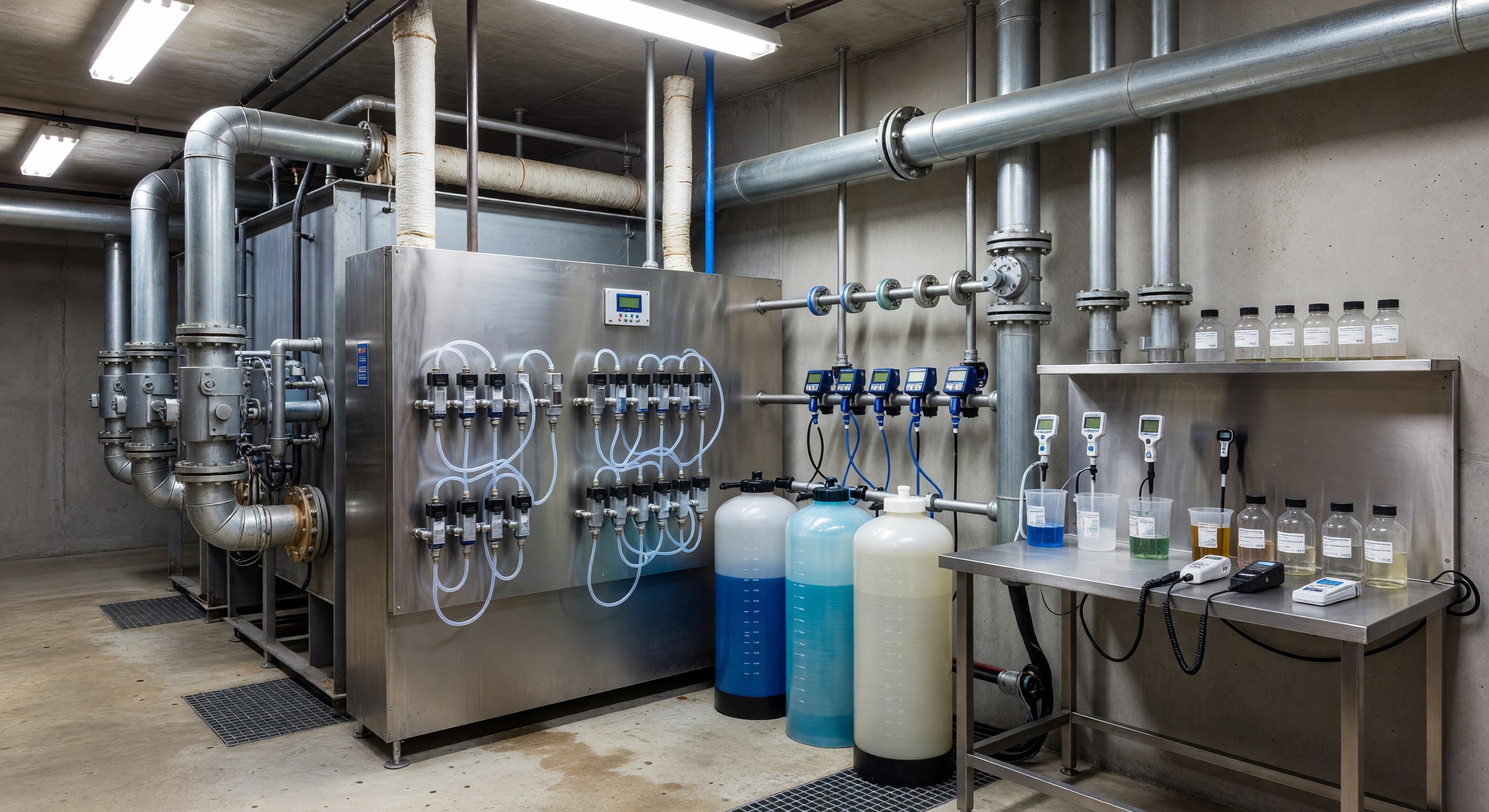
Automatic chemical feed systems: Modern cooling tower treatment uses automated controllers that monitor conductivity, pH, and biocide residual, feeding chemicals automatically to maintain targets. Automated systems maintain more consistent treatment than periodic manual dosing and provide operational data logs useful for compliance documentation.
Chiller System Water Treatment (Chilled Water and Condenser Water)
Chiller systems circulate chilled water (typically at 44–54°F) and condenser water (85–95°F at cooling tower return). Both loops require treatment:
Chilled water loop: Closed loop with minimal water loss — makeup water additions are infrequent. Primary concerns are corrosion (particularly galvanic corrosion between dissimilar metals in the loop) and biological growth (though lower temperature slows biological activity). Chemical treatment includes corrosion inhibitors and occasional biocide treatment.
Condenser water loop: Open loop that connects to the cooling tower — subject to the same treatment requirements as the tower system. Typically treated as an integrated system with the cooling tower.
Monitoring: Closed loops require periodic water testing (semi-annual minimum) to verify inhibitor levels and identify early corrosion indicators (iron, copper levels in water indicate metal loss). The treatment vendor should collect and analyze water samples and report results against target ranges.
Boiler System Water Treatment
Hotel boilers (hot water boilers for space heating, steam boilers for laundry or kitchen applications) require careful water treatment to prevent scale and corrosion that dramatically shortens boiler service life:
Scale control: Scale on boiler heat exchanger surfaces reduces heat transfer, causing overheating and tube failure. Scale prevention requires control of hardness (calcium and magnesium) in boiler feedwater through water softening and chemical scale inhibitors.
Oxygen control: Dissolved oxygen in boiler feedwater causes pitting corrosion (oxygen attack) in boiler tubes and the steam distribution system. Oxygen scavengers (sodium sulfite, hydrazine alternatives) neutralize dissolved oxygen chemically; deaerator systems provide mechanical oxygen removal for larger boilers.
pH control: Boiler water pH should be maintained in the alkaline range (typically 10.5–12.5 for steam boilers) to protect steel surfaces. Caustic soda or other alkalinity builders maintain pH.
Chemical feed and testing: Boiler water treatment requires periodic feed of treatment chemicals (through a chemical feed pump into the boiler feedwater) and regular water testing to verify control parameters. Daily or weekly testing by operating staff maintains visibility between vendor visits.
Frequently Asked Questions
How do I know if my hotel’s water treatment program is adequate? Warning signs of inadequate water treatment: (1) Visible scale on cooling tower fill media or heat exchanger surfaces at inspection; (2) Corrosion-related failures (pitting on copper pipes, red/brown water in the system indicating iron corrosion); (3) Chiller efficiency decline (rising energy consumption per ton of cooling) from fouled heat exchanger tubes; (4) Biological growth visible in the cooling tower basin or distribution system; (5) Legionella culture results above action levels. If any of these conditions exist, the treatment program needs immediate review.
What should hotels expect from a water treatment service contract? A complete water treatment service contract should include: monthly service visits with water sampling and analysis; automatic chemical feed system maintenance and calibration; treatment chemical supply included in the contract price; monthly written service reports documenting water test results versus target ranges, chemicals fed, and equipment observations; 24-hour emergency response; and annual system assessment report with recommendations. Water treatment contracts that only supply chemicals without regular monitoring and analysis provide inadequate program oversight.
How often should cooling tower water be tested? At minimum: monthly testing by the water treatment vendor service representative. For high-risk systems (towers serving large buildings, properties in warm climates with high biological growth risk): bi-weekly vendor testing or automated continuous monitoring for key parameters (conductivity, pH, ORP as biocide indicator). Legionella testing: quarterly per ASHRAE 188. Between vendor visits, hotel engineering staff should verify that automatic chemical feed systems are operating and that biocide dispensing is functioning — a biocide system failure for even 2–3 days can allow significant biological growth in warm tower water.
What is the cost of water treatment for hotel cooling towers? Annual cooling tower water treatment costs vary by system size and number of towers. A single cooling tower serving a 200-room hotel typically costs $12,000–$25,000 annually including chemicals, service visits, and laboratory analysis. Larger systems with multiple towers may cost $30,000–$60,000+ annually. This cost should be viewed against the cost of chiller tube replacements ($50,000–$150,000), cooling tower fill replacement ($20,000–$50,000), or a Legionellosis investigation (costs potentially in the millions from legal liability) — all of which inadequate water treatment can cause.
Further Reading from Authoritative Sources
- ASHRAE 188 hotel cooling tower water treatment and Legionella control standards — ASHRAE Standard 188 establishes Legionella water management program requirements including cooling tower testing frequencies, control parameters, and monitoring protocols applicable to hotel HVAC water treatment program oversight and cooling tower Legionella risk management.
- EPA hotel cooling tower water quality and Legionella prevention guidance — EPA provides Legionella prevention guidance, water system management standards, and environmental protection requirements applicable to hotel cooling tower water treatment programs, Legionella control compliance, and cooling tower chemical management environmental obligations.