Computerized Maintenance Management Systems (CMMS) have been available for hotel facility management for decades, but adoption has historically been uneven — many hotel engineering departments still operate with paper PM schedules, whiteboard work order queues, and maintenance histories stored primarily in the institutional memory of long-tenured chief engineers.
By 2025, that pattern is shifting. The proliferation of IoT sensor technology, mobile-first software interfaces, and AI-enhanced work order management has made modern CMMS platforms more accessible and more valuable than their predecessors. And as hotel engineering departments face ongoing staffing challenges, technology that multiplies the effectiveness of available staff becomes a competitive necessity rather than a luxury.
This guide reviews the current CMMS landscape for hotel applications, the integration capabilities that are reshaping maintenance management, and how to evaluate and select the right platform for a specific property.
What Modern Hotel CMMS Platforms Do
A contemporary hotel CMMS platform — as distinct from a simple work order log — provides:
Asset management: A database of every maintainable asset in the hotel, populated with equipment type, manufacturer, model, serial number, installation date, warranty status, associated vendor contacts, and attached documentation (manuals, drawings, inspection reports). The asset database is the foundation of all preventive maintenance scheduling and maintenance history analysis.
Preventive maintenance scheduling: PM tasks (quarterly PTAC filter replacement, monthly fire door inspection, semi-annual cooling tower cleaning) are built as recurring templates that generate work orders automatically on schedule. PM completion tracking — what percentage of scheduled PMs were completed on time — is the primary KPI for preventive maintenance programs.
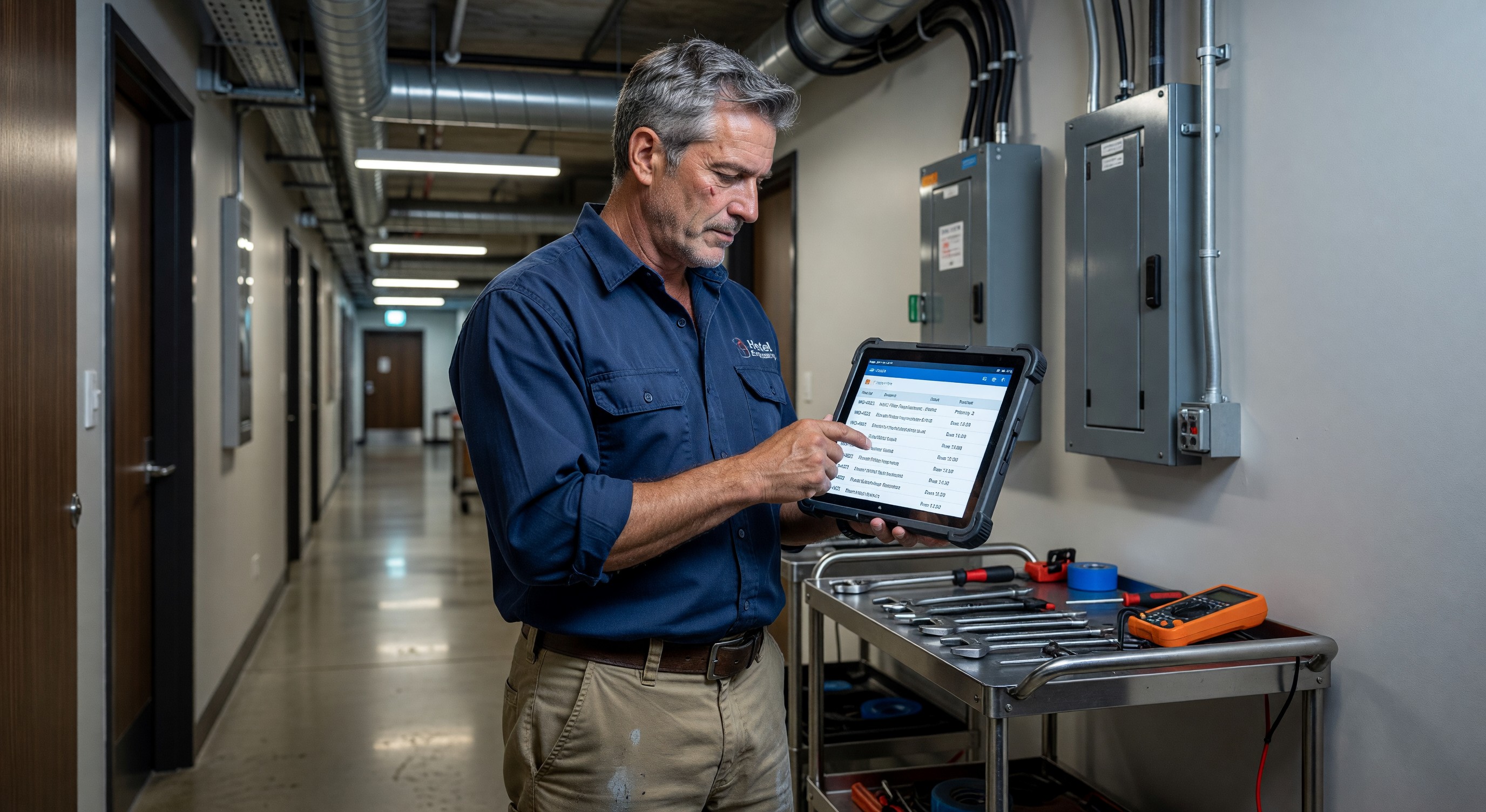
Work order management: Guest room maintenance requests, equipment repair work orders, and project tasks are managed through a lifecycle of: created → assigned → in progress → completed. Mobile app interfaces allow engineers in the field to receive, update, and close work orders from their phones or tablets without returning to the engineering office.
Guest request integration: Many platforms integrate with hotel PMS or service platform (Alice, Quore, HotSOS) APIs to automatically convert guest service requests to maintenance work orders — routing the request to the right technician, tracking response time, and recording completion.
Inventory management: Maintenance parts and supply inventory — spare PTAC filters, light bulbs, plumbing fittings, HVAC belts — is tracked in the CMMS, with minimum stock alerts and reorder triggers that prevent the “engineer doesn’t have the right filter” delay on routine maintenance.
Reporting and analytics: Work order volume by type and location, PM completion rates, response time by request type, parts cost by equipment, and staff productivity metrics are all standard report categories in mature CMMS platforms.
IoT Integration in 2025
The distinguishing feature of the current CMMS generation is integration with IoT sensor networks. Where first-generation CMMS relied entirely on manually entered data, modern platforms accept automatic data feeds from:
BAS/BMS: Equipment runtime data, alarm events, and operational parameters from building automation systems automatically trigger work orders and update equipment records in the CMMS — a chiller fault code generates a CMMS work order with the fault code attached before an engineer has been manually notified.
Predictive maintenance sensors: Vibration, temperature, and current sensors generate condition data that, when analyzed by AI models, triggers condition-based maintenance work orders. The CMMS work order can include the specific anomaly data, suggested diagnostic steps, and links to relevant equipment documentation.
Energy monitoring: Utility sub-meters or smart panels feed energy consumption data into CMMS-connected dashboards, allowing engineers to see energy consumption alongside maintenance history — correlating HVAC maintenance events with consumption trends.
AI-Assisted Maintenance Management
AI is entering hotel CMMS in several practical ways:
Fault diagnosis assistance: When a work order is created for an equipment malfunction, AI analysis of the equipment’s maintenance history, current sensor readings, and similar fault cases at comparable equipment across the platform’s customer base can suggest the most likely root cause — reducing diagnostic time for less experienced technicians.
Priority optimization: AI ranking of open work orders based on guest impact, safety risk, equipment criticality, and technician availability helps engineering supervisors make better dispatch decisions than intuition alone.
Predictive PM scheduling: Rather than fixed calendar-based schedules, AI-adjusted PM intervals based on actual equipment usage and condition data optimize both maintenance effectiveness and labor efficiency.
Natural language work order creation: Voice-to-text and AI work order parsing allow engineers to describe problems in natural language (“toilet in room 412 running constantly, handle sticking”) and have the CMMS automatically categorize, route, and create the structured work order from the natural language description.
Platform Options for Hotels
The hotel CMMS market includes hospitality-specific platforms and general commercial building platforms adapted for hotel use:
Hospitality-specific CMMS:
- Quore: Built for hospitality operations, integrates with major PMS platforms, strong mobile interface
- HotSOS (Knowcross): Widely deployed at branded properties, deep PMS integration, service recovery workflows
- Amadeus (formerly HOTSOS Optimize): Enterprise-scale platform for large hotel portfolios
General commercial CMMS with hotel adoption:
- UpKeep: Mobile-first, strong IoT integration, widely used across industries including hospitality
- Limble CMMS: User-friendly interface, strong reporting, mid-market pricing
- Hippo CMMS: Affordable entry-level option for smaller properties
- IBM Maximo: Enterprise-scale, complex implementation, justified for large portfolios or complex mixed-use properties
Evaluation criteria specific to hotel applications:
- PMS integration capability (for automatic work order creation from guest requests)
- Mobile interface quality (engineers work in the field, not at desks)
- IoT/BAS integration capability for properties investing in connected infrastructure
- Reporting granularity for brand compliance documentation (PM completion rates, inspection records)
- Vendor support model (24/7 support is relevant for properties with 24-hour operations)
Implementation Realities
CMMS implementation success depends more on people and process than technology. Common implementation failures:
Asset data quality: A CMMS is only as useful as its asset database. If equipment records are inaccurate, incomplete, or not maintained as equipment changes, the platform’s value degrades rapidly. Dedicate 60–90 days to asset data cleanup before go-live.
PM task design: PM tasks that are too generic (“inspect HVAC system”) don’t provide guidance to technicians; PM tasks that are too detailed (“check 47 specific items on each AHU”) don’t get completed. Balance specificity with practicality in PM template design.
Adoption and workflow change: Engineers who have managed maintenance through personal experience and informal systems need to understand why the CMMS improves their work — not just that management has mandated its use. Involve the engineering team in configuration decisions and communicate the “what’s in it for me” clearly.
Frequently Asked Questions
What is the typical cost of hotel CMMS software? Cloud-based CMMS platforms for hotel applications typically run $100–$500 per month for small-to-medium properties (up to 200 rooms), $500–$2,000/month for large full-service properties, and enterprise pricing for portfolio-level implementations. Most platforms are now SaaS subscription, with implementation/setup fees of $1,000–$10,000 depending on complexity and data migration needs.
How long does CMMS implementation take for a hotel? A realistic timeline for a mid-size hotel: 60–90 days for data preparation and asset entry, 30 days for system configuration and PM template creation, 2 weeks for staff training, and 90 days for stabilization after go-live where workflows are refined and adoption issues are addressed. Total clock time from decision to stable operation: 6–8 months. Rushing implementation typically results in poor data quality and low adoption.
Should a hotel use the same CMMS as its brand mandates? Brand-mandated platforms (often HotSOS or brand-specific operations systems at major chains) should generally be used if mandated, as brand QA documentation and reporting requirements may be built around those platforms. Independent hotels and management companies choosing their own systems should prioritize hospitality-specific options that integrate with their PMS and have hospitality-aware support teams.
How can a hotel demonstrate maintenance program effectiveness to ownership? CMMS reporting enables the specific metrics that hotel ownership and asset management firms typically require: PM completion rate (target: 90%+), emergency work order percentage of total (target: <15%), mean time to complete guest room maintenance requests (target: <4 hours), cost-per-room for engineering department (benchmark against comp set), and major system incident frequency. A well-run CMMS produces these metrics automatically from operational data — no manual compilation required.
Further Reading from Authoritative Sources
- IFMA facility management technology and CMMS standards — IFMA provides facility management technology standards, CMMS implementation guidance, and benchmarking data relevant to hotel maintenance management software selection and performance measurement.
- HFTP hospitality technology standards for maintenance platforms — HFTP provides hospitality technology professionals with standards and guidance for facility management software selection, PMS integration requirements, and technology implementation best practices.