The in-room entertainment landscape has shifted fundamentally over the past five years. Hotel guests increasingly arrive with their own content subscriptions — Netflix, Disney+, HBO Max, Apple TV+, Amazon Prime Video — and expect to access that content on the in-room television as naturally as they would at home. Properties that offer only traditional cable TV lineups are increasingly viewed as out-of-step with guest expectations, particularly among younger travelers who may not own a cable subscription at all.
At the same time, the technology infrastructure required to deliver modern entertainment experiences has grown more complex: streaming platform partnerships, secure account authentication, personal device connectivity, gaming bandwidth requirements, and privacy controls that ensure one guest’s viewing history doesn’t appear on the next guest’s screen all require deliberate management.
This guide addresses the current state of hotel in-room entertainment technology: streaming platform integration, gaming considerations, device connectivity, and the operational management that keeps entertainment systems guest-ready.
The Shift to Streaming-First Entertainment
By 2024, the majority of hotel guests who watch in-room television prefer streaming content over traditional cable or satellite. Research from hospitality technology firms consistently shows:
- 65–75% of guests who use the in-room television prefer streaming services to traditional hotel cable
- Guest satisfaction with entertainment systems correlates strongly with streaming availability
- Hotels offering casting or streaming-enabled TVs score measurably higher on in-room entertainment satisfaction than those with cable-only
Approaches to streaming delivery:
Native apps on Smart TV platforms: Hospitality-grade Smart TVs from LG (webOS hospitality platform) and Samsung (LYNK hospitality) now include pre-loaded streaming apps (Netflix, Hulu, Disney+, etc.) that guests can sign in to with their own credentials. The guest experience is clean — select the app, log in, stream. The operational challenge is ensuring accounts are properly logged out at checkout, preventing the next guest from accessing the prior guest’s account.
Casting (Chromecast/AirPlay): Google Chromecast or Apple AirPlay integration allows guests to cast content from their mobile device to the in-room TV. No account login on the TV is required; the guest controls everything from their phone or tablet. Chromecast-based solutions (from Enseo, Sonifi, and others) are the most widely deployed hotel streaming approach as of 2024. Privacy is maintained because no account credentials are stored on the TV — everything remains on the guest’s device.
BYOD (Bring Your Own Device) screen mirroring: HDMI input availability allows guests to connect laptops, streaming sticks, or gaming consoles directly to the TV. Simple and reliable, but requires the guest to bring their own device and cable — not the seamless experience of casting.
Hotel streaming apps: Several hotel brands (Marriott, Hilton) have developed proprietary streaming apps that provide curated content (original content, live TV streams, VOD libraries) accessible through the hotel’s entertainment platform without requiring the guest’s personal accounts.
Gaming Connectivity
Gaming represents a growing segment of hotel entertainment demand, particularly among younger travelers. Gaming connectivity requirements:
Input latency: Gaming requires low input latency — the delay between a controller action and the corresponding screen response. High latency makes games unplayable. Standard cable TV processing introduces latency; gaming mode on modern televisions bypasses video processing to minimize latency. Verify that in-room TVs include a game mode and that it can be activated by guests without requiring staff assistance.
HDMI connectivity: Console gaming requires HDMI connection. Guest room TVs should have at least one accessible HDMI input — not just inputs that are accessible by removing a furniture panel or accessing the rear of the TV.
Internet bandwidth for cloud gaming: Cloud gaming platforms (Xbox Cloud Gaming, PlayStation Now, NVIDIA GeForce NOW) stream games over the internet, requiring 15–35 Mbps of stable, low-latency bandwidth per active session. Hotels with congested guest WiFi networks will fail to deliver adequate cloud gaming experiences. Dedicated gaming bandwidth allocations or wired Ethernet options in rooms improve this experience significantly.
Privacy and Account Management
The most significant operational concern with streaming-enabled in-room TVs is the privacy risk of residual guest account data. A guest who logs into Netflix on the room TV and then checks out without logging out leaves their account accessible to the next guest.
Automatic account logout protocols:
- At checkout, the PMS should trigger an automatic “reset” signal to the room’s entertainment system, logging out all accounts and clearing viewing history
- Entertainment platforms designed for hospitality (LG LYNK, Samsung LYNK, commercial hospitality IPTV systems) support PMS-triggered resets
- Verify this reset actually works by testing: check in, log into a streaming service, check out, re-enter the room as a new guest, and confirm no prior guest’s account is accessible
If your entertainment system cannot reliably clear guest accounts on checkout, consider casting-based approaches (no hotel-side account storage) rather than native app approaches.
IPTV and Hotel-Branded Interface
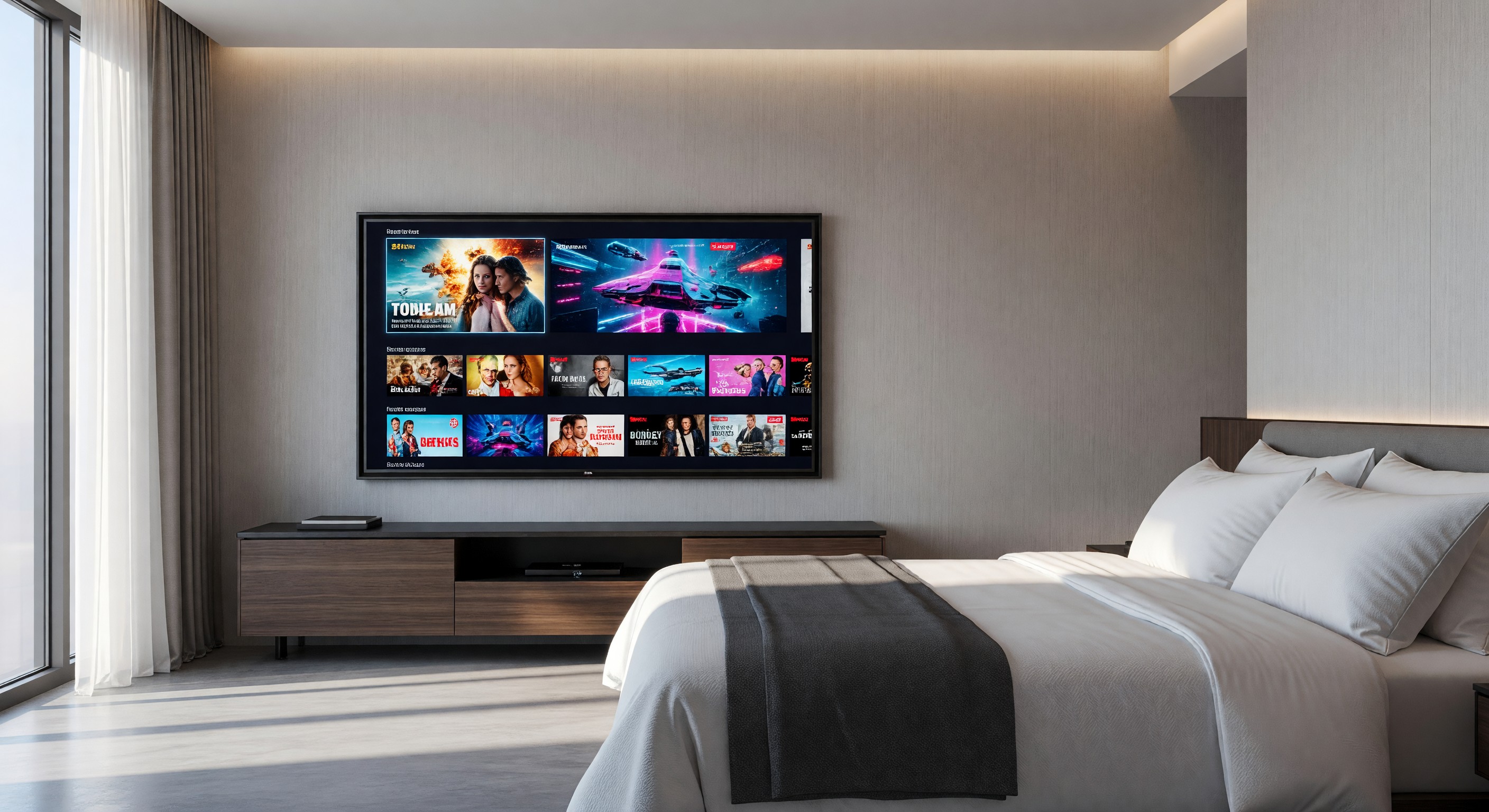
Many full-service hotels deploy IPTV (internet protocol television) platforms that provide a branded guest interface — the TV shows the hotel’s branded home screen with navigation to streaming apps, hotel services (room service menu, welcome message, bill review), local information, and live TV channels.
IPTV platform providers for hospitality include: Enseo, Sonifi/Otrum, Nonius, Acentic, and Telkonet. These platforms typically integrate with the hotel’s PMS to display personalized guest information (welcome by name, folio balance) and can include service ordering capability (room service, housekeeping requests, spa reservations) through the TV interface.
IPTV systems add operational complexity compared to standalone commercial televisions but provide the branded experience and service integration that premium hotels expect.
Television Hardware Selection
Commercial hospitality televisions — not consumer TVs — are the correct specification for hotel guest rooms:
- Commercial warranties (covering commercial-use hour requirements that would void consumer warranties)
- Pro:idiom content protection for premium channels
- Hospitality firmware that enables remote management, automatic volume limits, and property-branding customization
- Port management that locks unused inputs (prevents guests from accessing settings menus or changing channel configurations)
Current-generation hospitality TVs from LG (US model line) and Samsung (HG series) are the dominant hospitality market specifications. Screen sizes have shifted toward 55–65 inches in standard rooms and 65–75 inches in suites, reflecting both falling panel costs and increasing guest expectations.
Frequently Asked Questions
What is the most popular streaming option for hotel rooms in 2024? Casting-based solutions (hotel-provided Chromecast or AirPlay capability) are the most widely deployed approach as of 2024, primarily because they avoid the account management privacy complications of native streaming apps while providing a simple, familiar guest experience. Native app integration on Smart hospitality TV platforms is growing as automatic logout capabilities mature.
Should hotels still include traditional cable channels? Local news channels, sports programming with live broadcast rights, and network content that isn’t always available on streaming platforms justify maintaining some live TV channel access. However, large cable packages with hundreds of channels are increasingly perceived as noise rather than value. Most hotels are moving toward slimmer live TV packages (local broadcast + sports) combined with streaming for on-demand content.
How much internet bandwidth do hotel guest rooms need for streaming? Netflix recommends 15 Mbps per device for 4K streaming; standard 1080p HD requires 5 Mbps. A room with two streaming devices simultaneously active needs 30 Mbps. When aggregated across a 200-room hotel at even 20% simultaneous streaming, the total internet bandwidth requirement is substantial — this is one of the primary drivers of hotel bandwidth upgrade investments. Guest WiFi networks should be designed for 10–20 Mbps guaranteed per room, not just aggregate capacity.
What is the typical replacement cycle for hotel in-room televisions? Commercial hospitality televisions have a practical replacement cycle of 7–10 years. At 7 years, screen quality and features (especially HDR, 4K capability, streaming platform compatibility) have often fallen behind guest expectations relative to competitors. At 10 years, panel degradation (backlight uniformity loss, color accuracy decline) and software platform obsolescence (streaming app compatibility issues) typically force replacement. Budget for replacement on a rolling program — replacing 10–15% of room TVs annually — rather than full property replacements every 8–10 years.
Further Reading from Authoritative Sources
- HFTP in-room entertainment technology standards — HFTP provides hospitality technology professionals with in-room entertainment standards, guest experience benchmarks, and technology selection guidance for hotel room entertainment systems.
- AHLA hotel technology and guest experience resources — AHLA tracks hotel industry technology adoption and guest satisfaction benchmarks relevant to in-room entertainment investment decisions and competitive positioning.