Guest room power and charging infrastructure has become a meaningful differentiator in hotel guest satisfaction. The average hotel guest travels with 3–5 devices — smartphone, tablet, laptop, smartwatch, earbuds — each with different charging requirements. A guest room with two standard AC outlets and no USB ports, or USB-A ports that cannot adequately charge a modern USB-C device, creates genuine friction and negative sentiment.
Hotel engineering teams face a technical and capital challenge in this space: the technology landscape has shifted rapidly from USB-A to USB-C, power delivery requirements have increased substantially, and the placement of charging infrastructure in guest rooms involves both new construction standards and retrofit solutions for existing properties.
The Charging Standard Transition: USB-A to USB-C
USB-A (the flat rectangular port that has been universal since the late 1990s) remains common in hotel rooms installed through approximately 2021. USB-A ports in hotel rooms typically provide 5V/1A (5W) or 5V/2.4A (12W) output — adequate for phones a generation ago, inadequate for current high-capacity smartphones, tablets, or USB-C devices.
USB-C with Power Delivery has become the universal charging standard across smartphones, tablets, laptops, and accessories. USB-C PD supports power delivery from 5W to 240W (USB PD 3.1), with most smartphones charging at 18–65W and laptops at 45–100W.
The practical gap: a hotel guest room with USB-A ports cannot natively fast-charge a current-generation iPhone, Android flagship, or iPad — let alone a laptop. The guest uses their own power adapter (occupying an AC outlet) or charges slowly overnight.
Hotels investing in in-room power infrastructure in 2024–2026 should specify USB-C with Power Delivery as the primary charging interface, with USB-A maintained for backward compatibility where space permits.
Placement and Integration Options
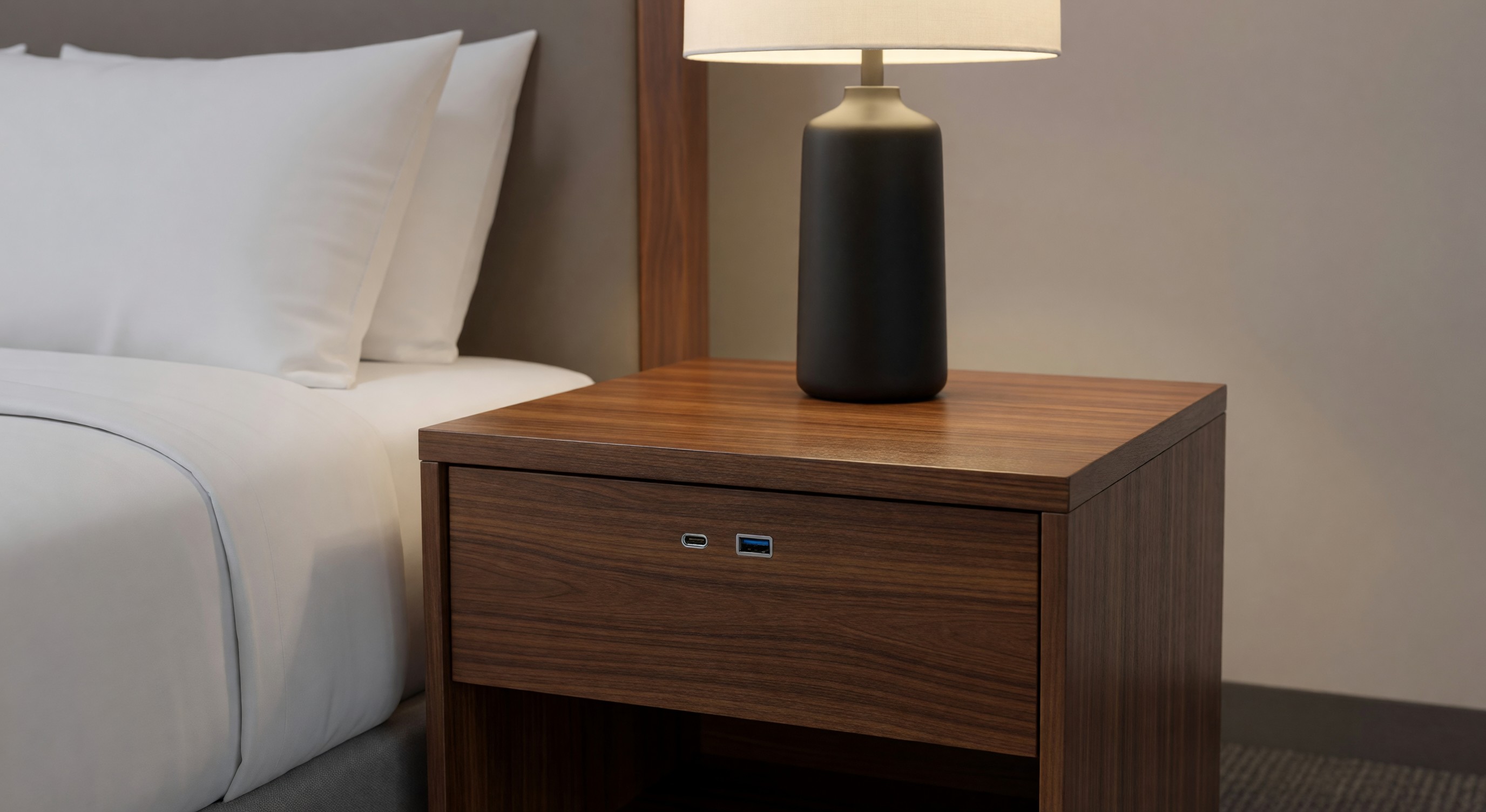
Nightstand and bedside panels: The highest-priority charging location for most hotel guests is the nightstand — the device charges overnight within arm’s reach. Dedicated bedside power units (tabletop or integrated into the nightstand) provide the cleanest solution for new construction or renovations. Current products typically include 2 AC outlets, 1 USB-A, and 1 USB-C (at minimum 18W PD).
Lamp base integration: Charging ports integrated into the base of bedside lamps provide power without occupying surface space. A popular option for renovations that preserves existing furniture layout while adding charging capability.
Desk and work area power: Business travelers charging laptops require accessible AC outlets and high-wattage USB-C at the desk. Desk surface power units with cable management accommodate the laptop-and-phone-simultaneously use case common among business travelers.
Furniture integration: Custom hotel furniture increasingly incorporates recessed power strips with integrated USB-C into headboard panels, nightstands, and desks — concealing wiring while providing convenient access. This approach requires coordination between FF&E specification and electrical rough-in planning during renovation.
Outlet placement geometry: The common hotel room problem of outlets placed behind furniture — inaccessible without moving the nightstand — is a code-compliant but functionally deficient placement. Accessible outlet placement (at the nightstand surface level, at the desk within reach of the work surface, at the vanity for personal care devices) is worth specifying explicitly in renovation scopes.
Power Delivery Specifications
When specifying guest room USB-C charging, power delivery wattage determines the guest experience:
- 18W USB-C PD: Provides standard fast charging for most smartphones. Minimum useful specification.
- 45W USB-C PD: Charges phones quickly and provides adequate power for many tablets. A reasonable mid-tier specification.
- 65W USB-C PD: Charges phones, tablets, and most thin-and-light laptops. Covers the majority of guest device needs.
- 100W USB-C PD: Full-power charging for all USB-C laptops including power-hungry models (MacBook Pro, high-performance Windows laptops). Premium specification appropriate for luxury properties and business-oriented rooms.
For a business hotel or suite-level room targeting corporate travelers, 65W minimum (100W preferred) USB-C PD at the desk is the specification that eliminates the need for guests to bring laptop power adapters.
Retrofit Approaches for Existing Properties
Full nightstand replacement with integrated charging is the preferred solution for new construction and comprehensive renovations. For limited renovations or between renovation cycles, retrofit options:
Outlet replacement: Standard dual-AC outlets can be replaced with combination outlets that include USB-A and USB-C ports in the same wall plate, using existing rough-in wiring. Cost: $50–$150 per outlet location (device plus electrician labor). This is the most economical retrofit approach for adding USB charging without furniture replacement.
Table-top charging units: Freestanding bedside charging stations (tabletop power strips with integrated USB-C) provide charging without electrical work, at the cost of additional cords and surface clutter. Appropriate as an interim measure; not ideal for branded guestroom aesthetics.
Furniture overlays: Surface-mounted cable management systems that route power from existing wall outlets to more accessible positions on furniture surfaces. More complex to install cleanly but avoids both outlet replacement and furniture replacement.
Wireless Charging Considerations
Wireless charging (Qi standard, now Qi2 in 2024) eliminates cables for compatible devices. Qi2 supports up to 15W charging speed for certified devices.
Wireless charging pads integrated into nightstands or desk surfaces are a premium feature at upscale and luxury properties — providing cable-free charging for guests with Qi2-compatible devices. However, wireless charging does not replace wired USB-C for guests with laptops, non-Qi devices, or multiple devices to charge simultaneously. Wireless charging is best treated as an additive convenience rather than a replacement for adequate wired USB-C infrastructure.
Frequently Asked Questions
What is the minimum USB charging infrastructure hotels should provide in 2025? Minimum for a renovated guest room: two accessible AC outlets within reach of the bedside, one USB-A port (for legacy cables), and one USB-C port with at least 18W Power Delivery at the bedside. At the desk: two accessible AC outlets and one USB-C with at least 45W PD for business travelers. Properties below this minimum will receive negative charging-related mentions in guest reviews with increasing frequency.
Should hotels provide charging cables in guest rooms? Providing universal charging cables (USB-C to USB-C, USB-C to Lightning/MagSafe for Apple devices) is a high-perceived-value amenity that addresses the “forgot my cable” scenario. Single-use or per-stay charging cables are offered at luxury properties. The practical alternative — communicating to guests that cables are available at the front desk — handles occasional requests without stocking cables in every room. Cables in rooms increase theft and housekeeping replacement costs.
How does in-room USB charging power affect hotel electrical infrastructure? Individual USB-C PD ports draw at most 5–6 amps at 120V at maximum power delivery. The aggregate load of hotel-wide USB-C charging is not a significant electrical infrastructure concern — the power draw of in-room charging is modest compared to HVAC and lighting loads. Electrical infrastructure planning for USB-C retrofits primarily concerns outlet accessibility (position within reach of devices) rather than capacity.
Are there hotel brand standards for in-room charging infrastructure? Major hotel brands increasingly specify minimum in-room charging requirements as part of brand standards for new construction and renovation. Hilton’s Connected Room initiative, Marriott’s room technology standards, and Hyatt’s brand standards all address in-room power and technology infrastructure. Franchisees should confirm current brand standards before finalizing renovation scopes — incomplete specification against brand requirements can create PIP (Property Improvement Plan) obligations.
Further Reading from Authoritative Sources
- AHLA hotel in-room technology and guest satisfaction resources — AHLA provides hospitality industry research on in-room technology standards, guest satisfaction drivers related to device charging, and brand specification compliance applicable to hotel USB charging infrastructure planning.
- HFTP hotel in-room technology standards and guest connectivity resources — HFTP provides hospitality technology professionals with in-room technology standards, USB charging specification guidance, and guest connectivity frameworks applicable to hotel guest room power infrastructure decisions.