The building envelope — the assembly of exterior elements that separates conditioned interior space from the outdoor environment — is among the most consequential systems a hotel facility manager oversees. Roof systems, facades, windows, caulking, waterproofing membranes, and below-grade systems work together to control heat flow, moisture infiltration, and air leakage. When the envelope fails, the consequences cascade through the building: water intrusion damages finishes, flooring, and structural elements; air infiltration degrades HVAC performance and guest comfort; failed waterproofing allows moisture to accumulate in assemblies where it promotes mold growth.
Envelope maintenance is often underfunded because failures are not always immediately visible — moisture infiltration can track horizontally through assemblies before manifesting as water stains or efflorescence. This guide covers each major envelope component, its maintenance requirements, and the inspection practices that catch problems before they become expensive remediation projects.
Roofing Systems
Hotels employ several roofing types, each with distinct maintenance requirements:
Low-slope membrane roofing (TPO, EPDM, PVC, modified bitumen) covers most hotel podium decks, mechanical equipment platforms, and flat sections. These systems require:
- Bi-annual inspection (spring and fall) for membrane punctures, seam separations, and flashings
- Immediate repair of any puncture, cut, or seam separation — water migrating under the membrane spreads laterally through insulation before appearing indoors
- Drain inspection and clearing — standing water (ponding) accelerates membrane deterioration and adds structural load
- Flashing inspection at all penetrations (HVAC equipment, skylights, pipes, expansion joints) — these are the most common water entry points
Steep-slope roofing (asphalt shingles, tile, metal standing seam) on hotel towers and amenity buildings requires:
- Annual inspection for damaged, missing, or displaced shingles or tiles
- Valley and flashing condition review
- Gutter and downspout function verification — blocked drainage causes water to back up under roofing at eaves
Green roofs and rooftop amenities (pool decks, terraces) incorporate waterproofing membranes beneath growing media or hardscaping. These require specialist inspection — visual inspection alone cannot confirm membrane integrity under ballast or growing media. Infrared thermography or nuclear moisture detection surveys can identify wet insulation without destructive probing.
Roof system service lives range from 15 years (asphalt shingles in harsh climates) to 30+ years (quality metal systems with proper maintenance). The most common cause of premature failure is deferred maintenance — small punctures or flashing failures that are left unrepaired allow moisture to saturate the insulation layer, where freeze-thaw cycles cause progressive damage.
Facades and Exterior Cladding
Hotel facades range from brick veneer to EIFS (Exterior Insulation and Finish System) stucco to glass curtain wall to precast concrete panels. Each presents different maintenance challenges:
EIFS/stucco: Susceptible to water infiltration at cracks, penetrations, and transitions. Cracks wider than 1/16 inch require immediate sealant repair. Annual inspection for cracks, especially at window corners, control joints, and transitions to other materials, is essential. Impact damage from landscaping equipment or vehicles must be repaired promptly — moisture entry into EIFS insulation layer is difficult and expensive to remediate.
Brick veneer: Mortar joint deterioration (spalling, cracking) is the primary maintenance concern. Repointing deteriorated joints prevents moisture entry and is substantially less expensive than remediation of water damage that has penetrated behind the veneer. Inspect annually; repoint as needed, typically every 20–30 years in moderate climates.
Glass curtain wall: Gasket and sealant systems have service lives of 15–25 years. Failed gaskets allow water infiltration at mullion joints. Annual inspection for failed sealant, gasket shrinkage, and evidence of water staining at frame components enables proactive repair before guest room water intrusion occurs.
Precast concrete: Panel joint sealants (silicone or polyurethane) require inspection and replacement on 15–20 year cycles. Cracks in panels warrant structural engineering review before simple cosmetic repair.
Windows
Hotel windows serve multiple functions: weather resistance, thermal performance, acoustic isolation, and aesthetic. Window performance deteriorates through seal failure (insulated glazing units — IGUs — develop seal failures that allow moisture into the airspace, causing fogging), frame weatherstripping degradation, and operator hardware failure.
IGU seal failure is visible as fogging or condensation between panes. Failed IGUs require replacement of the glass unit — the failed seal cannot be effectively repaired. Large-scale IGU replacement programs can span multiple years at major hotels; prioritize visible guest room windows and any unit where water infiltration has occurred.
Weatherstripping inspection: Check seal compression and integrity at all operable windows annually. Failed weatherstripping allows air and water infiltration that guests notice as drafts and condensation.
Hardware: Casement operators, tilt-turn hardware, and restrictor cables (for safety compliance) require lubrication and function testing annually. Failed restrictors — which limit window opening depth for fall prevention — are a safety and liability concern that should be addressed immediately.
Waterproofing and Below-Grade Systems
Below-grade areas (basements, underground parking garages, loading docks) are subject to hydrostatic pressure that drives water through any crack or discontinuity in the waterproofing membrane. Signs of below-grade water intrusion include:
- Active seepage or efflorescence on concrete walls
- Damp spots on floor slabs
- Rust staining from reinforcing steel (indicating moisture has reached the rebar layer)
- Mold or musty odors in mechanical rooms
Below-grade waterproofing remediation is expensive — the most effective approaches often require excavation or internal injection grouting, which disrupts operations. Annual inspection focused on early detection of seepage, followed by prompt crack injection repair, is far more cost-effective than major remediation of established leaks.
Expansion joints in concrete structures — both above and below grade — require periodic inspection and re-sealing. Failed expansion joint sealant is a primary water entry point in parking structures and podium decks.
Infrared Thermography Surveys
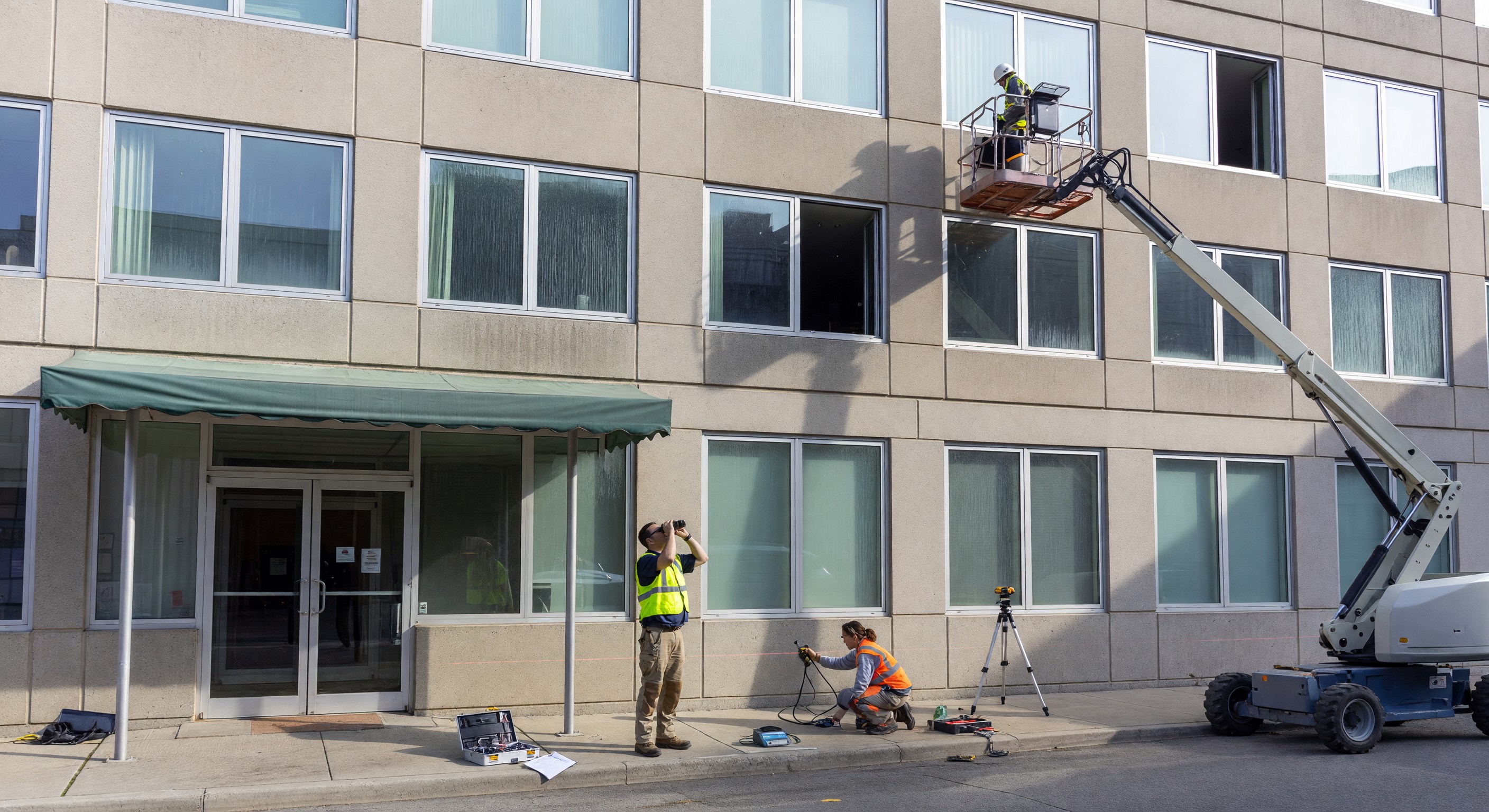
Infrared (IR) thermography surveys are among the most valuable diagnostic tools available for building envelope assessment. Conducted after sunset on clear, still nights when the building envelope has a temperature differential between interior and exterior, IR surveys reveal:
- Moisture-saturated roof insulation (wet insulation has different thermal mass than dry)
- Air infiltration pathways at windows and facade joints
- Missing or displaced insulation in cavity walls
Annual IR surveys of the roof and periodic (every 3–5 years) facade surveys provide early detection of problems not visible during standard visual inspection. The cost of an IR survey is typically recovered many times over in avoided remediation costs.
Frequently Asked Questions
How often should hotel roofs be inspected? Flat/low-slope membrane roofing should be inspected twice per year — spring (after freeze-thaw season) and fall (before winter loading). Steep-slope roofing should be inspected annually. After any significant weather event (hail, high winds, heavy snow loading), conduct an additional inspection regardless of the regular schedule.
What is EIFS and why is it problematic for hotels? EIFS (Exterior Insulation and Finish System) is a synthetic stucco cladding system widely used on hotel facades since the 1980s. It is prone to moisture intrusion at cracks, penetrations, and transitions when not properly maintained, because moisture that enters the system is trapped between the EIFS and the substrate. Preventive maintenance — annual inspection and immediate crack repair — is essential for EIFS-clad properties. Known problematic installations should be evaluated by a building envelope specialist.
How can hotels detect water infiltration before it causes visible damage? Infrared thermography surveys, electronic leak detection on roofing membranes, and moisture sensor arrays embedded in facade systems during construction or major renovation all provide early detection. For established buildings, annual IR roof surveys and probing at high-risk locations (window sills, facade transitions, mechanical penetrations) during regular inspections catch most problems before they penetrate to interior finishes.
What is the typical cost to replace hotel windows? Hotel window replacement costs vary widely by window size, type, and building access challenges. Typical costs for standard hotel room windows range from $800–$2,500 per opening for window-only replacement in accessible mid-rise buildings. High-rise window replacement involving swing stages or specialty access equipment can double or triple these costs. Large-scale window replacement programs typically warrant hotel brand capital reserve planning over 3–5 years.
Further Reading from Authoritative Sources
- IFMA building envelope maintenance best practices — IFMA is the International Facility Management Association, providing professional standards and best practices for building envelope maintenance and capital planning.
- DOE building envelope performance resources — The DOE Buildings program provides research and guidance on building envelope performance, moisture control, and energy-efficient envelope systems for commercial buildings.