Boiler systems heat the domestic hot water and, in many full-service hotel properties, provide hydronic space heating. They’re inherently high-stakes systems: gas combustion, high-pressure steam or hot water, and complex controls create failure modes that range from operational disruption to serious safety incidents.
Hotel boiler management requires a more formalized approach than most mechanical systems — with documented safety procedures, licensed technicians for significant maintenance, and regulatory compliance that varies meaningfully by state and local jurisdiction.
Boiler Types in Hotels
Condensing vs. Non-Condensing Boilers
Condensing boilers are the current standard for new installations. They recover heat from exhaust gases by condensing water vapor out of the flue gas — achieving efficiencies of 90–98% vs. 70–85% for standard boilers. They require lower return water temperatures to enable condensing operation (typically below 130°F).
Non-condensing (standard efficiency) boilers operate at higher temperatures and exhaust higher-temperature flue gases. Less efficient, but simpler and often less expensive initially. Many existing hotel boiler installations are non-condensing.
The efficiency premium of condensing boilers typically pays back in 3–7 years in fuel savings, making them the right specification for any boiler replacement.
Hot Water vs. Steam
Hot water (hydronic) boilers: Heat water and circulate it through a piping network to fan coil units, baseboard radiators, or other terminal units. The most common configuration in hotels built or renovated in the past 30–40 years.
Steam boilers: Heat water to steam, which is distributed and condensed in terminal units, returning as condensate. Steam systems are found primarily in older hotel buildings (pre-1960s construction) and have more complex distribution and maintenance requirements than hot water systems.
Commercial vs. Modular
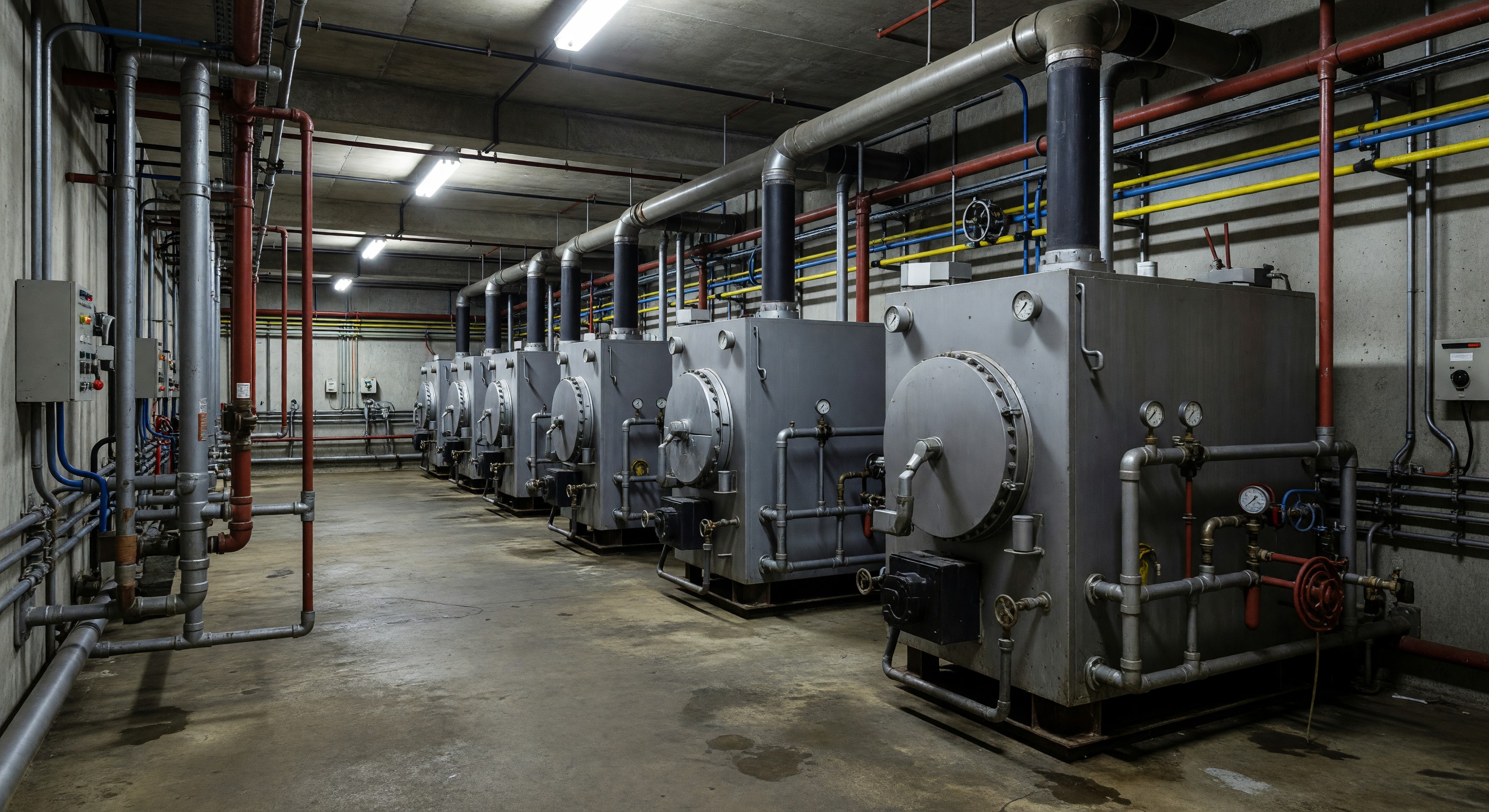
Large-capacity single boilers are common in established full-service hotels. Modular boiler systems — multiple smaller boilers that stage on and off as load requires — offer better part-load efficiency and built-in redundancy. For new installations and major replacements, modular configurations are often the better engineering choice.
Regulatory Framework
Boilers are among the most heavily regulated mechanical systems in most jurisdictions. Key regulatory elements:
Boiler certificates of inspection: Most states require annual or biennial boiler inspections by a licensed boiler inspector (either a state inspector or an authorized third party). The inspection certificate must be posted on or near the boiler.
Operating licenses: Some jurisdictions require that boilers above a certain capacity be operated only by licensed stationary engineers. Know your local requirements — operating without required licenses creates serious liability.
Boiler registration: Many jurisdictions require that all boilers above a threshold capacity be registered with the state.
State pressure vessel codes: Boiler design, installation, and repair must comply with ASME Boiler and Pressure Vessel Code as adopted by the state.
Annual inspection preparation: Before the inspection, verify that all safety devices (pressure relief valves, low-water cutoffs, high-limit controls) are functional and dated within their inspection intervals.
Safety Systems and Requirements
Boiler safety systems are non-negotiable. Every boiler must have:
Pressure relief valve (PRV): Opens automatically if system pressure exceeds the rated maximum, preventing catastrophic pressure buildup. Must be tested annually (lift-the-lever test) and replaced if it doesn’t reset cleanly. Never remove or disable a PRV.
Low water cutoff (LWCO): Shuts off the burner if water level drops below a safe minimum. Steam boilers and hot water boilers above a certain size both require LWCOs. Must be tested at each annual inspection.
High-limit controls: Temperature and pressure controls that shut off the burner if operating parameters exceed safe limits.
Combustion air supply: Gas-fired boilers require adequate combustion air. Sealed or poorly ventilated boiler rooms create carbon monoxide risk from incomplete combustion. Verify that combustion air openings are clear and that the boiler room has adequate fresh air supply.
Flue gas management: The vent system must safely exhaust combustion gases to the outside. Check the flue regularly for blockages, corrosion, or joint failures.
Carbon monoxide detection: CO detectors in and adjacent to the boiler room, with alarm notification to an occupied location, are essential.
Preventive Maintenance Program
Daily Checks
For boilers in active heating season:
- Check operating pressure and temperature against normal range
- Verify pilot or ignition function (on-demand if the burner cycles)
- Check water level gauge (steam boilers)
- Verify that the CO detector is functioning
Monthly Maintenance
- Test low water cutoff device (for steam boilers, blow down the float chamber)
- Test pressure relief valve (lift lever briefly to verify it opens and reseats)
- Check system pressure against seasonal expectations
- Inspect flue connections and draft hood
- Check combustion air supply is clear
- Inspect all visible piping, valves, and connections for leaks
Annual Maintenance (Professional Service)
Annual professional service for gas-fired boilers includes:
Combustion analysis: Measuring flue gas oxygen, carbon dioxide, carbon monoxide, and temperature to verify efficient combustion. Combustion that’s out of adjustment wastes fuel and may produce CO. Adjust as needed.
Burner cleaning and adjustment: Clean the burner, inspect electrodes or pilot, and verify ignition.
Heat exchanger inspection and cleaning: Scale on the heat exchanger reduces efficiency and can lead to overheating and damage. Clean as needed.
Control calibration: Verify that operating controls, aquastats, and high-limit controls are calibrated and functioning.
Safety device testing: Full test of all safety devices (PRV, LWCO, high-limit) per manufacturer and code requirements.
Flue system inspection: Check for corrosion, joint integrity, and proper draft.
Water chemistry check: For hot water systems, check inhibitor levels, pH, and oxygen content. Treat as needed to prevent corrosion.
Seasonal Startup and Shutdown
Fall startup (pre-heating season):
- Complete the annual maintenance and inspection before the heating season
- Verify that expansion tanks are properly pressurized
- Check and purge air from the distribution system
- Test all zones and verify heat delivery to all areas
- Verify controls are set for heating season setpoints
Spring shutdown (post-heating season):
- Complete a mid-season inspection before turning off for summer
- Clean the system and document condition
- Set summer-only DHW mode if the boiler serves both space heating and DHW
- Check for any corrosion or issues that developed during the heating season
- Schedule fall startup maintenance before summer ends
Efficiency Optimization
Return Water Temperature
Condensing boiler efficiency is maximized at lower return water temperatures. If your system has a modern condensing boiler, but is returning water at 160°F, it may not be operating in condensing mode and you’re not getting the efficiency you paid for.
Review the system design — if the terminal units (fan coils, baseboard) were designed for high-temperature operation, and the boiler is designed for condensing operation, there may be a mismatch. A hydronic systems engineer can assess whether a low-temperature reset strategy is appropriate.
Boiler Staging (Multiple Boilers)
For systems with multiple boilers, proper staging significantly affects efficiency:
- Lead-lag rotation to equalize runtime and wear
- Stage-up based on load demand rather than fixed schedules
- Minimum firing time requirements to prevent short-cycling
- Proper sequencing controls that match the number of boilers firing to actual load
Many older multi-boiler systems use simple timers or manual staging rather than load-responsive controls. Upgrading the staging controls is often a low-cost efficiency improvement.
Pipe Insulation
Distribution piping that is inadequately insulated loses heat continuously. Hot water at 180°F in an uninsulated pipe in a 55°F mechanical room is constantly losing energy. Inspect all accessible distribution piping for insulation condition and completeness. Replace any damaged insulation and add insulation to any uninsulated pipe runs.
Capital Replacement Planning
Commercial boilers typically have a useful life of 20–25 years, though this varies significantly with maintenance quality and water chemistry management. The capital replacement planning triggers:
- Age exceeding 20 years with increasing maintenance events
- Repair costs exceeding 30% of replacement cost for any single event
- Significant heat exchanger deterioration found in inspection
- Efficiency substantially below original nameplate specifications
- Regulatory changes that require system modifications that approach replacement cost
When replacing boilers, evaluate:
- Condensing vs. non-condensing (almost always condensing for new installations)
- Modular vs. single large boiler
- Compatibility with existing distribution piping temperature requirements
- Upgrade to sealed combustion (direct vent) to improve indoor air quality and safety
FAQ
Does our hotel need a stationary engineer license to operate the boilers? This depends on your state and the boiler classification (typically defined by BTU output or horsepower). Many states require licensed stationary engineers for larger commercial boilers; others have no such requirement. Contact your state’s boiler safety division or labor department for your specific situation.
How do we know if our boiler efficiency has declined from its original specification? A combustion analysis by a qualified technician compares current flue gas readings against the expected performance for your boiler’s efficiency class. A significant decline in combustion efficiency indicates a cleaning or calibration need. Comparing current gas consumption to historical records at similar outdoor temperatures is another indicator.
What’s the difference between a pressure relief valve test and replacement? A PRV test (lifting the lever) verifies that the valve opens under pressure. A PRV replacement swaps the valve when it fails to reseat properly after testing, has reached its service life (typically 3–5 years for heavily tested PRVs), or when its set pressure doesn’t match current code requirements. Never assume a tested PRV is good indefinitely.
How do we handle a boiler failure during peak heating season? Every hotel with boiler-based heating should have a contingency plan: a rental boiler vendor relationship (rental boilers can be delivered and piped in within 24–48 hours for emergency situations), portable electric space heaters for temporary room conditioning, and a guest communication plan. The best contingency is having sufficient redundancy in the boiler plant that one unit failure doesn’t take down the entire system.
Further Reading from Authoritative Sources
- ASHRAE boiler and mechanical system standards — ASHRAE provides the HVAC and mechanical system standards that govern boiler system design and operation in commercial buildings including hotels.
- OSHA boiler and pressure vessel safety requirements — OSHA provides federal worker safety standards governing boiler operations, combustion safety, and mechanical room safety requirements.