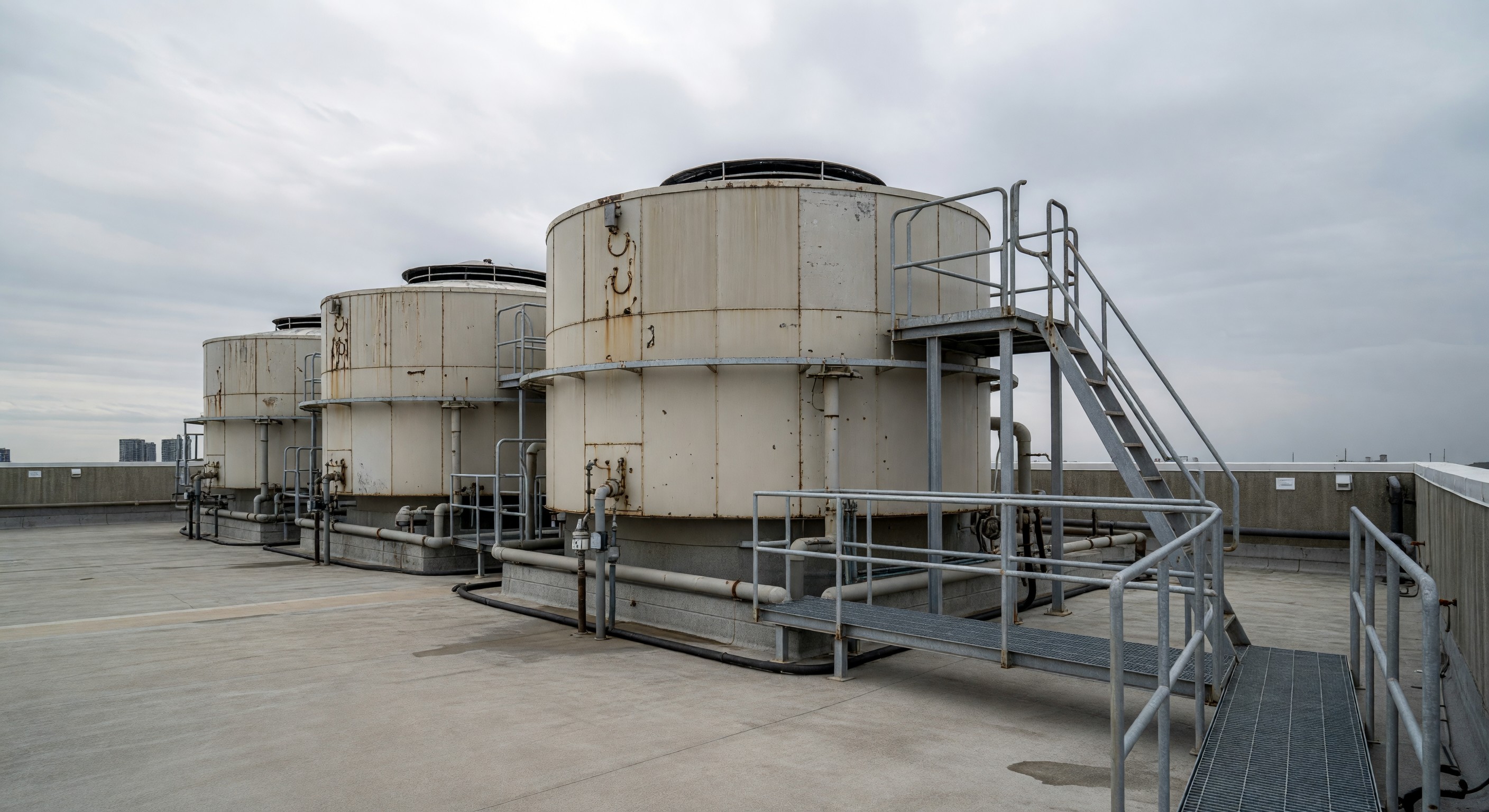
Cooling towers are a critical component of central chilled water systems and heat pump systems in hotels. They reject heat from the refrigeration cycle to the atmosphere through evaporative cooling — a highly effective process that also creates the conditions most favorable for Legionella bacteria growth. This dual characteristic — essential to the building’s cooling capacity and high-risk from a public health perspective — makes cooling tower management one of the most technically demanding and regulatory-intensive responsibilities for hotel engineers.
How Hotel Cooling Towers Work
A cooling tower receives warm condenser water from the building’s chillers. This water flows through the tower while fans draw air across it. As a portion of the water evaporates, it carries heat away, cooling the remaining water. The cooled condenser water returns to the chillers to absorb more heat. The cycle repeats continuously.
The evaporation process is effective at heat rejection but creates two important operational consequences:
Water loss: The evaporation removes water from the system, which must be continuously made up. A 500-ton cooling tower system might evaporate 10–15 gallons per minute during peak cooling season.
Mineral concentration: As water evaporates, the dissolved minerals remain in the system and concentrate. Without management, mineral scale would build up on heat transfer surfaces, reducing efficiency and eventually blocking flow. Water treatment programs manage this concentration through a combination of chemical treatment and blowdown (deliberately draining concentrated water and replacing it with makeup water).
Cooling Tower Water Treatment
Why Water Treatment Matters
The three primary goals of cooling tower water treatment:
- Scale control: Prevent mineral deposits on heat transfer surfaces that reduce efficiency and eventually cause damage
- Corrosion control: Protect metal surfaces (pipes, heat exchangers, tower fill) from corrosion caused by the treated water
- Biological control: Prevent the growth of bacteria, algae, and other microorganisms — with Legionella being the most critical concern
Treatment Program Components
A comprehensive cooling tower water treatment program includes:
Chemical treatment: Inhibitors for scale and corrosion, biocides for biological control. Most programs use a blend of chemicals applied via an automated dosing system that maintains target concentrations based on regular water testing.
Cycles of concentration (COC) control: The ratio of dissolved solids in the cooling water to the makeup water. Higher COC means more efficient water use (less blowdown) but requires more aggressive chemical treatment to prevent scale. Typical hotel cooling tower programs target 3–5 cycles of concentration.
Blowdown control: Automatic blowdown (timed or conductivity-controlled) to maintain the COC at the target level. Conductivity meters and automated blowdown controllers maintain COC without manual adjustment.
Biocide program: Alternating biocides applied on a schedule to prevent biocide resistance. Common biocides include oxidizing biocides (halogen-based: chlorine or bromine) and non-oxidizing biocides (various chemistries). The biocide program should be designed by a qualified water treatment chemist.
Water Testing Requirements
Regular water testing verifies that the treatment program is maintaining target parameters:
Daily or weekly: Conductivity (as a proxy for COC), pH, biocide level (free halogen) Weekly: Calcium hardness, alkalinity, inhibitor level Monthly: Biological testing (heterotrophic plate count as a general indicator) As required by WMP: Legionella-specific testing per the Water Management Program
Water testing should be performed by the water treatment vendor with results reviewed by the chief engineer. Don’t just file the reports — read them and understand what they’re telling you about system performance.
Legionella Risk in Cooling Towers
Cooling towers are the most significant Legionella risk source in most hotel facilities. The warm, aerosolized water environment is nearly ideal for Legionella growth and transmission. Several high-profile Legionnaire’s disease outbreaks have been traced to hotel cooling towers.
ASHRAE 188 Requirements for Cooling Towers
ASHRAE Standard 188 identifies cooling towers as a high-priority water system requiring specific Water Management Program elements:
- Regular visual inspection for biological growth (slime, algae)
- Routine monitoring of biocide levels and biological indicator organisms
- Periodic Legionella-specific testing (culture or PCR methods)
- Response procedures when Legionella or indicator organisms exceed target levels
- Inspection and cleaning requirements for the physical tower components
Routine Maintenance for Legionella Control
Physical maintenance of the cooling tower is as important as chemical treatment for Legionella control:
Basin cleaning: The collection basin at the bottom of the tower collects sediment, debris, and biological material. Annual basin cleaning (draining, high-pressure washing, and inspection) removes the organic material that biofilm — and Legionella within it — requires.
Fill cleaning: The fill media (the corrugated plastic or wood slats through which water flows) provides enormous surface area for biofilm growth. Inspect fill annually and clean or replace as needed. Fouled fill significantly reduces cooling tower efficiency.
Drift eliminators: These baffles at the air discharge reduce the amount of water droplets (drift) that leave the tower. Drift eliminators are important because it’s the aerosolized drift — not the evaporative vapor — that can carry Legionella to people nearby. Inspect and maintain drift eliminators as part of the annual tower service.
Sump strainers: Clean regularly to prevent debris accumulation that creates dead zones in the basin.
Response to Positive Legionella Results
When cooling tower water testing returns a Legionella-positive result above the action level in your Water Management Program:
- Immediately increase biocide treatment to the shock level
- Investigate the trigger (lapsed biocide dosing, equipment failure, biological growth)
- Conduct targeted Legionella testing to assess remediation effectiveness
- Consider temporary tower shutdown if results are severe or building occupants are high-risk
- Notify public health authorities if required by local regulations
- Document all actions with timestamps
Work with your water treatment vendor on the specific response protocol. Pre-define the response procedures in the WMP rather than developing them under emergency conditions.
Mechanical Maintenance
Fan and Motor Maintenance
Cooling tower fans are high-cycle mechanical components. Maintenance requirements:
- Monthly: Inspect fan blade condition, check for vibration, verify motor amperage is within nameplate range
- Quarterly: Lubricate motor bearings (if grease-lubricated), inspect drive belt tension and condition (if belt-driven), verify motor and fan are balanced
- Annual: Detailed fan blade inspection, motor insulation resistance test, bearing replacement if warranted
Variable frequency drives (VFDs) on cooling tower fans enable fan speed modulation that improves energy efficiency and reduces mechanical wear. If your cooling tower fans are running at fixed speed, VFD retrofit is worth evaluating.
Structural Inspection
Cooling towers are exposed to year-round weather and the chemically treated water environment. Annual structural inspection should cover:
- Structural frame for corrosion, cracking, or deformation
- Basin for cracks, leaks, or scale buildup
- Fill condition (fouling, damage, collapse)
- Drift eliminators for damage or gaps
- Water distribution system (spray nozzles or distribution decks) for clogs or damage
Winterization
In cold climates, cooling towers require winterization when ambient temperatures drop below freezing:
- Turn off makeup water supply and drain the basin to the freeze protection level
- Install basin heaters to prevent freeze damage to the basin
- Inspect and operate basin heaters before the first freezing weather each season
- In extended cold shutdown, fully drain the tower and piping
Regulatory Environment
Cooling tower regulation has increased significantly since several high-profile Legionella outbreaks. Several jurisdictions (New York City, Maryland, Virginia, and others) now have specific cooling tower registration and maintenance requirements.
New York City Local Law 77 (2015, strengthened in 2021) requires:
- Annual registration and inspection of all cooling towers
- Routine testing and record-keeping
- Notification of positive Legionella results to the health department
- Maintenance contractor requirements
Even in jurisdictions without specific cooling tower regulations, ASHRAE 188 compliance is increasingly being used as the benchmark for liability purposes in Legionella outbreak litigation.
FAQ
How often should cooling tower water be tested for Legionella? ASHRAE 188 suggests a risk-based frequency — at minimum quarterly for cooling towers, with increased frequency if risk factors are elevated. Many state regulations specify minimum testing frequencies. Consult your Water Management Program document and applicable local regulations.
Can we self-perform cooling tower water treatment or do we need a vendor? Chemical water treatment for cooling towers requires professional expertise in chemistry, biology, and regulatory compliance. The liability exposure from a Legionella outbreak traced to inadequate cooling tower treatment is severe. Use a qualified water treatment company with Legionella-control expertise, not a general cleaning vendor.
What’s the expected lifespan of a hotel cooling tower? The cooling tower structure and fill media typically last 15–20 years with proper maintenance. Fan and motor components are replaced on a shorter cycle (10–15 years). Towers with galvanized steel frames can have corrosion issues in 10–15 years if water treatment is inadequate.
What does it cost to properly manage a hotel cooling tower? Annual water treatment costs for a typical hotel cooling tower system run $15,000–$35,000 depending on system size and program scope. Add the annual mechanical inspection and service ($2,000–$5,000), basin cleaning ($3,000–$8,000), and Legionella testing ($500–$2,000/year). Total annual cost of $20,000–$50,000 for a complete program on a mid-size system.
Further Reading from Authoritative Sources
- ASHRAE Standard 188 Legionella water management — ASHRAE 188 is the primary standard governing Legionella risk management in building water systems and is the benchmark used in liability cases involving hotel cooling tower outbreaks.
- CDC Legionella prevention and building water systems guidance — The CDC is the authoritative public health source for Legionella prevention, outbreak investigation, and building water management program guidance.