Electrical systems are the invisible infrastructure that makes everything else in a hotel function. When they work, nobody thinks about them. When they fail — a tripped breaker that kills a corridor, a generator that doesn’t start during a storm, a panel fault that takes down half the property — the impact is immediate and significant.
For directors of engineering, managing electrical systems means navigating both the technical complexity of high-voltage infrastructure and the regulatory framework that governs it. This guide covers the management practices, maintenance requirements, and capital considerations for hotel electrical systems.
Understanding Hotel Electrical Infrastructure
Service Entrance
The electrical service entrance is where utility power enters the building. For most hotels, this is medium-voltage power (typically 4,160V or 13,800V) that is stepped down to utilization voltage by transformer. Larger properties may have their own substations.
The service entrance capacity — measured in amps at the utilization voltage — defines the maximum electrical load the property can draw. Understanding your service entrance capacity matters when evaluating additions like EV charging, data center growth, or kitchen equipment expansion.
Main Distribution and Sub-Panels
From the service entrance, power flows through the main switchboard and then through a hierarchy of distribution panels to the load. Hotel electrical distribution typically includes:
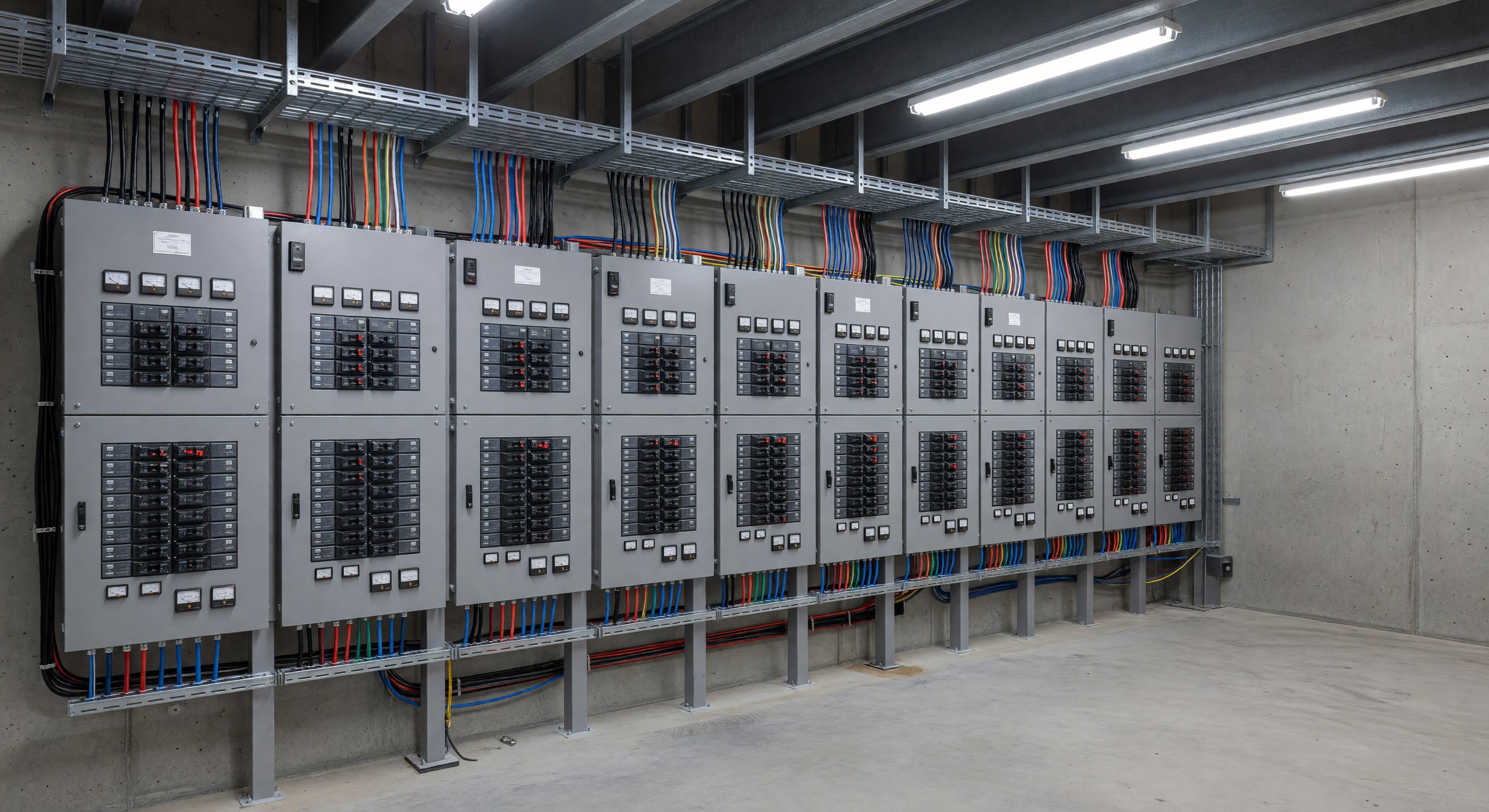
Main switchboard: The primary distribution point. Houses the main circuit breakers and meters. In many hotels, this is in a dedicated electrical room in the basement or ground floor.
Floor panels or sub-panels: Distribution panels on each floor or in each zone, fed from the main switchboard via feeder circuits. Reducing the circuit length from panel to load improves efficiency and reliability.
Guestroom panels: In some configurations, individual panels for clusters of guestrooms. More common in older construction.
Critical Loads and Emergency Power
A subset of hotel electrical loads must remain operational during a utility power outage:
Emergency loads (required by code): Fire alarm, emergency lighting in corridors and stairwells, elevator (at least one), fire pump, emergency communications.
Life safety loads: Automatically transferred to emergency power when utility fails.
Critical operational loads (property choice): Front desk systems, PMS servers, CCTV recording, phone systems, refrigeration for perishables, kitchen for food safety.
Guest comfort loads (property choice): Some hotels configure their generator to maintain guest amenities during outages. This requires a larger generator capacity.
Emergency Generator Management
Sizing
Generator sizing for a hotel depends on which loads you’re powering. Life-safety-only generator sizing for a 200-room full-service hotel might require 100–150 kW. A generator sized to maintain full hotel operations during an extended outage might be 500 kW–1.5 MW.
The right sizing involves a load calculation by a licensed electrical engineer. Don’t rely on rough rules of thumb for this decision — both undersizing (inadequate emergency coverage) and oversizing (excess capital cost and maintenance expense) are costly mistakes.
Fuel Management
Diesel generators require fuel on hand to start when needed. Maintain a minimum fuel supply capable of running the generator for 72 hours at rated load — more in hurricane-prone or disaster-risk areas.
Fuel management requirements:
- Regular fuel testing for water contamination and diesel bug (microbial growth)
- Fuel treatment (biocide and stabilizer) for stored diesel
- Tank inspection annually
- Fuel rotation (diesel degrades over time — don’t store more than 12 months without treatment or rotation)
Testing and Maintenance
Generator reliability is only meaningful if you test and maintain it properly. An untested generator that fails during an emergency provides no protection.
Weekly test run: Run the generator under no load for 15–30 minutes to verify it starts, runs, and temperatures stabilize normally. Document every run.
Monthly load test: Run under actual building load for at least 30 minutes. Transfer building loads to generator, verify all critical systems operate normally under generator power, then transfer back. This tests the full emergency power system including the automatic transfer switch.
Annual load bank test: Test at 75–100% of rated capacity using a portable load bank. Verifies full output capability. Required by NFPA 110 (Standard for Emergency and Standby Power Systems).
PM schedule: Oil change and filter replacement per manufacturer schedule (typically every 200–400 hours of runtime or annually). Coolant testing and replacement. Belt inspection. Battery testing (generator starting battery is a common failure point).
Arc Flash Safety
Arc flash is one of the most serious electrical hazards in a facility environment. An arc flash event — where electrical energy is released in an uncontrolled arc through the air — can cause severe burns, blindness, and death. Hotels with significant electrical infrastructure must take arc flash safety seriously.
Requirements:
- Arc flash hazard analysis for all electrical equipment (performed by a licensed electrical engineer)
- Arc flash hazard labeling on all panels and switchgear
- Appropriate PPE for electrical work based on the incident energy at each work location
- Lockout/tagout (LOTO) procedures for all electrical maintenance
Training: Any staff or contractors who work on or near electrical equipment must be trained on arc flash hazards and required PPE. “Near electrical equipment” means within the arc flash boundary — for some equipment, this can be several feet away.
Electrical Maintenance Program
Panel Inspections
Main switchboard and sub-panel inspections should include:
- Thermal imaging of all breakers and connections (hot connections indicate resistance problems before visible failure)
- Tightening of bus and breaker connections
- Breaker operation testing (trip test on critical breakers)
- Verification of labeling accuracy (every circuit should be accurately labeled)
- Insulation inspection of visible wiring
Annual thermal imaging by a qualified thermographer is one of the highest-value predictive maintenance activities for electrical systems — it identifies problems before they become failures.
Common Electrical Problems in Hotels
Overloaded circuits: Hotels add equipment over time without formal load analysis. Circuits originally designed for a specific load accumulate additional devices. Periodic load surveys help identify overloaded circuits before they cause problems.
Deteriorated wiring insulation: Older properties may have wiring with insulation that has deteriorated with age. Knob-and-tube wiring, aluminum branch circuit wiring (common in buildings from the 1960s–1970s), and wiring with cloth or rubber insulation are safety concerns that require evaluation by a licensed electrician.
Loose connections: Vibration, thermal cycling, and age cause electrical connections to loosen over time. Loose connections create resistance, which creates heat, which causes failures and fire risk. This is what thermal imaging detects.
Nuisance tripping: Breakers that trip without obvious cause may be at the end of their service life or may indicate an actual overload or fault condition. Don’t simply reset a repeatedly tripping breaker without investigating the cause.
Power Quality
Power quality issues — harmonic distortion, voltage sags and swells, transients — affect sensitive electronic equipment and can cause premature failure of hotel technology infrastructure.
Common sources in hotels: variable-speed drives (elevators, HVAC), lighting dimmers, and UPS systems. Common effects: nuisance electronic failures, overheating of neutral conductors, data system instability.
A power quality survey (performed with a power quality analyzer) can identify and quantify issues if you’re seeing unexplained electronic equipment failures or instability.
FAQ
How do we know if our electrical service entrance has capacity for new loads (EV charging, kitchen upgrades, etc.)? Start with your existing utility meter data — if you’re at or near service capacity during peak demand periods, any significant addition requires a service upgrade. If you have significant headroom, a licensed electrical engineer can calculate whether the new load fits within existing capacity.
How long after a utility power outage should our generator automatically start? Automatic transfer switches are typically set to transfer after 10–30 seconds of power loss — long enough to avoid unnecessary transfers during momentary blips, short enough to restore emergency power before batteries discharge. Life safety code requires the generator to accept load within 10 seconds for certain loads.
Should we hire in-house licensed electricians or rely on contractors? For most hotels below 400 rooms, the volume of electrical work doesn’t justify full-time licensed electricians. A better model: train general maintenance staff on low-voltage work (lighting, outlets), maintain a relationship with a qualified electrical contractor for higher-voltage work, and budget for contracted PM for major systems (switchgear, generator).
What are the most important electrical safety practices for hotel maintenance staff? Lockout/tagout (LOTO) before working on any electrical equipment, never working hot except when testing requires it, using appropriate PPE, and calling a licensed electrician for any work beyond their training. Non-negotiable: no one works on energized equipment above 50 volts without proper training and authorization.
Further Reading from Authoritative Sources
- NFPA hotel electrical safety and emergency power system standards — NFPA 110 (Emergency and Standby Power Systems) and NFPA 70 (National Electrical Code) are the primary standards governing hotel electrical system safety, emergency generator requirements, and ATS maintenance applicable to hotel electrical infrastructure management.
- OSHA hotel electrical safety and arc flash hazard standards — OSHA 1910 Subpart S electrical safety standards establish the arc flash hazard analysis, PPE, and lockout/tagout requirements applicable to hotel electrical maintenance programs and the training required for engineering staff working on or near electrical equipment.