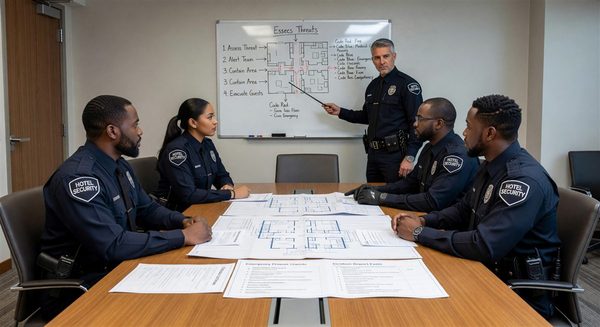
Hotel security programs face a fundamental challenge: threats evolve continuously while security measures tend to solidify into routine. An access control system deployed and tested in 2022 may have vulnerabilities in 2026 that weren’t apparent at installation. Procedures that were well-implemented when training was fresh may have degraded through staff turnover and familiarity. New amenities, renovations, and technology additions may have created gaps that weren’t assessed when the changes were made.
A formal security audit program — periodic, systematic assessment of the hotel’s security measures against current threats — is the mechanism that identifies these gaps before they’re exploited. This guide covers how hotels structure effective audit programs, what should be assessed, and how findings translate to improvements.
Types of Security Audits for Hotels
Internal security review: Conducted by the hotel’s own security management using a defined checklist. Covers observable security conditions — camera coverage, access control operation, lighting adequacy, security staff deployment, documentation compliance. Internal reviews are low cost and can be conducted frequently (monthly or quarterly), but are limited by familiarity and institutional blind spots.
Third-party security assessment: Conducted by an independent security consultant or security consulting firm. A fresh perspective from qualified security professionals who are not embedded in the property’s routine identifies gaps that internal reviewers miss. Should be conducted annually or following major property changes.
Penetration testing (physical): A hired security tester attempts to gain unauthorized access to hotel areas — the bag room, the back-of-house, guest floors, the server room — using social engineering and physical bypass techniques. Physical penetration testing reveals gaps in access control and staff challenge protocols that are not visible in a checklist review. Should be conducted by qualified firms with documented scope and legal authorization.
Compliance audit: Review of documentation compliance — security camera testing records, access control audit logs, staff training records, incident report documentation, and fire and life safety records. Compliance audits confirm that required programs are being documented and executed, not just theoretically in place.
Guest experience security review: Assessment from the guest perspective — what a guest encounters, observes, and experiences regarding security during a typical stay. Covers arrival and parking, check-in, elevator access, floor access, room security features, and emergency information availability.
The Hotel Security Audit Scope
A comprehensive hotel security audit should address:
Physical access controls: Operation of all access control points — main entrance, side and service entrances, elevator access, guest floor stairwell access, back-of-house areas, and restricted areas. Test that access restrictions are actually enforced: do doors to restricted areas actually require credentials? Do service entrances close and latch properly?
Electronic security systems: Camera coverage assessment (are all intended areas covered? Are there blind spots? Is image quality adequate for identification?). Camera recording function verification (is footage actually being recorded and retained?). Alarm system testing — are intrusion alarms, door prop alarms, and panic alarms functional and properly monitored?
Key control: Physical key and access credential inventory. Are master keys accounted for? Is the electronic lock audit trail being reviewed? Are terminated employee credentials promptly deactivated?
Staff procedures: Does staff actually challenge unescorted visitors in back-of-house areas? Do front desk staff verify guest identity before providing room number or key replacement? Do security staff conduct documented patrols at specified intervals?
Incident documentation: Review of recent incident reports for completeness, accuracy, and appropriate escalation. Are incidents being reported and documented, or managed informally without records?
Perimeter security: Exterior lighting adequacy — are all parking areas, entrance approaches, and exterior amenity areas illuminated to adequate foot-candle levels? Are perimeter barriers (fencing, walls, bollards) maintained? Are camera housings intact and aimed correctly?
Cyber-physical intersection: Are physical access control systems on an isolated network segment? Are badge readers and camera systems protected from unauthorized configuration changes? Is the BAS accessible from the guest WiFi network?
Audit Methodology and Reporting
Checklist-based assessment: The foundation of any security audit. Structured checklists ensure systematic coverage of all assessment areas. Checklists should be reviewed annually to reflect current security standards and property-specific risks.
Observation and testing: Checklists alone cannot verify actual performance — observing security staff behavior, testing door lock function, and physically verifying camera coverage requires moving through the property and testing conditions rather than reviewing records.
Finding classification: Security audit findings should be classified by risk level:
- Critical: Conditions that create immediate, significant risk of harm or loss (non-functional fire door, unmonitored public entrance, inoperable camera covering a high-risk area)
- High: Significant gaps that should be corrected within 30 days
- Medium: Gaps that should be addressed within 90 days
- Low/recommendation: Best practice improvements that should be incorporated into future planning
Corrective action tracking: Audit findings without corrective action plans and tracking have limited value. Each finding should be assigned to a responsible owner with a target completion date. Follow-up review confirms implementation.
Calibrating Audit Frequency
Audit frequency should reflect the hotel’s risk profile:
High-frequency internal reviews: Monthly engineering and security rounds that include security condition observation — camera operation, access control function, lighting adequacy, egress route clarity.
Quarterly compliance review: Documentation audit of required testing records, training completions, and incident report review.
Annual third-party assessment: Independent professional assessment that provides objective perspective on program adequacy.
Event-triggered reviews: Security assessments following significant events — a security incident at the property, a major renovation that changed access routes or added new spaces, a change in the hotel’s security staffing model, or a significant criminal incident at a comparable property in the area.
Frequently Asked Questions
How much does a hotel security audit cost? Internal security reviews have primarily a labor cost — the time of the security manager or Director of Engineering conducting the review. Third-party assessments from security consulting firms typically cost $3,000–$10,000 for a hotel property, depending on scope and property size. Physical penetration testing engagements range from $5,000–$20,000 depending on scope. The cost of audits is small relative to the cost of the security incidents they help prevent — or the liability of a documented gap in security that is later cited in litigation following an incident.
What should hotels do with security audit findings? Act on them. Security audit findings that are documented and then not addressed are potential evidence in litigation — they demonstrate that the hotel was aware of a security vulnerability and chose not to correct it. Prioritize critical and high-risk findings for immediate action. Create written corrective action plans with assigned responsibility and target dates for all findings. Document completion of each corrective action. Conduct a follow-up review to confirm that corrective actions actually resolved the identified gap (not just that the assigned corrective action was completed on paper).
Should hotel security audit reports be shared with ownership or asset managers? The Director of Engineering and General Manager should share security audit findings — in summary form — with ownership and asset management. Significant security gaps that require capital investment (major camera system upgrade, access control replacement) require owner awareness and authorization. Summary reporting keeps ownership informed of security program status without creating unnecessarily detailed documentation of vulnerabilities that could be discoverable in litigation. Work with legal counsel on the appropriate communication and retention approach for detailed audit reports.
How do hotel security audits differ from fire safety inspections? Fire safety inspections address the life safety compliance aspects of hotel security systems — fire alarm testing, sprinkler inspection, emergency lighting, egress compliance. Fire safety inspections are conducted by licensed fire protection contractors and reviewed by the authority having jurisdiction (fire marshal). Security audits are broader — they encompass access control, surveillance, staff procedures, loss prevention, and cyber-physical security in addition to life safety. The two programs are complementary; many hotels conduct fire safety compliance reviews and security audits on different schedules with different personnel.
Further Reading from Authoritative Sources
- OSHA hotel security audit compliance requirements and finding remediation standards — OSHA provides the regulatory framework for hotel safety and security compliance audits, finding classification requirements, corrective action documentation standards, and employer liability applicable to hotel security audit program development, finding remediation timelines, and compliance audit frequency.
- AHLA hotel security audit program standards and third-party assessment requirements — AHLA provides hospitality industry security audit standards, assessment frequency requirements, finding management frameworks, and security program development guidance applicable to hotel security audit calendar development, third-party assessment procurement, and remediation prioritization.