Noise complaints rank consistently among the top negative mentions in hotel guest reviews. A study of TripAdvisor review language found that noise-related terms appear in 25–35% of negative reviews at mid-scale properties — more frequently than any other single complaint category. Guests who experience noise from adjacent rooms, corridors, mechanical systems, or the exterior are predictably dissatisfied, regardless of other positive property attributes.
Acoustic performance is largely determined at construction — walls, floors, ceilings, and HVAC systems that were not acoustically engineered during design are expensive to remediate post-occupancy. However, many noise problems are addressable through maintenance improvements, targeted renovations, and operational protocols without full structural renovation. This guide covers both the engineering fundamentals of hotel acoustics and the practical remediation options available to existing properties.
How Sound Travels in Hotels
Understanding noise transmission pathways is essential for targeting effective solutions.
Airborne sound transmission: Sound waves traveling through air — voices, television audio, music — transmit through building assemblies primarily at their weakest points: gaps around doors, unsealed penetrations, light switch boxes, and window frames. STC (Sound Transmission Class) ratings measure a partition’s resistance to airborne sound transmission. ASHRAE recommends STC 50+ for hotel guest room partitions; STC 55+ for partitions between guest rooms and corridors.
Structure-borne (impact) sound: Sound generated by physical impact on building structure — footsteps on upper floor, dropped objects, furniture moving — travels through the building structure itself and radiates as sound from surfaces throughout the building. Impact Insulation Class (IIC) ratings measure floor assembly resistance to impact noise. IIC 50+ is the ASHRAE minimum recommendation for hotel guest room floors.
Flanking paths: Sound that bypasses the primary partition by traveling through connected structures — through the ceiling plenum above a partition, through a continuous concrete slab, or through shared HVAC ductwork — is called flanking. Flanking is responsible for many acoustic failures in buildings with seemingly adequate partition construction.
Mechanical system noise: HVAC equipment, plumbing systems, and elevators generate noise that transmits through the building structure or ductwork into guest rooms. HVAC noise in guest rooms is typically measured in NC (Noise Criteria) ratings; NC 25–35 is the ASHRAE recommendation for hotel guest rooms.
Common Hotel Acoustic Deficiencies
Corridor-to-room sound transmission: Hotel corridor to guest room partitions are often the weakest link — particularly the portion beneath the door. A 1/4-inch gap under a hotel room door allows significant sound transmission regardless of partition STC rating. Door bottom seals (automatic drop seals or sweeps) and full-perimeter door frame sealing dramatically improve corridor noise isolation.
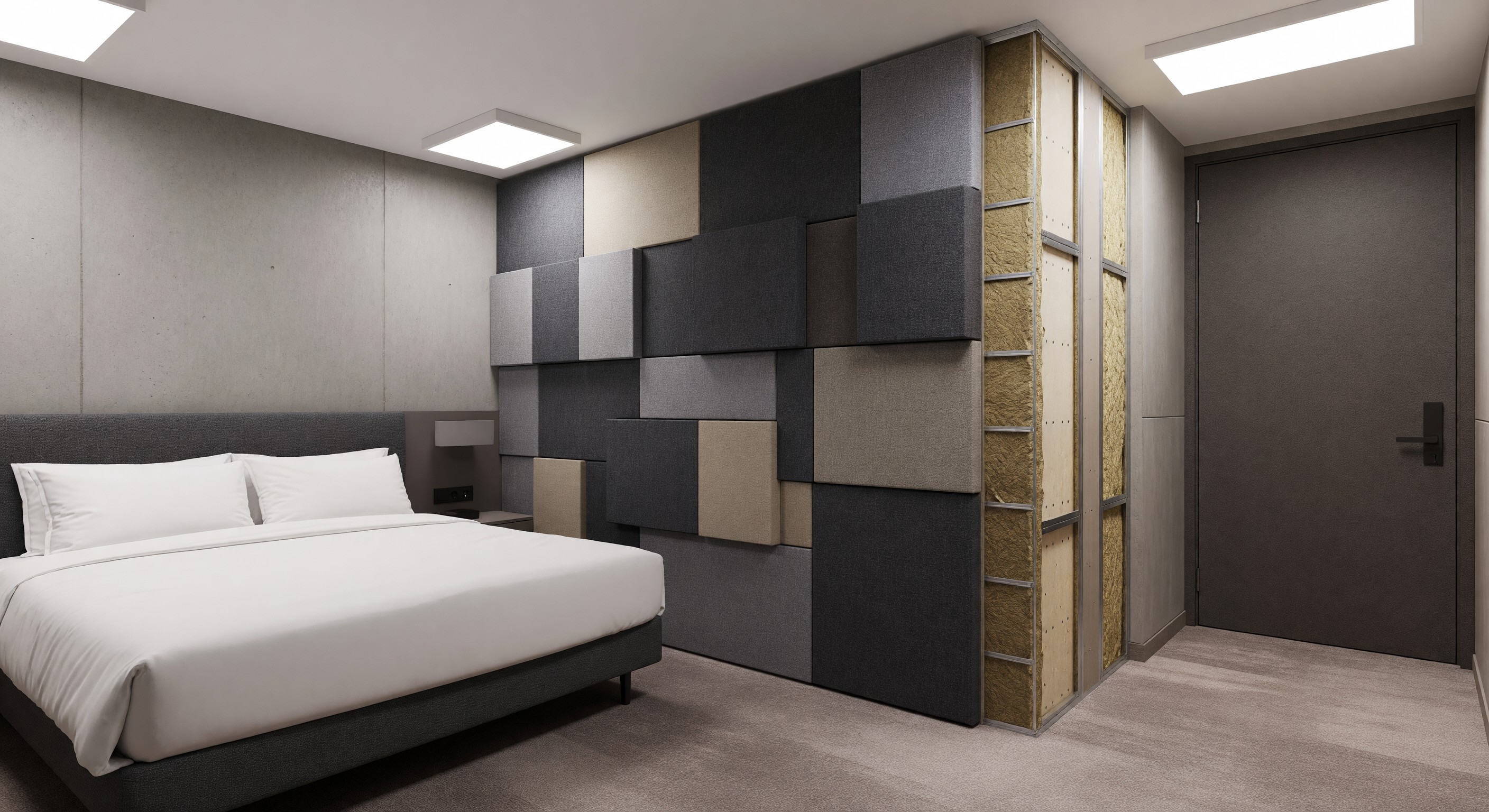
Room-to-room through walls: Standard drywall on metal stud partitions achieves STC 40–44 — below the ASHRAE 50 recommendation. Adding mass (additional drywall layers), resilient mounting (decoupling drywall from studs using resilient channels), and insulation fill improves STC. Penetrations through the party wall for plumbing, electrical boxes, and HVAC are common flanking paths that must be acoustically sealed.
Bathroom adjacency noise: Plumbing noise from toilet flushing and drain flow in one room transmitting to the adjacent room is among the most common guest complaints. Acoustic pipe wrap on supply and drain pipes in wall cavities, and isolation pads under plumbing fixture mounting brackets, reduce structure-borne plumbing noise.
HVAC noise from PTAC units: PTACs (Packaged Terminal Air Conditioners) are inherently noisy HVAC solutions — the compressor, fans, and refrigerant flow generate noise levels that vary from 38–58 dB(A) depending on unit age, brand, and operating mode. As PTACs age, component wear increases noise levels. Replacing aging PTACs with current-generation units typically reduces noise levels by 5–10 dB(A). VRF (Variable Refrigerant Flow) systems with indoor fan coil units are substantially quieter than PTACs.
Exterior traffic and environmental noise: Urban hotels near highways, airports, or entertainment districts may experience significant exterior noise intrusion. The primary mitigation is window performance — window STC ratings from 28 (single-pane) to 40+ (laminated insulating glass units). Laminated glass (PVB interlayer between glass lites) provides meaningful acoustic improvement over standard insulating glass.
Renovation Approaches for Acoustic Improvement
Door upgrade: Replacing standard hollow-core hotel doors with solid-core doors and adding perimeter seals and automatic door bottoms is one of the highest-return acoustic improvements for existing hotels. Cost: $400–$800 per door installed; noise reduction: 5–10 STC points at the door assembly.
Wall treatment: Adding mass to existing room-to-room walls without full demolition — by installing additional drywall layers on one side, supported by resilient channels — improves STC without rebuilding the partition. Cost: $15–$25 per square foot installed. Acoustical sealant at all penetrations and perimeter joints is essential.
Ceiling treatment: Sound traveling through the floor/ceiling assembly from upper floors is addressable through ceiling isolation — installing a secondary ceiling layer on resilient hangers below the existing ceiling, with insulation fill in the new plenum. This approach is expensive ($25–$50/sq ft) and requires headroom allowance, but significantly reduces impact noise transmission.
HVAC noise treatment: Adding duct silencers (sound attenuators) in supply and return ducts reduces fan noise transmission. Vibration isolation of equipment from structure reduces structure-borne mechanical noise. These measures are most economical during HVAC renovations when ductwork is accessible.
Operational Noise Management
Beyond construction, operational protocols address noise complaints:
Quiet hours policy: Clearly communicated quiet hours (typically 10 p.m.–7 a.m.) with consistent enforcement by security and management establish expectations. Guest complaints about noise during quiet hours should be responded to within 10 minutes.
Room assignment strategy: Noisy guests (parties, groups traveling together) can be concentrated on specific floors away from light sleepers when booking data allows strategic assignment. Family groups can be concentrated near each other.
Elevator lobby and ice machine placement: Identifying rooms adjacent to elevator lobbies, ice machines, and vending areas — inherently noisier locations — and avoiding assigning guests with noise sensitivity to these rooms reduces complaints. In renovations, these areas warrant acoustic treatment priority.
Frequently Asked Questions
What STC rating should hotel room partitions achieve? ASHRAE recommends a minimum STC of 50 for hotel guest room-to-room partitions and STC 55 for partitions between rooms and public corridors. Upscale and luxury properties should target STC 55–60 for room-to-room partitions. Current-code drywall on metal stud construction without special measures achieves approximately STC 40–44 — below recommended minimum levels in most codes and hospitality guidance.
How can hotels reduce impact noise from footsteps in upper-floor rooms? Impact noise reduction requires addressing the floor/ceiling assembly. Options include: carpet and dense pad in upper-floor rooms (carpet with high-density pad achieves IIC 50–60, versus hard flooring at IIC 25–35), resilient mat underlayment beneath hard flooring (adds IIC 5–15 points), and isolated ceiling systems in the room below. Carpet removal in favor of hard flooring — increasingly popular for hygiene and aesthetic reasons — significantly increases impact noise complaints unless acoustic underlayment is specified.
Are hotel PTAC units significantly noisier than alternative HVAC systems? Yes. PTACs operate with the compressor and fans in or near the guest room, producing noise levels of 38–58 dB(A) during compressor operation. VRF systems with indoor fan coil units operate at 30–40 dB(A) — substantially quieter. Central HVAC with variable air volume (VAV) terminals is quieter than PTACs but requires more complex distribution infrastructure. At major hotel renovations, the noise improvement from PTAC-to-VRF conversion is often cited as a guest satisfaction improvement comparable to aesthetic renovation in newer markets.
What is the most cost-effective acoustic improvement for an existing hotel with noise complaints? For most hotels experiencing room-to-room or corridor noise complaints, door upgrade is the most cost-effective first investment: solid-core doors with automatic drop seals and perimeter weatherstripping address a major sound path at $400–$800 per door. Acoustical sealant at all electrical boxes, HVAC penetrations, and pipe penetrations in party walls addresses flanking at minimal material cost. These two measures together resolve a significant percentage of guest noise complaints at a fraction of the cost of wall reconstruction.
Further Reading from Authoritative Sources
- ASHRAE acoustic standards for hotel guest rooms — ASHRAE is the primary standards body cited in this article for STC, IIC, and NC acoustic benchmarks in hotel facilities.
- American Hotel & Lodging Association guest experience resources — AHLA is the leading hospitality industry association with resources on guest satisfaction benchmarks and hotel operations best practices.