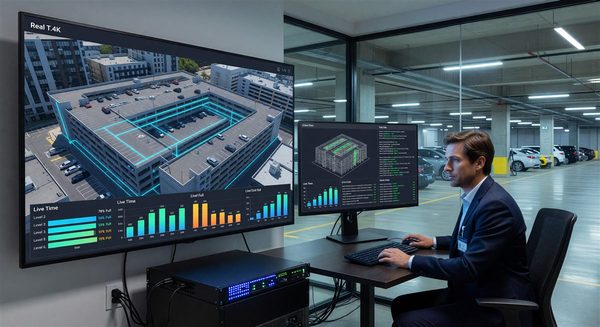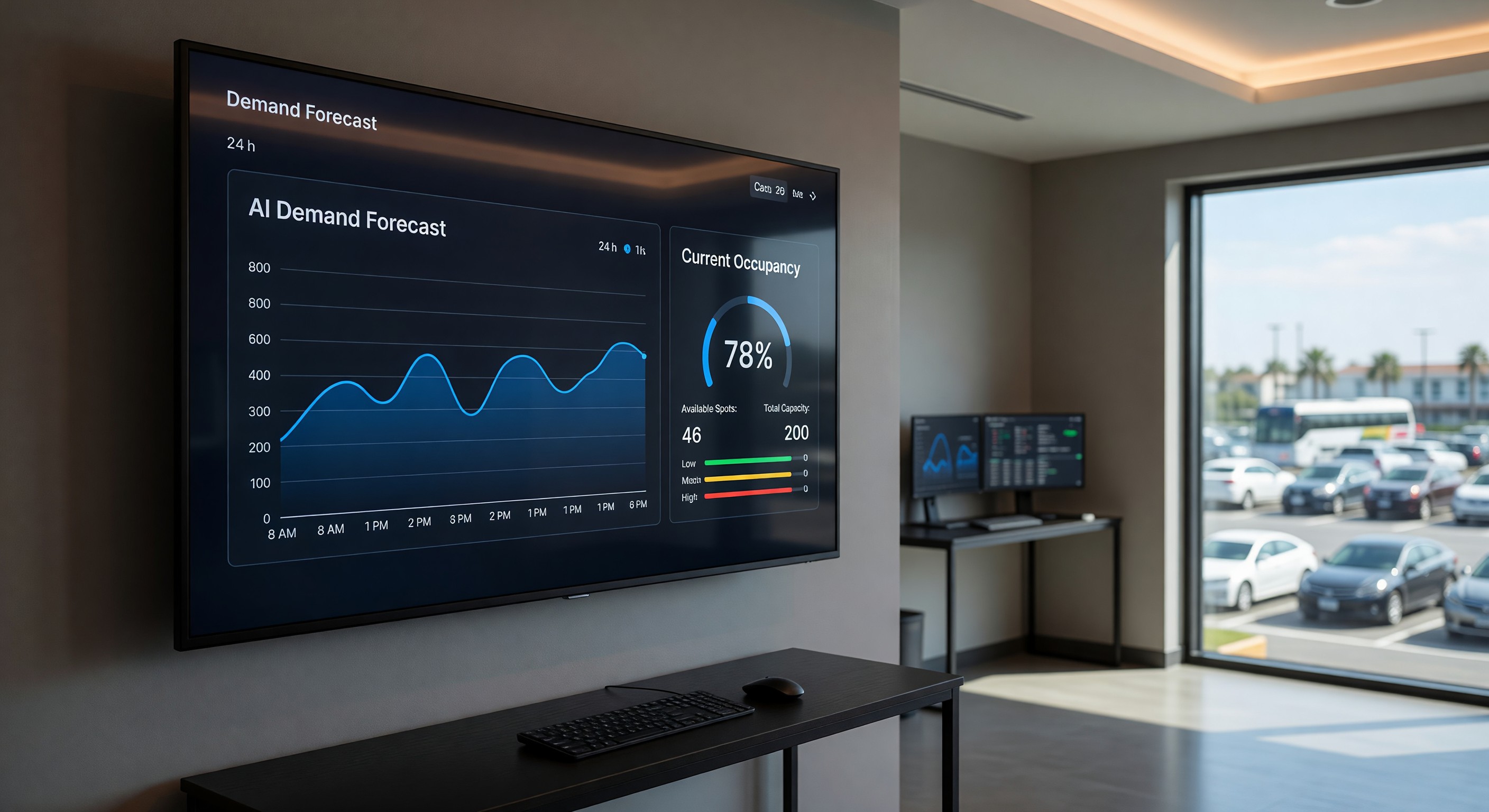
Hotel revenue management has used demand forecasting for decades — predicting future room demand to optimize pricing and inventory. Hotel parking, despite representing a significant revenue opportunity at most full-service properties, has largely been managed without comparable forecasting sophistication. Parking managers look at yesterday’s occupancy and today’s hotel bookings to estimate tomorrow’s parking demand — a process that is better than nothing but misses the complexity of factors that actually drive parking utilization.
AI-driven parking demand forecasting applies machine learning to historical occupancy data, hotel booking patterns, event calendars, weather forecasts, and external demand signals to produce accurate forward-looking demand estimates that enable more intelligent pricing, staffing, and guest communication decisions.
Why Hotel Parking Demand Is Complex to Forecast
Parking demand at hotels is driven by multiple interacting factors:
Hotel room occupancy: The most obvious driver — but the relationship is not linear. A hotel at 95% room occupancy on a leisure weekend may fill the parking lot. A hotel at 95% room occupancy hosting a conference whose attendees all arrived by plane may have 30% parking utilization.
Arrival method mix: Business travelers in major urban markets often arrive by transit, taxi, or rideshare with high frequency; leisure travelers at highway-adjacent properties arrive almost universally by car. The same room occupancy produces dramatically different parking demand depending on the mix.
Non-hotel parking demand: Properties with parking that is also used by restaurant, spa, or event center visitors experience parking demand independent of room occupancy. An event at the hotel’s ballroom can fill the parking lot during afternoon hours when only 40% of hotel rooms are occupied.
Weather: Inclement weather reduces walking and cycling, increasing parking demand from local visitors. Extreme cold reduces parking lot utilization as guests prefer transit or rideshare.
Nearby events: A sports event, concert, or festival within walking distance of the hotel dramatically increases parking demand from external visitors. Failure to anticipate this creates a situation where hotel guests cannot park at their own hotel because the lot was not closed or priced appropriately for the external demand.
Seasonal patterns: Resort properties see predictable seasonal demand curves; urban business properties see weekday/weekend demand inversions; highway properties see holiday travel patterns.
What AI Forecasting Adds
A mature AI demand forecasting platform for hotel parking ingests historical data across these dimensions and identifies patterns that human analysis misses:
Non-linear factor interactions: ML models can identify that a combination of 90%+ room occupancy + rain + a nearby event produces near-certain parking lot overflow — a pattern that simple rules-based analysis might not capture.
Rolling calibration: As actual occupancy data accumulates, the model continuously recalibrates its predictions against actual outcomes, improving accuracy over time.
Anomaly detection: When actual demand significantly differs from the forecast — parking fills 4 hours before the model predicted — the system flags this for investigation, potentially identifying events or demand drivers that the model hadn’t incorporated.
Multi-day forward view: Rather than just tomorrow’s forecast, AI models provide 7–14 day forward demand visibility, enabling pricing decisions and staff scheduling with appropriate lead time.
Operational Applications of Parking Demand Forecasts
Dynamic pricing integration: AI demand forecasts can drive automated pricing rules — when the forecast indicates a high-probability overflow event 5 days out, pricing can be increased immediately on the booking channel, increasing revenue from guests who plan ahead while discouraging casual usage that would displace hotel guests.
Overflow parking pre-arrangement: When the forecast indicates demand will exceed capacity, pre-arranging overflow parking at nearby facilities — and communicating this to guests before arrival — prevents the guest experience failure of arriving at a full lot. This preparation is only possible with advance demand visibility.
Valet staffing: AI demand forecasts enable valet staffing decisions with 48–72 hour lead time — hiring additional valet staff for a peak demand event rather than scrambling day-of. Given that qualified valet staff have other employment options, same-day staffing calls are frequently unsuccessful.
Pre-arrival guest communication: Guests arriving on high-demand dates benefit from proactive communication about parking: “We’re anticipating full parking on your arrival date. Consider using our valet service or pre-booking a guaranteed self-park space.” This communication converts would-be disappointed guests into satisfied ones who appreciated the heads-up.
Maintenance scheduling: Planned maintenance on parking equipment (gate servicing, lighting replacement, striping) can be scheduled during forecasted low-demand periods — avoiding the service disruption that occurs when maintenance happens on unexpectedly busy days.
Integration with Modern Parking Management Platforms
Modern parking access and revenue control platforms are incorporating demand forecasting capabilities either natively or through integration with third-party analytics platforms. When evaluating PARC system upgrades, ask vendors about:
- Native demand forecasting capability or documented API connections to forecasting platforms
- Automated pricing rule application based on forecast triggers
- Reporting that compares forecast accuracy against actual outcomes (enabling continuous model improvement)
- Data export capability for integration with the hotel’s broader analytics infrastructure
Getting Started with Parking Demand Forecasting
The data foundation for AI demand forecasting requires at minimum 12–24 months of historical parking transaction data (entry/exit timestamps, occupancy at intervals) matched with hotel occupancy data and ideally external event data. Hotels that lack this data foundation should begin systematic parking data collection immediately — every month of high-quality historical data improves future forecasting accuracy.
Steps toward parking demand forecasting capability:
- Ensure your PARC system records and retains transaction-level data with accurate timestamps and occupancy calculations
- Export and review 12–24 months of historical data to understand your current demand patterns
- Identify the key external demand drivers for your specific location (nearby venues, transportation patterns, business/leisure mix)
- Evaluate PARC system forecast capabilities or third-party analytics platforms that integrate with your existing infrastructure
- Start with manual rule-based forecasting using the patterns identified in historical data review — this builds the operational discipline to apply AI forecasts when the technology is in place
Frequently Asked Questions
How accurate are AI parking demand forecasts for hotels? Mature AI forecasting implementations in hospitality parking report forecast accuracy of 85–95% at the daily level — meaning the forecast is within 5–15% of actual occupancy for a given day. Accuracy is lower for specific time-of-day predictions and for unusual event-driven demand. As models accumulate more property-specific historical data, accuracy improves. Even 85% accuracy represents a major improvement over manual estimation, which is often off by 30–50% for high-demand event days.
Can a small hotel benefit from parking demand forecasting? The value of forecasting scales with parking complexity and revenue potential. Small hotels with 20–30 parking spaces and relatively stable demand patterns may find that manual pattern analysis (looking at historical data weekly) provides most of the benefit of AI forecasting at lower cost. Properties with 50+ parking spaces, variable external demand from restaurants or events, and significant valet operations have the most compelling use case for systematic AI forecasting.
How does parking demand forecasting connect to hotel revenue management? The best-integrated implementations share a common data platform where parking demand forecasting and room revenue management both access the same demand signals — hotel booking pace, event calendar, weather forecasts, historical patterns. When the revenue management system anticipates a high-demand period and raises room rates, the parking system should automatically adjust pricing in parallel. This requires data integration between systems that most hotels are only beginning to achieve in 2025.
What happens when the parking demand forecast is wrong? The operational response depends on which direction the error goes. If actual demand exceeds forecast and the lot fills before expected, staff must manage overflow (pre-arranged overflow lot, valet-managed street parking, apologetic guest communication) and the event should be captured in the training data to improve future forecasting. If actual demand is lower than forecast (over-pricing, over-staffed for a slow day), pricing can be adjusted real-time and the operational overallocation noted for future modeling. Neither error is catastrophic if backup operational processes are in place.
Further Reading from Authoritative Sources
- AHLA hotel revenue management and parking demand forecasting resources — AHLA provides hospitality industry research on revenue management practices, demand forecasting applications, and parking yield optimization applicable to hotel parking predictive analytics program development.
- HFTP hospitality technology and predictive analytics standards — HFTP provides hospitality technology professionals with analytics standards, AI application guidance, and technology ROI frameworks applicable to hotel parking demand forecasting system selection and deployment.
Predictive demand models are especially important during summer peak season, when compressed arrival windows and extended dwell times create the largest variance from normal patterns. See Hotel Parking During Summer Peak: Managing Demand, Valet, and Self-Park Mix for how these forecasts translate into operational staffing and capacity decisions.