Hotel roofs are simultaneously one of the most critical building components and one of the most neglected. A failing roof can cause water intrusion that damages guestrooms, destroys FF&E, ruins structural elements, and creates mold — all of which can result in room closures, guest compensation costs, and brand damage. Yet many properties go years between professional roof inspections, only engaging with their roof when a leak has already manifested inside the building.
The economics of roof maintenance are compelling: a $30,000 annual maintenance program extends a $500,000 roof for 5–10 additional years. A leak that goes undetected until it damages guestroom interiors can cost $50,000–$150,000 in repairs and lost revenue before the source is found and repaired.
Hotel Roof System Types
Low-Slope Roofing
Most hotel buildings have at least some low-slope (flat or near-flat) roof area — often covering the majority of the building on multi-story properties. Low-slope roofing systems include:
TPO (Thermoplastic Polyolefin): The most common new-construction roofing specification for commercial buildings today. White or light-colored membrane that reflects heat well. Heat-welded seams provide strong joints when properly installed. Expected life: 20–30 years with proper maintenance.
EPDM (Ethylene Propylene Diene Monomer): Black rubber membrane, very common on properties built or last replaced in the 1980s–2000s. Seams are adhered rather than heat-welded, which can be a vulnerability over time. Expected life: 20–30 years.
Built-Up Roofing (BUR): Multiple alternating layers of bitumen (asphalt or coal tar) and reinforcing fabric, often topped with gravel. Older systems; expected life: 20–25 years. Many hotels have original BUR systems approaching end of life.
Modified Bitumen: Two- or three-ply system using polymer-modified bitumen membranes. Better cold-temperature performance than standard BUR. Expected life: 20–30 years.
Metal Roofing: Standing seam and other metal roof systems on portions of the building (often decorative mansard slopes, portico roofs, or specialty structures). Long lifespan (40–60+ years) but requires periodic sealant maintenance at seams and penetrations.
Steep-Slope Roofing
Resort properties, full-service hotels with architectural character, and many branded select-service properties have pitched roofs with:
Asphalt shingles: The most common residential-derived roofing material. Expected life: 20–30 years for premium grades. Not appropriate for slopes below 2:12.
Metal standing seam: Increasingly common as hotel design aesthetics favor clean lines and longevity. Expected life: 40–70 years with minimal maintenance.
Concrete or clay tile: Common in Southwestern, Mediterranean, and resort architecture. Very long life (50–100 years) but the underlayment beneath the tile typically fails first (15–20 years).
Slate: Exceptional longevity (75–150+ years for natural slate) but expensive and requires specialized installation and repair knowledge.
The Inspection Program
Why Professional Inspection Is Non-Negotiable
In-house staff can walk a roof and observe obvious damage, but professional roofing inspectors identify problems invisible to untrained observers: seam separations hidden by lap joints, blisters indicating trapped moisture, membrane fatigue that will fail in the next freeze-thaw cycle, and deterioration at penetrations before it becomes a leak.
Professional roof inspections should occur:
- Annually (minimum) for all roof systems
- After any significant weather event (hail, high winds, heavy snow load)
- Before and after any rooftop work (HVAC replacements, antenna installations, other trades on the roof)
- When contemplating the purchase of a property (as part of due diligence)
What a Professional Inspection Covers
A comprehensive roof inspection report should include:
- Membrane condition assessment (blistering, cracking, granule loss, punctures)
- Seam and lap condition
- Flashing condition at all penetrations, edges, drains, and equipment curbs
- Drain and scupper condition and clearance
- Equipment curb and attachment condition
- Ponding water areas (areas that hold water after rain)
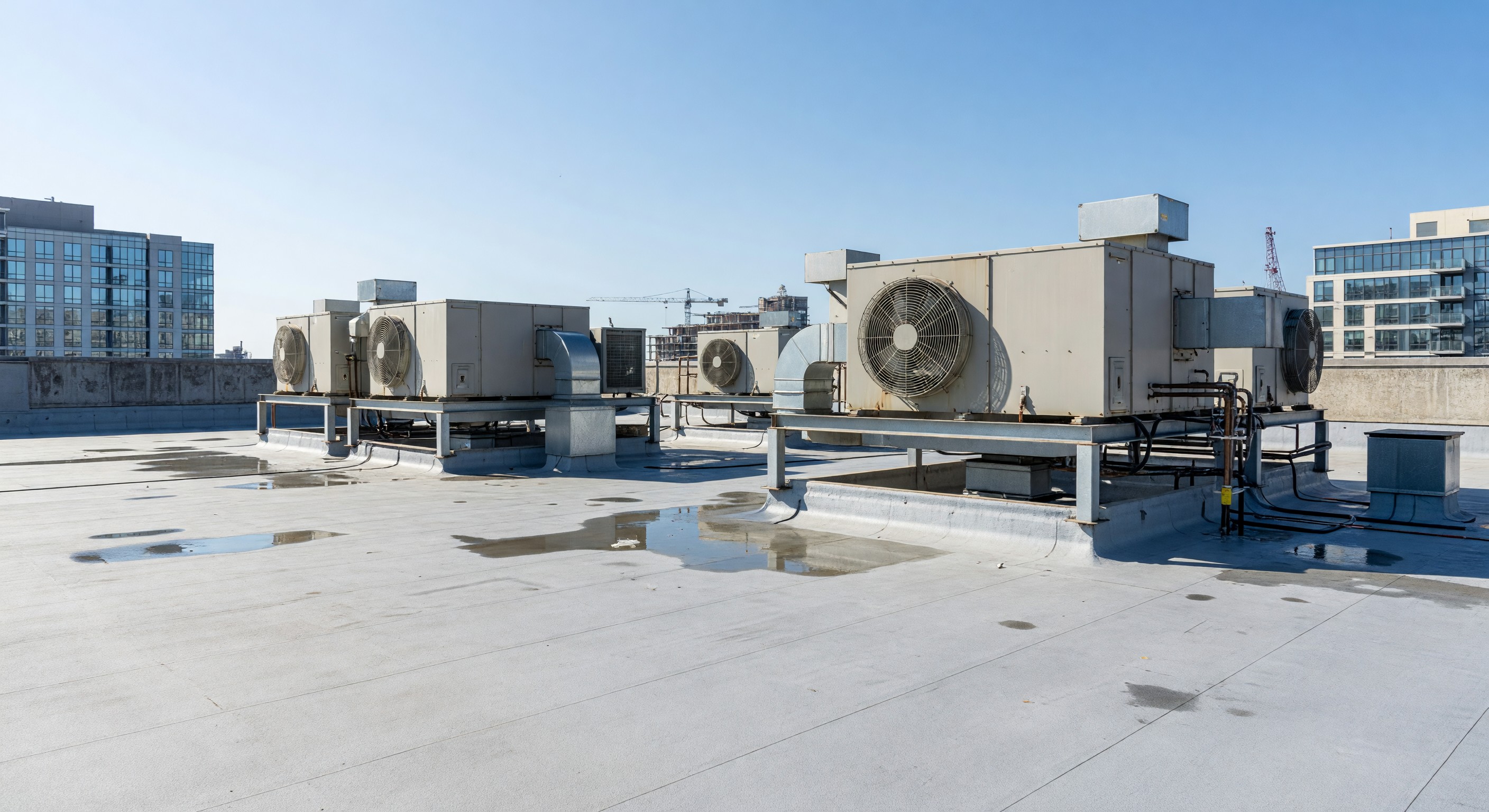
- Rooftop equipment footprint and attachment
- Infrared scan recommendation (if moisture intrusion is suspected)
Infrared thermography: An infrared scan of the roof at dusk can identify areas of wet insulation beneath the membrane — wet insulation retains heat and appears as warm spots in the IR image, while dry insulation cools quickly. This is the best diagnostic tool for identifying subsurface moisture intrusion that isn’t yet visible from above or below.
Maintenance Best Practices
Regular Maintenance Tasks
After every significant rainfall: Walk the roof to identify and clear any drain blockages. Ponding water on a flat roof that remains more than 48 hours after rain indicates a drainage problem that stresses the membrane.
Semi-annual: Full rooftop walkthrough. Clear all drains, gutters, and scuppers. Remove any debris from the roof surface. Inspect visible membrane, flashings, and penetrations for obvious changes since the last inspection. Check that HVAC equipment hasn’t shifted or caused membrane damage.
Annual: Professional inspection (per above). Inspect and clean roof drains internally (from inside the building at the drain body, not just clearing the strainer on top). Check and reseal any sealant joints that show cracking or separation.
After any rooftop trade work: Inspect the roof immediately after any non-roofing contractor completes work on the roof. Tool drops, equipment dragging, and foot traffic from untrained workers are common sources of membrane punctures.
Leak Identification and Source Location
A common challenge: water appears inside the building, but the entry point on the roof is not directly above the wet area. Water travels on structural members, insulation, and decking before it appears as an interior wet spot.
When tracing a leak:
- Identify the interior wet spot location precisely
- Don’t assume the roof leak is directly above — trace the moisture path (which direction does structural steel run? what slope does the deck have?)
- Look for the actual roof penetration or failure point in the area where water could have entered
- Engage a professional roofer with leak detection experience — they use probing tools, moisture meters, and sometimes electronic leak detection to locate the actual entry point
Electronic leak detection: For flat membrane roofing, electronic leak detection systems (low-voltage scanning or vector mapping) can identify the exact point of membrane failure without invasive probing. Worth the cost when the leak source is elusive or when significant interior damage warrants certainty about the repair location.
Roof Asset Management and Capital Planning
Tracking Roof System Age and Condition
Maintain a record for every roof section that includes:
- Roof system type and manufacturer
- Installation date and warranty information (manufacturer warranty and installer workmanship warranty)
- Documented condition ratings from each professional inspection
- History of repairs, with dates and locations
If the property has multiple roof sections of different ages or types (which is common after multiple renovation phases), this tracking system is essential to understanding the overall roof asset profile.
Roof Condition Ratings
Use a standardized condition rating system in your inspection records:
- Good (1–2): Membrane in excellent condition, minimal wear, no active concerns
- Fair (3–4): Moderate wear, some maintenance items, limited remaining life
- Poor (5–6): Significant deterioration, multiple problem areas, repair approaching the cost-effectiveness threshold for replacement
- Critical (7–8): Active leaks, severe deterioration, replacement required
Repair vs. Replacement Decision
The general rule of thumb: when annual maintenance and repair costs exceed 25–30% of the replacement cost, replacement is usually more economical. Additional factors that favor replacement over continued repair:
- Wet insulation identified under more than 25% of the roof area (infrared survey)
- Membrane is at or beyond its rated life
- Repeated failures at repaired locations
- Brand renovation requirement creates a practical opportunity to replace
Roof Replacement Capital Planning
Budget significant time for roof replacement capital planning:
- Professional assessment 2–3 years before anticipated replacement
- Specification development by a roofing consultant (not the contractor who will bid the work)
- Competitive bidding from qualified roofing contractors
- Manufacturer warranty registration and inspection requirements
Roof replacement for a 100,000 sq ft hotel property (common for a 200-room mid-rise) runs $400,000–$800,000 depending on system type, condition of the substrate, and rooftop complexity (HVAC equipment, penetrations, etc.).
FAQ
How do we prevent other contractors from damaging the roof membrane? Establish a rooftop access protocol: any contractor requiring roof access must be accompanied by engineering staff or must sign an acknowledgment of the roof access rules (no dragging equipment, protection over the membrane when equipment is being positioned, no uncovered sharp objects). Inspect the roof immediately after every contractor visit.
When should we add a new roof system over an existing one (recover) vs. tearing off and replacing? Recover is appropriate when: the existing membrane is in poor condition but the insulation and substrate are dry and sound, and local code and the roof deck structure allow an additional layer. Tear-off and replacement is required when: wet insulation is present (recovering traps moisture), the deck structure needs inspection or repair, or the existing system is already a recover of a previous roof (most codes limit to two roof systems stacked).
How important is the roofing contractor’s experience? Critical. Roofing is a trade where contractor quality variation is extreme. A well-specified roof installed by an inexperienced contractor will fail prematurely. Require that the contractor has specific experience with the system type you’re specifying, is approved by the membrane manufacturer for warranty purposes, and can provide references from similar hotel roofing projects.
Should we get an extended manufacturer warranty? For new roof installations, a 20-year NDL (No Dollar Limit) manufacturer warranty is the standard to target for full-service and upscale hotels. NDL warranties cover repair costs without a cap on the dollar amount, which is more meaningful protection than standard warranties with dollar limits. The manufacturer warranty requires using approved materials and certified contractors.
Further Reading from Authoritative Sources
- IFMA roof asset management and capital planning guidance — IFMA provides facility management professionals with roof asset management standards, lifecycle planning frameworks, and capital budgeting guidance applicable to hotel roofing programs.
- DOE cool roofing and building envelope resources — The DOE Buildings program provides technical guidance on cool roofing systems, building envelope performance, and energy-efficient roof specifications applicable to hotel roof maintenance and replacement decisions.