Indoor air quality has moved to the forefront of hotel operations since COVID-19 raised guest awareness of airborne health risks. What was once a background operational requirement is now a topic guests ask about directly and rate on. For facility managers, the challenge is managing IAQ systematically across a complex property where sources of poor air quality can come from HVAC deficiencies, building materials, guest behavior, cleaning chemicals, and a dozen other sources.
This guide covers the major IAQ parameters hotels should monitor, common sources of IAQ problems, and the management practices that maintain acceptable indoor environments.
What Indoor Air Quality Means for Hotels
IAQ encompasses several distinct parameters, each with different sources and management approaches:
CO2 (carbon dioxide): The product of human respiration. In occupied spaces, CO2 concentration rises when ventilation is insufficient to dilute the CO2 that people exhale. High CO2 concentrations (above 1000–1200 ppm) cause drowsiness, reduced concentration, and complaints. CO2 is the most accessible IAQ indicator because low-cost sensors are readily available.
VOCs (volatile organic compounds): Chemicals that evaporate at room temperature from cleaning products, paints, furniture off-gassing, carpeting adhesives, and other building materials. VOCs include a wide range of compounds with varying toxicity. New construction and renovation create elevated VOC environments that require enhanced ventilation.
Particulate matter (PM): Airborne particles of various sizes. PM2.5 (particles under 2.5 microns) is the most health-relevant fraction. Sources: outdoor air pollution, combustion (cooking, candles), dust resuspension, and biological particles. HVAC filtration is the primary control.
Relative humidity: Both too low (under 30%) and too high (above 70%) create IAQ problems. Low humidity causes respiratory irritation and increased viral transmission risk. High humidity promotes mold growth and biological contamination.
Biological contaminants: Mold, bacteria, dust mites, and other biological agents. Mold is the most common hotel IAQ biological concern and the one with the most regulatory and liability implications.
Carbon monoxide (CO): A combustion byproduct that’s odorless and colorless. Sources in hotels: combustion HVAC equipment, parking structures, and backup generators. Lethal at high concentrations; code-required CO detectors are the primary protection.
Ventilation as the Foundation of Hotel IAQ
Adequate ventilation — the delivery of sufficient outdoor air to occupied spaces — is the foundation of hotel IAQ. Most IAQ problems can be traced in some way to inadequate ventilation.
Minimum Ventilation Requirements
ASHRAE Standard 62.1 (Ventilation for Acceptable Indoor Air Quality) specifies minimum outdoor air delivery rates for different occupancy types. For hotel applications, key requirements:
- Guestrooms: 0.06 CFM/sq ft + 5 CFM/person (typically 2 people/room)
- Lobbies: 0.06 CFM/sq ft + 7.5 CFM/person
- Meeting rooms: 0.06 CFM/sq ft + 7.5 CFM/person
- Fitness centers: 0.06 CFM/sq ft + 20 CFM/person
These are minimums — properties with specific IAQ goals or in markets with air quality concerns may target higher ventilation rates.
Demand-Controlled Ventilation (DCV)
DCV uses CO2 sensors to modulate outdoor air delivery based on occupancy. When a meeting room is empty, the CO2 concentration is near outdoor levels and the system reduces outdoor air delivery. When the room fills with people, CO2 rises and the system increases outdoor air delivery.
DCV is an energy efficiency measure that also ensures adequate ventilation when it’s actually needed. The alternative — fixed minimum ventilation regardless of occupancy — either under-ventilates occupied spaces or over-ventilates empty ones.
COVID-19 guidance recommended temporarily disabling DCV to maintain maximum ventilation. As the acute pandemic phase has passed, the question of whether to restore DCV or maintain elevated ventilation is a property-specific decision based on your ventilation system capacity and energy cost.
Air Filtration in Hotel HVAC
Filtration removes particles from recirculated air before it’s delivered to occupied spaces. As discussed in the COVID-era HVAC article, MERV ratings determine filtration efficiency.
Recommended Filtration Standards (2023)
Post-pandemic, the industry has largely settled on MERV-11 or MERV-13 as the target for hotel HVAC systems that can support it. Key considerations:
Central AHU systems: MERV-13 is achievable in most central air handling units designed for commercial applications. Verify that the system’s fan can deliver adequate airflow against the higher static pressure of MERV-13 filters.
PTAC units: Most PTAC units are designed for low-MERV filters (MERV-4 to MERV-8). Check the manufacturer’s specification before upgrading to higher-MERV filters — restricted airflow reduces capacity and can cause problems.
Fan coil units: Typically use low-efficiency filters (MERV-6 to MERV-8) at the return air grill. Upgrading FCU filter efficiency is possible but requires verification of airflow capacity.
Filter Maintenance
Filter maintenance discipline is the most common IAQ management gap in hotels. Filters installed on a regular schedule but monitored only by their calendar date can become severely loaded — reducing airflow and allowing bypass around the filter media — without anyone noticing.
Add differential pressure monitoring across filters in air handling units to detect when filters are loaded regardless of the calendar schedule. High differential pressure = loaded filter = replace now.
Mold Prevention and Management
Mold is the IAQ biological contamination that creates the most hotel guest complaints and the most liability exposure.
Prevention: Controlling Moisture
Mold requires moisture. The most effective mold prevention is moisture control:
Humidity management: Keep indoor relative humidity below 60% in all occupied areas. Above 60%, the risk of mold growth on porous surfaces increases substantially. Monitor humidity in guestrooms, laundry areas, and any area prone to elevated moisture.
Water intrusion response: Any water intrusion — from roof leaks, plumbing failures, HVAC condensate issues, or exterior moisture — must be dried within 24–48 hours to prevent mold establishment. Establish a water intrusion response protocol that includes immediate notification, rapid drying, and documentation.
HVAC condensate management: The cooling coils in AHUs and PTAC units produce condensate. If condensate pans overflow, drain lines clog, or condensate leaks occur, moisture spreads to areas where mold can establish. Monthly inspection of condensate pans and drain lines is essential.
Bathroom ventilation: Bathrooms are high-humidity environments. Exhaust fans must be properly sized and maintained to remove moisture before it can accumulate on surfaces. Test exhaust fan airflow annually.
Window and exterior seal maintenance: Failed window seals, deteriorated weatherstripping, and compromised exterior caulk allow moisture infiltration. Include window seal inspection in the annual exterior building inspection.
Identifying Mold
Visual mold identification is the most straightforward approach — if you see mold, you have mold. Less obvious are:
- Musty odors without visible mold (mold may be hidden behind walls, under carpeting, or in HVAC systems)
- Water staining that may indicate historical moisture even if currently dry
- Dark or discolored grout that may be mold rather than dirt
When mold is suspected but not visible, air or surface sampling by a qualified industrial hygienist can confirm its presence and identify the species.
Mold Remediation
When mold is found, remediation follows protocols based on the area affected:
Small area (under 10 sq ft): Trained hotel staff with appropriate PPE (N95 minimum, disposable gloves and coveralls) can remediate surface mold using HEPA-filtered vacuums and appropriate biocidal cleaner.
Medium area (10–100 sq ft): Typically requires a professional remediation contractor and containment to prevent spore spread.
Large area (over 100 sq ft) or any hidden mold within walls: Always requires professional remediation with full containment, HEPA air filtration, and post-remediation clearance testing.
Guestroom mold: Take the room out of service immediately until remediation is complete and post-remediation sampling confirms clearance.
IAQ Monitoring Technology
CO2 Monitors
Low-cost CO2 sensors ($100–$300) provide continuous measurement that can be used for both ventilation management (if integrated with HVAC controls) and IAQ documentation. Deploy in high-occupancy areas: lobby, fitness center, meeting rooms.
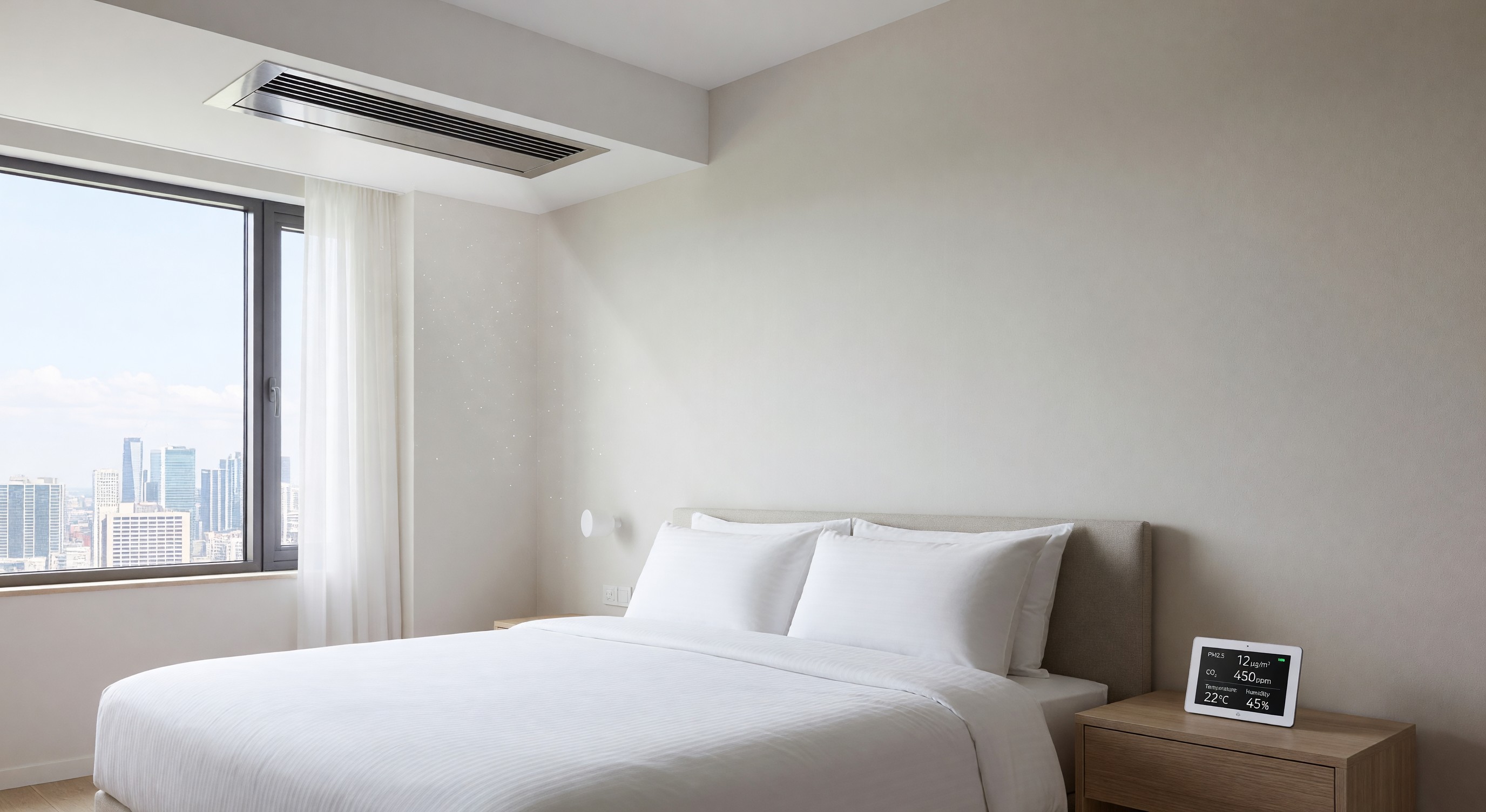
Guestroom CO2 monitoring is valuable as part of a smart room system — high CO2 in a guestroom indicates either insufficient ventilation or the HVAC is not delivering outdoor air properly.
Multi-Parameter IAQ Monitors
More sophisticated monitors measure CO2, VOCs, PM2.5, humidity, and temperature simultaneously. These provide a more complete IAQ picture and are appropriate for:
- Meeting rooms where air quality directly affects event quality
- Fitness centers with high breathing rates
- Any area with IAQ complaints history
Cloud-connected monitors: Many current IAQ monitors transmit data to cloud platforms for logging and alert generation. This enables trend analysis (is air quality consistently poor in a specific area at a specific time?) that discrete spot measurements can’t provide.
Communicating IAQ Practices to Guests
Guests who are aware of a hotel’s IAQ practices are more likely to book and to view their experience positively. Effective communication:
- Post filter replacement records or current filter specifications on request
- Include air quality measures in the property’s sustainability or wellness communication
- For meeting spaces, consider displaying real-time CO2 concentration on a small display (many corporate clients view this favorably)
- Brief front desk staff on the property’s ventilation and filtration standards so they can answer guest questions accurately
FAQ
How often should we replace air filters in central HVAC systems? MERV-11 and MERV-13 filters in central AHUs should be replaced when the pressure differential across the filter section indicates loading — not simply on a calendar schedule. Typical replacement frequency is every 3–6 months depending on outdoor air quality and occupancy. Properties in high-particulate environments (near construction, heavy traffic) will need more frequent replacement.
What do we do if a guest complains about odors in their room? Investigate immediately: check the HVAC function (odors from HVAC indicate a system issue or duct contamination), check for visible mold in the bathroom and HVAC unit, check whether the room is below or adjacent to a source (kitchen, loading dock, smoking area). If no source is identified, offer a room change and take the original room out of service for inspection.
Should we test guestroom air quality routinely? Routine air quality testing is not standard practice in most hotels. Targeted testing is appropriate when: there are persistent guest complaints about air quality in specific rooms or areas, there’s been a water intrusion event that might have caused mold, or there’s a building renovation generating VOCs or dust. For routine operations, maintaining proper ventilation, filtration, and humidity control is more effective than reactive testing.
What ventilation standard should we use for a hotel fitness center? ASHRAE 62.1 requires 20 CFM/person for exercise facilities. At typical fitness center occupancy, this requires significantly more outdoor air delivery than a guestroom or office. Test whether your fitness center HVAC can actually deliver this rate — many fitness center HVAC systems are inadequate for the occupancy and exercise intensity they serve, resulting in elevated CO2, humidity, and VOC concentrations.
Further Reading from Authoritative Sources
- ASHRAE Standard 62.1 ventilation for acceptable indoor air quality — ASHRAE 62.1 is the primary standard governing ventilation requirements in commercial buildings including hotels and is the benchmark for IAQ compliance and design.
- CDC mold remediation and indoor air quality guidance — The CDC provides authoritative guidance on mold remediation protocols, health effects of indoor air contaminants, and building-related illness prevention applicable to hotel facilities.