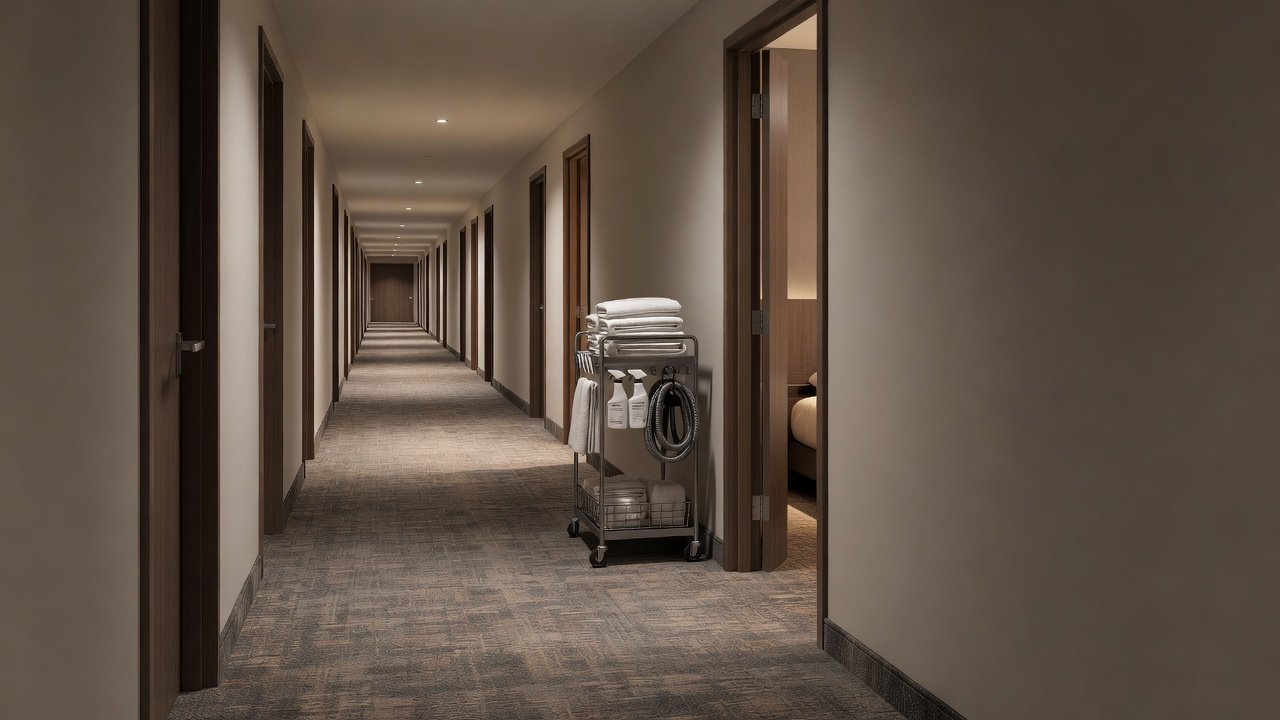
A housekeeper working a guest floor alone is, for most of her shift, out of sight of every other employee in the building. That isolation is the risk that employee safety devices were designed to close, and over the past decade the response has moved from a voluntary industry pledge to a patchwork of state and city laws with their own coverage rules, device standards and penalties. A property that bought buttons in 2019 to satisfy a brand commitment may not meet the law that now applies to it.
Where the 5-Star Promise came from
In September 2018 the American Hotel & Lodging Association and 17 hotel brands announced the 5-Star Promise, with the chief executives of Hilton, Hyatt, IHG, Marriott and Wyndham at the announcement. The pledge committed participating companies to provide employee safety devices to U.S. hotel workers and to strengthen the policies and training around sexual harassment and assault prevention.
By October 2019 AHLA reported a 230 percent increase in participation, with 56 hotel companies signed on, and said devices were already deployed in markets including New York, Washington, Chicago, Seattle and Miami Beach. The stated goal was nationwide implementation by 2020.
Two points matter for a facility team today. First, the promise is a voluntary commitment made at the company and brand level; it does not define what a compliant device is, how fast someone must respond, or what records must be kept. Second, the jurisdictions that have legislated since then have each written those details themselves, and they do not match.
The laws: who requires what
Seattle and Chicago: the early city ordinances
Seattle was first. Its hotel employee protections, codified at Seattle Municipal Code Chapter 14.26, require hotel employers to supply panic buttons to employees who work in or deliver to guest rooms. The city’s own comparison chart lists the ordinance as covering hotels with 60 or more rooms.
Chicago followed with the Hotel Workers Sexual Harassment Ordinance, widely known as “Hands Off Pants On,” passed by City Council on October 11, 2017 and in effect July 1, 2018. It requires hotels to give portable devices, at no cost, to employees assigned to work alone in guest rooms or restrooms, and to maintain a written anti-harassment policy that lets a worker stop work, leave the area and be reassigned away from the guest involved. Retaliation for using the device or reporting is prohibited.
New Jersey: a statewide mandate by room count
New Jersey requires the devices under a 2019 law covering hotels with 100 or more guest rooms that took effect in January 2020. It requires panic devices for employees assigned to guest rooms without other workers present, and adds duties around reporting alleged crimes to police and keeping records of guest accusations.
Illinois: hotels and casinos
The Illinois Hotel and Casino Employee Safety Act (820 ILCS 325) requires hotel and casino employers to provide a safety or notification device, at no cost, to employees who work alone in guest rooms, restrooms or casino floors, so they can summon help when they reasonably believe there is an ongoing crime, harassment, assault or other emergency. The statute’s source note gives an effective date of March 1, 2021 for the device article; it had originally been set for July 2020 and was moved back. Employers must also maintain a written anti-sexual-harassment policy, and the law provides a private right of action with a notice-and-cure period.
Washington: the isolated-worker law, amended for 2026
Washington’s RCW 49.60.515 and its implementing rules in Chapter 296-137 WAC cover isolated janitors, housekeepers and room service attendants at hotels and motels, as well as retail and security employers and property services contractors. Amendments effective January 1, 2026 tightened the device criteria, training and recordkeeping obligations and added civil penalties that, per a Seyfarth Shaw summary, start at $1,000 per willful violation and run from $2,000 to $10,000 for repeat willful violations. Because Washington’s version is now the most prescriptive about how the system has to perform, it has its own article: Washington State’s 2026 Panic-Device Spec (WAC 296-137): Facility Checklist Beyond ‘We Bought Buttons’.
New York City: tied to the hotel license
New York City’s Safe Hotels Act, signed November 4, 2024 and effective May 3, 2025, created a hotel licensing requirement. Among its conditions, operators must provide panic buttons at no cost to core employees whose duties involve entering occupied guest rooms, and the device must let the worker alert security or another on-site person and share their location. Because compliance is a licensing condition, a gap here is a license problem, not only an employment-law exposure.
California and pending bills
California has no statewide hotel panic-button mandate, but a number of cities, including Los Angeles and Long Beach, have local hotel worker protection ordinances with device requirements. Each has its own room-count threshold and definitions, so verify the text for the specific city. In Hawaii, bills introduced in the 2026 session (SB2968 and HB2405) would require portable panic buttons and annual training for room-cleaning staff; check their status with the legislature before treating them as law.
What the laws have in common
Read side by side, the requirements cluster around five elements:
- Who gets a device. Usually employees who work alone in guest rooms: housekeepers, room attendants, room service and, in some places, janitorial and security staff. Several laws extend to contracted or temporary workers doing the same work.
- What the device must do. Summon on-scene help from a supervisor, security officer or other designated responder, and in the more recent laws, identify where the worker is.
- No cost to the worker. Every law listed above puts device cost on the employer.
- A written policy. Most pair the device with an anti-harassment policy that covers reporting, investigation and protection from retaliation.
- Records. Training completion and, in Washington, purchase and use records that the state can request.
Building a program that survives a change in the law
For properties without a device program, or with one bought to a 2018 brand standard, the practical sequence is the same regardless of jurisdiction.
Start with the strictest rule that applies. A property in Seattle answers to the city ordinance and to Washington’s state law. A property in Chicago answers to the city ordinance and the Illinois Act. Build to the higher bar.
Specify the system, not the button. Location accuracy is the part that fails in the field. Fire stairs, service elevators, back corridors, parking structures and outbuildings are where signal-based systems lose coverage, and they are also where an isolated employee can be at the most risk. Include a coverage survey of every space a covered employee enters in the procurement scope, and test it on every shift, not once at commissioning.
Name the responders by shift. A device that alerts a manager who has left for the night does not summon help. Map who receives alerts on each shift and confirm they are on duty, not on a break.
Keep the evidence. Purchase records, device assignment, battery and maintenance logs, activation records, response times and training sign-offs. Washington already requires several of these; elsewhere they are what you will want in hand if an incident leads to a complaint or lawsuit.
Tie it to the wider program. Devices are one control within a broader approach to hotel workplace violence prevention, which covers risk assessment, staffing and incident response.
The brands made the promise; the jurisdictions are now writing the specification. Treat any device system bought before 2025 as due for a compliance review against the current law where the property sits, starting with location accuracy and response coverage on the overnight shift.