Parking wayfinding is a guest experience component that receives attention only when it fails. When guests miss the parking entrance on the first pass, circulate a parking structure unable to find an empty space, or end up in the wrong parking area entirely, the frustration colors their initial impression of the property. Effective parking signage and wayfinding is invisible when it works — guests navigate effortlessly to their space — and very visible when it doesn’t.
Designing and maintaining effective hotel parking signage is a collaboration between facility management (maintaining the physical signage), operations (keeping information current and accurate), and marketing (ensuring brand expression in the guest-facing environment).
Wayfinding Hierarchy: From Street to Space
Effective parking wayfinding follows a layered hierarchy — each sign at the appropriate decision point:
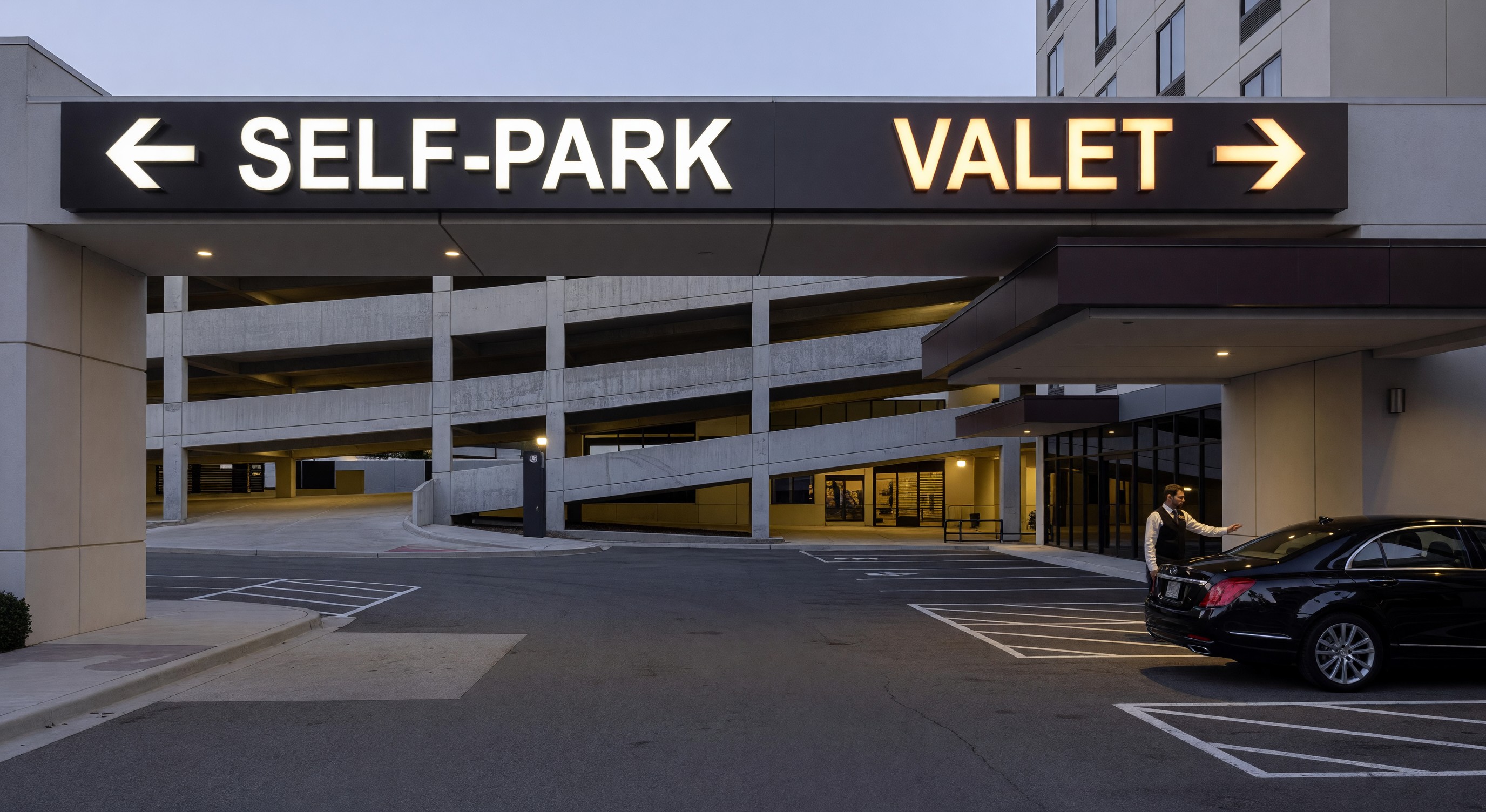
Street-level approach signage: Visible to approaching vehicles from a distance (50–100+ meters at street speeds), directing guests toward the property. This may be the hotel’s primary entrance identification sign, with “Parking” or “Self-Park / Valet Entrance” directional notation. Where the parking entrance is not co-located with the main vehicle entrance, separate directional signage from the main road is required — guests should not pass the property looking for the parking entrance.
Entry point identification: At the entrance to the parking area, clear identification of the facility (parking structure, surface lot), access type (self-park, valet, hotel guests, public), and any access control requirements (take ticket, use key card, license plate recognized automatically). For LPR-equipped properties, signage explaining the automated entry process reduces confusion for first-time visitors.
In-structure navigation: Within a parking structure, signs at each decision point (ramp entrances, level transitions, exit confirmation) guide guests efficiently. Level identification is particularly important — guests who can’t reliably return to their level will be frustrated at departure even if arrival was smooth.
Space availability guidance: In larger parking facilities, real-time space availability guidance (green/red lights over individual spaces, or floor-by-floor count displays at entry to each level) dramatically reduces the time guests spend searching for a space — and improves lot utilization by distributing vehicles across available spaces rather than concentrating demand on the first accessible level.
Pedestrian egress: After parking, wayfinding should guide guests from their vehicle to the hotel entrance — directional signs, clearly marked elevator and stair access, and external wayfinding to the hotel entry point if the parking facility is not directly connected.
Signage Types and Technology
Static exterior signs: Illuminated exterior identification and directional signs provide the first brand impression in the parking approach. Illuminated channel letter or cabinet signs ensure visibility at night. Brand standards typically govern sign design at franchised properties — verify compliance before fabricating.
Interior static signage: Internally illuminated signs within parking structures provide consistent visibility in the variable lighting conditions of parking facilities. Retroreflective backgrounds on non-illuminated signs improve visibility in lower light areas.
Dynamic count displays: LED displays that show available spaces on each level in real time require a space sensing system (ultrasonic sensors or magnetic sensors at individual spaces, or loop detectors at level entry counting incoming and outgoing vehicles). Level-by-level count displays are standard in urban parking structures; individual space guidance is a premium feature at full-service resort and urban hotel facilities.
Digital wayfinding screens: Touchscreen or motion-sensor-activated displays at elevator lobbies or pedestrian entry points within parking structures display facility maps, directions to the hotel entrance, and EV charging locations. Digital screens allow information updates without sign replacement.
Mobile integration: For hotels with LPR-integrated parking systems, the hotel’s app can provide turn-by-turn directions to the parking entrance, confirm the guest’s vehicle was recognized, and display real-time available space counts. App-based wayfinding is increasingly standard at full-service and luxury properties.
Maintenance Responsibilities
Parking signage maintenance falls primarily to facility management:
Illumination: Burned-out light sources in illuminated signs create both wayfinding failures and brand presentation failures. Include parking sign illumination in engineering weekly rounds — identify and address burned-out lamps or LED modules promptly.
Clarity and readability: Signs accumulate dirt, weathering, and damage over time. Annual cleaning of exterior signs and quarterly inspection for damage maintains readability. Retroreflective sign faces that have faded below useful reflectivity should be replaced.
Information currency: When operational changes occur (parking rate changes, access policy changes, construction that affects traffic flow), signage must be updated concurrently. Outdated signage is a trust and experience failure — a sign promising a rate different from what the guest is charged creates complaints.
Damage repair: Vehicle impact damage to parking signage (particularly low-clearance warning signs and structural column markers in parking structures) is common. Damaged signs should be replaced promptly — both for guest communication and for liability documentation (a vehicle that damages a structural element after missing a faded clearance sign creates a liability exposure).
Modern parking technology platforms increasingly integrate wayfinding capabilities with barrier gate and access control systems — connecting the physical entry experience with digital guidance for a seamless guest arrival sequence.
Frequently Asked Questions
What is the most common hotel parking wayfinding failure? The most common failure is ambiguity at the first approach decision point — the guest arrives near the hotel and cannot clearly identify where to drive for parking. This happens when the parking entrance is set back from the street, when the hotel’s main entrance is prominently marked but parking is not equally signed, or when valet and self-park compete for unclear priority at the entry point. The fix is always clearer, earlier signage — guests need to see their option before they’re past the decision point at road speed.
What minimum clearance height should hotel parking entrance signs show? Parking structures with limited vertical clearance must post clearance warnings at each entry point and at each ramp transition where the clearance restriction exists. Minimum signage: clearance height in feet and inches, posted at the entry lane overhead at the clearance-limiting point and 20–30 meters before the restriction so drivers have stopping distance. Low-clearance warning signs should be accompanied by physical warning devices (low-clearance bar or dangler) that contact high-profile vehicles before the limitation is reached. The legal minimum varies by jurisdiction; consult local signage codes for required specifications.
How should hotels communicate parking availability to guests before arrival? Pre-arrival parking information should be available through: (1) Hotel booking confirmation (parking options, prices, reservation link if available); (2) Pre-arrival email 24–48 hours before arrival (parking access instructions for LPR-equipped facilities, valet drop-off location, structure entry points); (3) Google Maps and Apple Maps business listings with parking information; (4) Hotel website directions page with clear parking instructions. Guests who arrive with a clear understanding of how parking works have better experiences and generate fewer wayfinding-related complaints and calls to the front desk.
Should hotels charge for parking signage upgrades in their capital planning? Yes — parking signage should be included in periodic capital planning cycles. Interior parking structure signage has a useful life of 7–10 years (before retroreflective material degrades and lighting technology becomes obsolete). Exterior entrance signs have longer physical lifespans but may need replacement when the property undergoes rebranding or significant renovations. Budget signage refresh as part of parking facility capital planning rather than treating it as a deferred maintenance item that’s addressed only when signs fail completely.
Further Reading from Authoritative Sources
- AHLA hotel guest arrival experience and parking communication standards — AHLA provides hospitality industry standards on guest arrival experience design, parking communication practices, and brand presentation guidelines applicable to hotel parking signage program planning and pre-arrival guest communication.
- HFTP hotel parking technology and wayfinding integration standards — HFTP provides hospitality technology professionals with parking system integration standards, digital wayfinding technology guidance, and connected parking experience frameworks applicable to hotel parking signage and technology program design.