ADA-compliant parking is not just a legal obligation — it reflects a hotel’s commitment to welcoming all guests equally. Yet hotel parking facilities are among the most frequently cited locations in ADA accessibility complaints and DOJ enforcement actions. Many accessible parking deficiencies are the result of design shortcuts during original construction, deferred maintenance that has degraded compliant surfaces, or simply unfamiliarity with what full ADA compliance actually requires.
For hotel facility managers and operators, this guide provides a practical overview of ADA parking requirements: space quantity and configuration standards, van-accessible requirements, signage, surface conditions, and the common compliance gaps that generate guest complaints and DOJ investigations.
ADA Parking Space Quantity Requirements
The ADA Standards for Accessible Design (2010 ADA Standards, Section 208) establish minimum numbers of accessible parking spaces based on total parking facility size:
| Total Spaces | Minimum Accessible Spaces |
|---|---|
| 1–25 | 1 |
| 26–50 | 2 |
| 51–75 | 3 |
| 76–100 | 4 |
| 101–150 | 5 |
| 151–200 | 6 |
| 201–300 | 7 |
| 301–400 | 8 |
| 401–500 | 9 |
| 501–1000 | 2% of total |
| 1001+ | 20 + 1 for each 100 over 1000 |
Hotels with medical outpatient facilities on the premises are subject to higher minimums (10% of spaces).
Of the total required accessible spaces, at least 1 in 6 must be van-accessible. For a 200-space hotel parking lot (6 accessible spaces required), at least 1 must be van-accessible. For an 800-space garage (16 accessible spaces), at least 3 must be van-accessible.
Van-Accessible Space Requirements
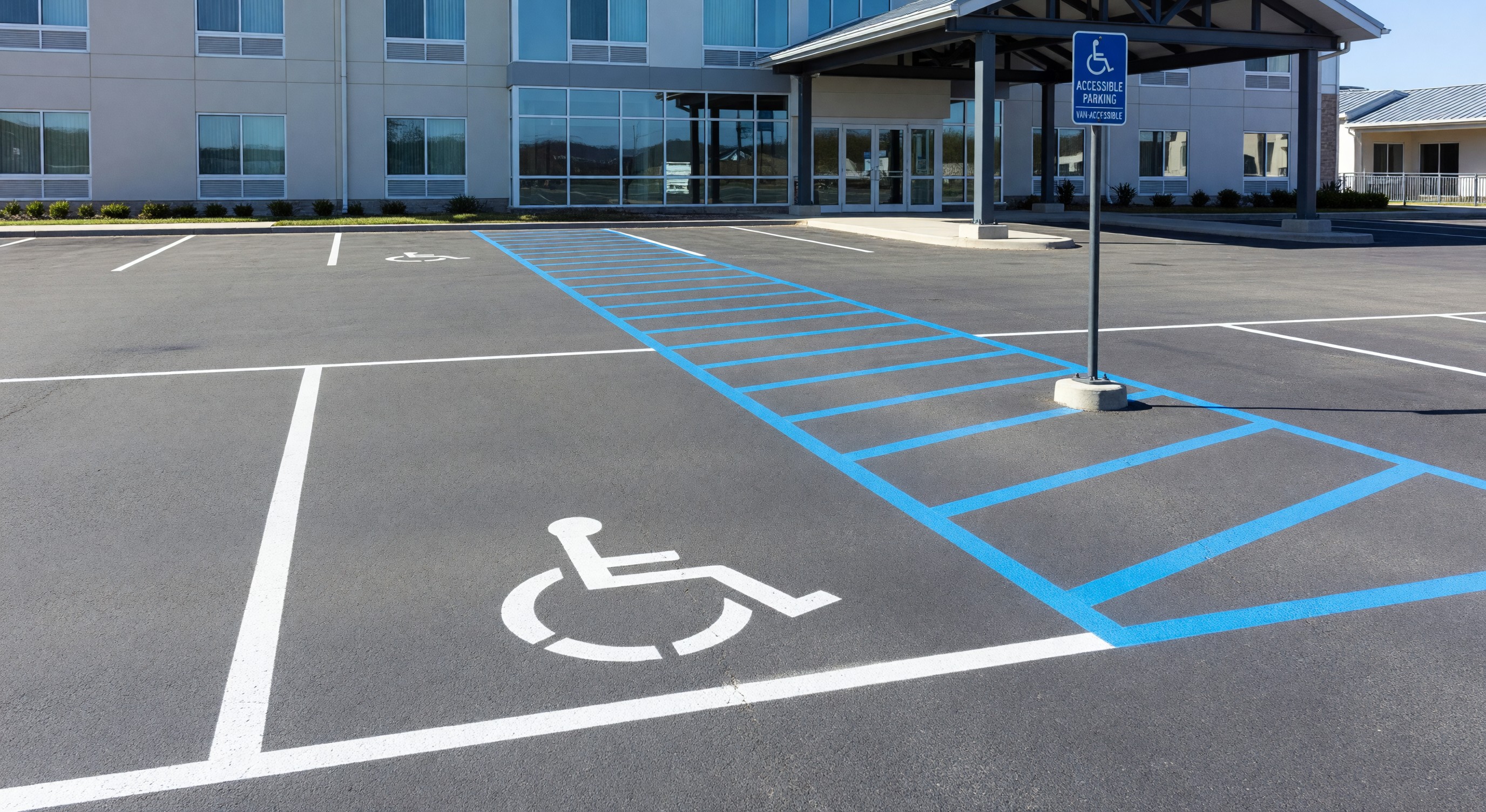
Standard accessible spaces require an 8-foot-wide space with a 5-foot-wide access aisle. Van-accessible spaces require:
- 11-foot-wide space with 5-foot access aisle, OR
- 8-foot-wide space with 8-foot access aisle
The access aisle must be level (maximum 2% slope in any direction), marked with hatching, and signed “No Parking.”
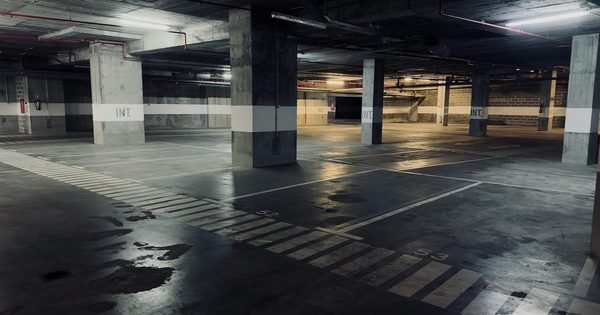
Vertical clearance in parking structures is critical for van-accessible spaces. Many guests with disabilities use vehicles equipped with roof-mounted lifts and raised rooflines. The ADA requires at least 98 inches (8 feet 2 inches) of vertical clearance throughout van-accessible routes, including at the parking level, at the vehicle entry point, and along the accessible route from parking to the hotel entrance.
This clearance requirement catches many hotels off guard — standard parking structures often have 7-foot-6-inch clearance that accommodates most vehicles but blocks vans with raised roofs from accessing accessible spaces.
Location and Route Requirements
Accessible parking spaces must be located on the shortest accessible route to the accessible hotel entrance. In practice, this means:
- Accessible spaces must be on the same level as the accessible building entrance (or with an elevator connection)
- The accessible route from parking to the entrance must not require traveling behind parked vehicles
- The route must be continuous, stable, firm, and slip resistant
- The route must have curb ramps or flush curb cuts wherever it crosses a raised curb
For surface lots, accessible spaces are typically required near the lobby entrance. For garages with multiple levels, accessible spaces should be located on the level with direct lobby access or at the nearest elevator to the lobby.
Hotels that have renovated their lobbies or changed their primary guest entrance without updating accessible parking location may be non-compliant even if the spaces themselves are properly configured.
Signage Requirements
Every accessible parking space must be marked with:
- The International Symbol of Accessibility (ISA) on a sign mounted 60–66 inches to the bottom of the sign (mounted high enough to be visible when a vehicle is parked in the space)
- Van-accessible spaces must have an additional sign reading “Van-Accessible” below the ISA
Common signage violations:
- Signs that have fallen over, faded, or been damaged and not replaced
- Signs mounted too low (visible only when the space is empty)
- Missing “Van-Accessible” signs on van-accessible spaces
- Faded pavement markings (the ISA stencil on the pavement is not required but is best practice and should be maintained if present)
Surface and Slope Requirements
Accessible parking spaces and access aisles must maintain:
- Slope: Maximum 2% (1:50) in any direction — both within the space and the aisle
- Surface: Stable, firm, and slip resistant — no significant cracks, heaving, or surface deterioration that would impede wheelchair users
Pavement maintenance is one of the most common accessible parking compliance failures. Concrete or asphalt surfaces that have heaved from tree roots, cracked from freeze-thaw cycles, or deteriorated from deferred maintenance may technically be marked as accessible spaces but fail to provide actual accessibility.
Annual inspection of accessible space surfaces and slopes is recommended. Any surface that fails the 2% slope standard or has deteriorated beyond stable/firm/slip-resistant must be repaired or taken out of accessible designation until corrected.
Common Compliance Gaps at Hotels
Based on DOJ enforcement actions and ADA compliance reviews at hotel properties, the most common violations include:
- Insufficient number of van-accessible spaces — many properties have the correct total count but fail to provide the 1-in-6 van-accessible ratio
- Inadequate vertical clearance for van-accessible spaces in garages
- Access aisle blocked or improperly marked — delivery vehicles, maintenance equipment, or other vehicles park in access aisles
- Surface slope exceeding 2% — often a result of pavement settling or heaving after original installation
- Non-accessible route from parking to entrance — broken pavement, missing curb cuts, or route that requires crossing traffic lanes
- Missing or damaged signage — signs that have fallen, faded, or were never installed
Enforcement and Liability
Hotels face ADA enforcement through multiple channels: DOJ investigations (triggered by complaints), private civil litigation by individuals, and disability rights organization audits. Common resolution includes both physical remediation and monetary damages. The cost of remediation after an enforcement action — which often involves court supervision and third-party monitoring — is substantially higher than proactive compliance investment.
Conduct an annual accessible parking audit using the ADA checklist available from the DOJ’s ADA website. Document the audit, address any deficiencies promptly, and maintain records of corrective action. Properties that demonstrate good-faith compliance efforts are treated more favorably in any subsequent enforcement context.
Frequently Asked Questions
Does an older hotel built before the ADA need to comply with accessible parking standards? Yes. The ADA requires removal of accessibility barriers at existing facilities when removal is “readily achievable” — meaning achievable without significant difficulty or expense. Accessible parking corrections are almost always considered readily achievable. Additionally, any renovation or alteration to the parking area triggers full ADA compliance for the altered area. Hotels that have not assessed their accessible parking compliance are at significant ongoing legal risk.
What is the difference between an accessible space and a van-accessible space? A standard accessible space is 8 feet wide with a 5-foot access aisle — sufficient for most users of wheelchairs and mobility devices who transfer from a standard vehicle door. A van-accessible space accommodates wheelchair lift-equipped vans, which require either an 11-foot-wide space or an 8-foot access aisle on the passenger side. The larger access aisle allows the lift to deploy fully without obstruction.
Who should hotels call if they’re unsure about their ADA parking compliance? Options include: a licensed architect with ADA expertise, a certified access consultant (CASP — Certified Access Specialist in California; similar programs in other states), or an accessibility consultant specializing in hospitality. The DOJ ADA website also provides free technical assistance and checklist resources. Do not rely solely on the original architect or the construction team — compliance should be verified by someone who understands current enforcement standards.
Are parking garages that charge fees subject to the same ADA requirements as free surface lots? Yes. ADA requirements apply regardless of whether parking is a paid or complimentary amenity, and regardless of whether the parking facility is owned by the hotel or operated by a third-party parking company. Hotels that contract parking operations to third-party operators remain legally responsible for ADA compliance at their facilities.
Further Reading from Authoritative Sources
- ADA parking facility accessibility standards and compliance resources — ADA.gov is the authoritative source for ADA Standards for Accessible Design, parking compliance requirements, DOJ enforcement guidance, and free technical assistance applicable to hotel accessible parking facility compliance assessment and remediation.
- US Access Board ADA parking design and technical standards — The US Access Board develops and maintains the ADA Standards for Accessible Design including parking facility technical requirements; its guidelines and technical bulletins are the primary reference for hotel accessible parking facility design and compliance verification.