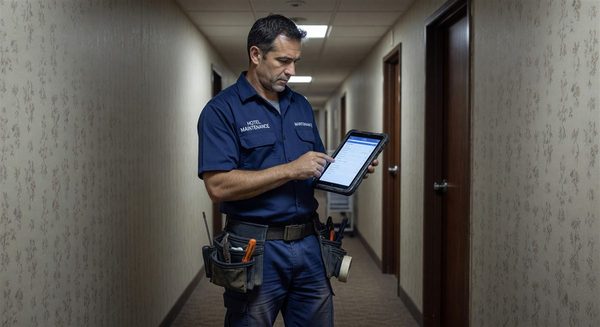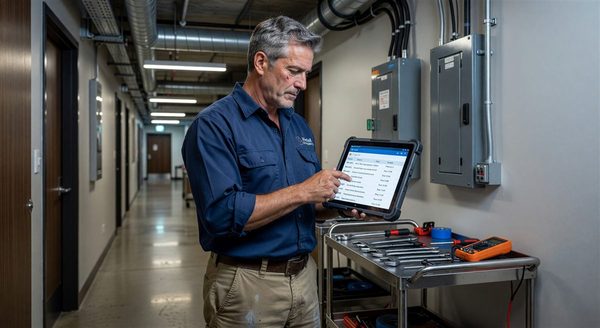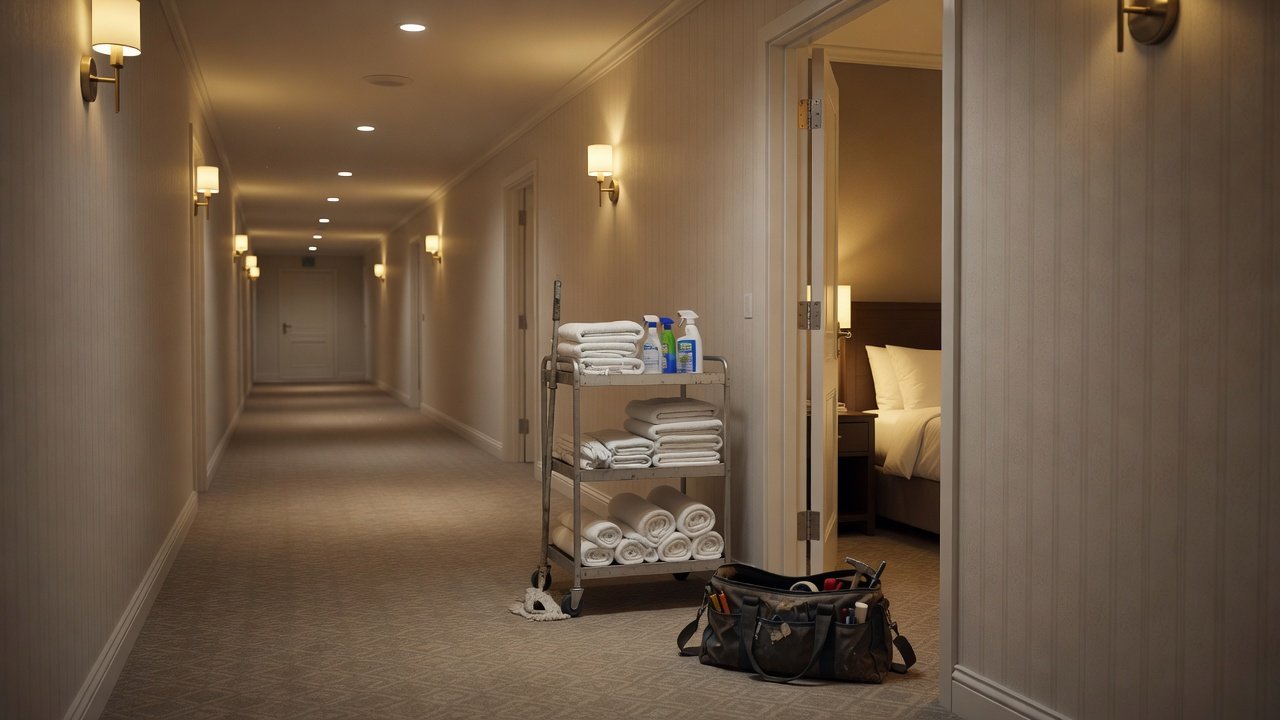
A housekeeper strips a room, finds the bathroom fan not running, and has three options. Tell the floor supervisor, who may or may not pass it on. Write it on a paper log that engineering checks at shift change. Or say nothing, because the last two things reported went nowhere and the room has to be turned in twenty-six minutes.
Every hotel engineering department knows this scenario and most treat it as a communication or discipline problem. It is neither. It is a workflow design problem, and the reason it persists is that the person who discovers the fault has no mechanism to create a work order and no feedback that one was created. Housekeeping is the largest fault-detection network in the building — staff who enter every room, every day, and look at it closely — and in most properties that network reports into a channel that loses things.
The Structural Fix
The design that resolves it is not more meetings. It is collapsing every request channel into a single intake that produces a timestamped, asset-linked, priority-classified work order regardless of who raised it.
In a properly configured system, the intake methods sit side by side and produce identical output: a housekeeping mobile submission, a front-desk web form, a guest-facing QR code in the room, an engineer’s self-report, and automated triggers from the PMS or building management system. What matters is not the number of channels but that they converge. A fault reported by a housekeeper on a phone and a fault detected by a BMS alarm should land in the same queue, in the same format, subject to the same escalation rules.
The moment that convergence exists, the housekeeper’s incentive changes. Reporting takes ten seconds rather than a conversation, and it produces a visible record. That is what turns the detection network on.
The PMS Link Is the Part Most Properties Skip
Bidirectional PMS integration is the difference between a maintenance system that records work and one that orchestrates it. The mature implementations connect to the major property management platforms — Oracle Opera Cloud, Guestline, and dozens of others — and the room status flows in both directions automatically.
The sequence that produces the value looks like this. Check-out triggers the housekeeping alert. Housekeeping finds the fault and submits it from the room. The work order is created and the room is flagged maintenance-in-progress in the PMS, which takes it out of the sellable pool without anyone calling the front desk. Engineering resolves it and clears the work order, which releases the room back to inventory — again, without a phone call.
Compare that with the manual version, where the same sequence involves a housekeeper telling a supervisor, a supervisor calling engineering, engineering deciding when to look, and the front desk either selling a room with a broken fan or holding a sellable room out of inventory because nobody confirmed it was fixed. The second failure mode is the expensive one and it is almost invisible on a P&L, because a room held out of inventory unnecessarily does not appear anywhere as a cost.
Priority Classification and the SLA Clock
The second orchestration decision is what happens after intake, and the useful pattern is that the clock starts at submission rather than at acknowledgement.
In systems configured this way, SLA timers begin the moment the work order is created and escalation alerts fire before the deadline is breached rather than after. Priority-one guest-safety issues route to a supervisor within about sixty seconds. Everything else runs against a defined response window appropriate to its class.
The behavioural effect is the point. When escalation is pre-emptive, a work order that is going to be missed announces itself while there is still time to reassign it. When escalation is retrospective — a report at the end of the week showing what was missed — the department learns about failures only after guests have.
Priority classification also protects engineering from the most common consequence of opening the intake floodgates. A property that suddenly lets every housekeeper create work orders and does not classify them gets a queue where a burnt-out lamp and a failed smoke detector look identical. Classification at intake, ideally driven by the fault category rather than by the reporter’s judgment, is what keeps the volume manageable.
What Changes Operationally
Three things shift once this is running, and it is worth setting expectations about all three.
Reported fault volume goes up, sharply, and this is a success signal that reads as a failure. The faults were always there; they were simply not reaching engineering. A department that interprets the spike as a new problem rather than as newly visible backlog will draw the wrong conclusion in month one. It is worth telling the general manager this before it happens.
The backlog becomes measurable and therefore arguable. A department that can show fault volume by category, by floor, and by asset has the basis for a capital request that a narrative cannot produce. Recurring faults on the same asset are the clearest possible evidence for replacement.
Housekeeping’s relationship with engineering changes. Closing the feedback loop — the reporter sees the work order closed — is what sustains reporting behaviour. Systems that accept reports but never confirm resolution back to the reporter see submission rates decay within a few months.
Getting There Without a Full Replacement
Not every property is in a position to replace its maintenance system, and the orchestration benefits do not all require that.
The sequence that works is to fix intake first. Give housekeeping a mobile submission path that reaches engineering directly, even if it is a simple one, and confirm resolution back to the submitter. That single change captures most of the detection benefit at minimal cost.
Add the PMS room-status link second, because that is where the revenue-side benefit lives and it is the piece that makes the front desk an advocate for the project rather than an obstacle.
Add SLA timing and escalation third. It has the least value on a small queue and the most on a queue that intake has already grown.
The properties that do this in the reverse order — buying the platform, configuring the SLAs, and then discovering that housekeeping still tells the supervisor — end up with sophisticated reporting on an incomplete picture. The detection network is the asset. Everything else is plumbing around it.