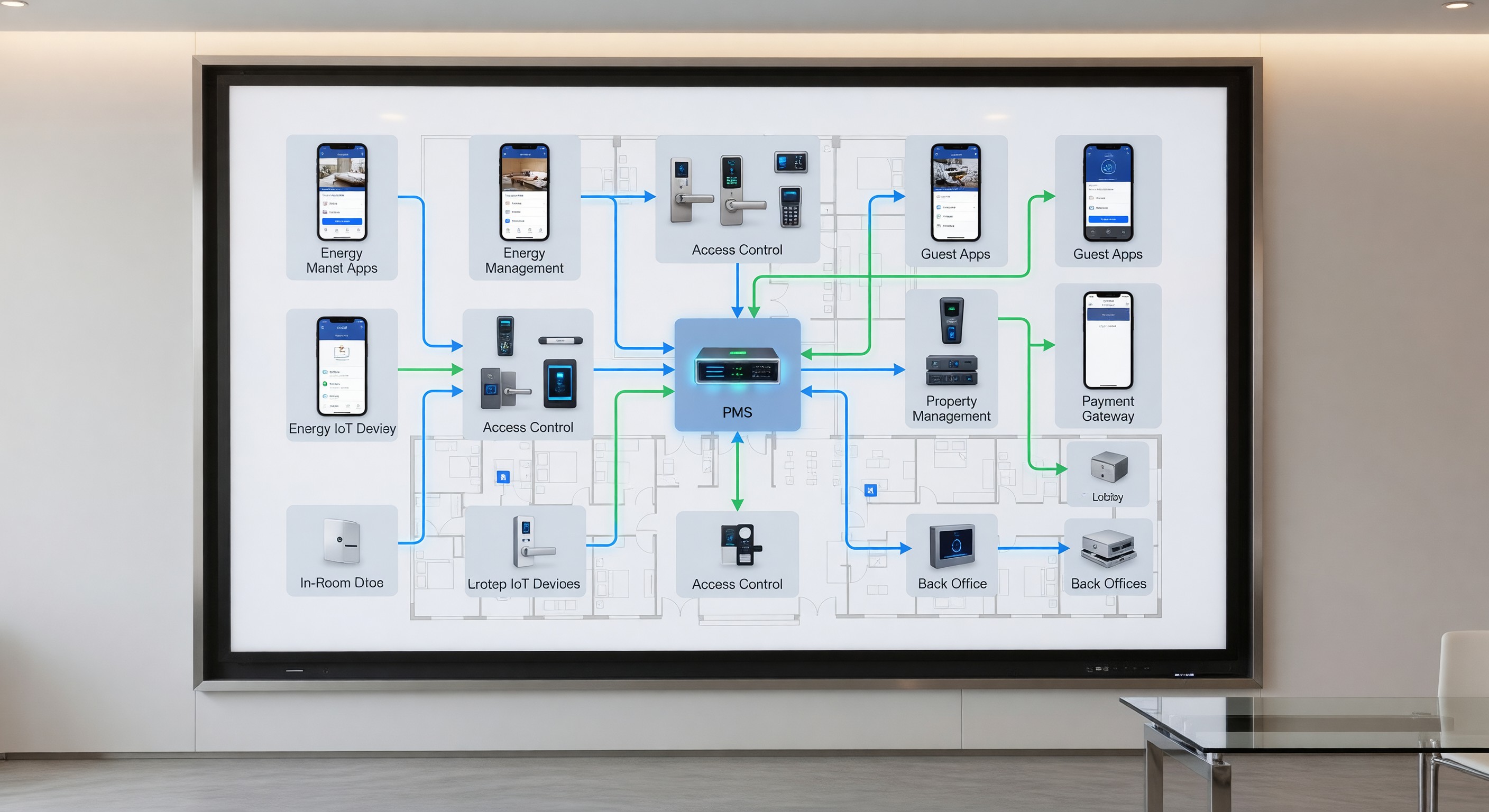
Modern hotel operations depend on a complex ecosystem of technology systems that need to share data and coordinate actions. The property management system (PMS) holds reservation and guest data. The access control system manages room keys. The parking management system controls gate access and folio posting. Guest messaging platforms communicate with guests. Building automation controls room environment. Revenue management calculates rates. Each system generates and consumes data that other systems need.
In 2026, the hotel technology integration challenge is less about whether these systems can be integrated and more about how to build integrations that are reliable, maintainable, and don’t create single points of failure.
The Core Integration Architecture
Hotel technology integration follows two fundamental patterns:
Direct API integration: System A makes API calls to System B to exchange data in real time. When a guest checks in, the PMS sends a check-in event to the access control system (via API), which activates the guest’s room key. When the guest checks out, the parking system sends a transaction to the PMS (via API), which posts the parking charge to the folio. Direct API integrations are the most reliable and the most current — data flows immediately without intermediary processing.
Middleware integration (iPaaS): A middleware platform (integration platform as a service) sits between systems, receiving data from System A, transforming it as needed, and passing it to System B. Middleware is used when direct API integration isn’t available (legacy systems without APIs), when data transformation is complex, or when multiple systems need to receive the same event from a single source. Hotel-specific iPaaS platforms include Hapi and Hotelier.ai; general-purpose platforms like MuleSoft or Zapier are also used for simpler integrations.
File-based integration: The legacy fallback — System A exports a file (CSV, XML) at defined intervals; System B imports the file. Common in older PMS ecosystems and for integrations with accounting systems. Lower real-time reliability but often the only option for older systems.
Priority Integrations for 2026
PMS ↔ Access Control: Bidirectional integration that activates room keys on check-in, deactivates on checkout, and updates key status when room changes occur. This integration is a standard offering from all major hotel lock vendors (ASSA ABLOY, dormakaba, Allegion) connecting to major PMS platforms (Opera Cloud, Mews, Cloudbeds, Maestro).
PMS ↔ Parking Management: Integration that recognizes hotel guests (by reservation lookup or license plate match) at the parking entry lane, enables seamless entry, and posts parking charges to the PMS folio at checkout. Hotels without this integration rely on manual parking charge posting or physical parking ticket exchange — both inferior guest experiences and less reliable revenue capture.
PMS ↔ Guest Messaging: Integration that triggers automated pre-arrival, arrival, mid-stay, and checkout messages with guest-specific data (name, room number, reservation details). Enables messaging platform staff to see PMS guest context when responding to messages.
PMS ↔ Revenue Management: Bidirectional data flow — PMS sends pickup data, historical occupancy, and current reservations to the revenue management system; revenue management sends recommended rates back to PMS for rate loading. Most modern RMS systems (IDeaS, Duetto, Atomize) maintain continuous real-time PMS sync.
BAS ↔ PMS: Check-in/checkout events from PMS trigger room preparation and setback sequences in the building automation system. Arriving guests receive a pre-conditioned room; departing guests’ rooms return to energy-saving setback mode without requiring manual thermostat adjustment.
Integration Reliability and Failure Handling
Integration failures are an underappreciated operational risk. When the PMS-to-access-control integration fails, check-ins may not activate room keys — creating front desk scrambles. When the parking integration fails, guests may be stuck at the gate or may not be recognized as hotel guests.
Graceful degradation: Well-designed integrations define fallback behavior when a connection fails. If the access control system cannot receive check-in events from the PMS, it should queue them for replay when connectivity is restored — not simply fail silently. If the parking system cannot verify a guest’s reservation in real time, it should allow entry and flag for reconciliation rather than blocking the lane.
Monitoring and alerting: Integration health monitoring should alert operations staff when an integration is down or returning errors. Silent failures — integrations that have stopped working without anyone knowing — are more dangerous than known failures that trigger immediate response.
Rollback procedures: When an integration update or configuration change causes problems, the operations team needs documented rollback procedures to restore the prior working configuration quickly. Integration changes should be tested in a staging environment before production deployment.
Vendor Selection and Integration Standards
When selecting hotel technology vendors, integration capability should be a primary evaluation criterion:
Open API with documentation: Vendors with well-documented REST APIs allow straightforward integration with other systems, both now and as the ecosystem evolves. Proprietary integration protocols that require vendor involvement for every connection limit flexibility and create vendor lock-in.
PMS-specific integrations: Verify that the vendor’s claimed PMS integration is a tested, supported native integration with your specific PMS — not a generic API that theoretically can be connected. Major PMS platforms publish certified integration directories (Opera Cloud’s Integration Marketplace, Mews Marketplace) that show which vendors have tested and certified integrations.
Hospitality industry standards: HTNG (Hospitality Technology Next Generation) standards and the newer OHIP (Oracle Hospitality Integration Platform) provide standardized integration frameworks that simplify the connection between systems from different vendors. Vendors who participate in HTNG standards and support OHIP have demonstrated commitment to interoperability.
Integration maintenance model: Integrations break when vendors update their systems. Understand how integration updates are managed — who is responsible when a PMS update breaks the parking integration? The answer to this question before purchase avoids disputes when the inevitable update-driven breakage occurs.
Frequently Asked Questions
What is the most important hotel technology integration to prioritize? For properties with digital key programs or mobile key capabilities, PMS-to-access-control integration is foundational — everything else depends on the PMS having accurate check-in/checkout data. For properties with significant parking revenue, PMS-to-parking integration prevents revenue leakage and guest friction. After these operational essentials, PMS-to-guest-messaging integration provides the most immediate guest experience impact.
How do smaller hotels manage technology integration without a dedicated IT team? Cloud-based PMS platforms (Mews, Cloudbeds, Little Hotelier) are designed with built-in integration marketplaces that make configuration of common integrations relatively accessible without deep technical expertise. These platforms maintain the integrations as part of their service — when a PMS update would break an integration, the PMS vendor handles the update. The trade-off is less customization than self-managed integrations, but for properties under 100 rooms without dedicated IT, the managed approach is practical.
What is “middleware” in hotel technology and when is it needed? Middleware in hotel technology is an intermediary software layer that facilitates communication between systems that don’t natively integrate with each other. Common hotel middleware uses: connecting a legacy PMS (without modern APIs) to current-generation systems; enabling one system to send data to multiple systems simultaneously (one PMS event triggers actions in access control, guest messaging, and BAS simultaneously); transforming data formats between systems that speak different “languages.” Middleware adds a component that can fail, so direct API integration is preferred when available; middleware is the practical solution when direct integration isn’t feasible.
How should hotels handle integration vendor relationships — separate contracts with each vendor? Most hotels manage integration vendor relationships independently — a contract with the PMS vendor, a separate contract with the access control vendor, a separate contract with the parking system vendor. Each vendor supports their system; the hotel (or a technology consultant) manages the integration between systems. Some hospitality technology consulting firms or managed IT service providers provide integration management as a service — maintaining and monitoring all integrations, managing updates, and serving as the first point of contact for integration failures. For complex multi-system properties, managed integration services reduce the coordination burden on hotel operations staff.
Further Reading from Authoritative Sources
- HFTP hotel technology integration standards and PMS ecosystem guidance for 2026 — HFTP provides hospitality technology integration standards, vendor evaluation frameworks, and hotel property stack architecture guidance applicable to hotel technology integration planning, PMS ecosystem design, and integration reliability management in 2026.
- AHLA hotel technology stack integration and vendor management standards — AHLA provides hospitality operations guidance on technology vendor management, integration contract standards, and property technology stack investment frameworks applicable to hotel technology integration decisions, vendor evaluation, and operational integration management.