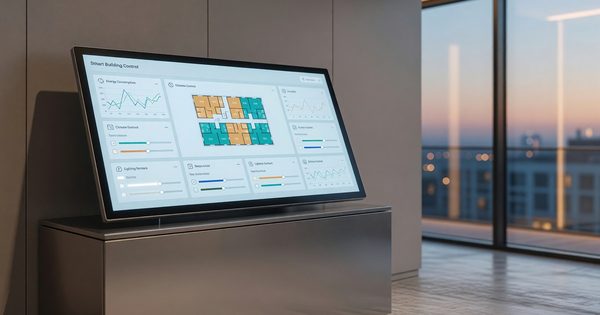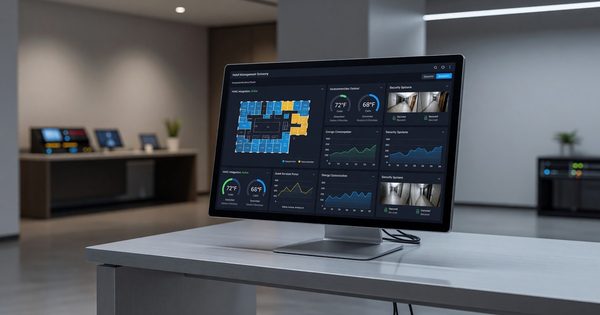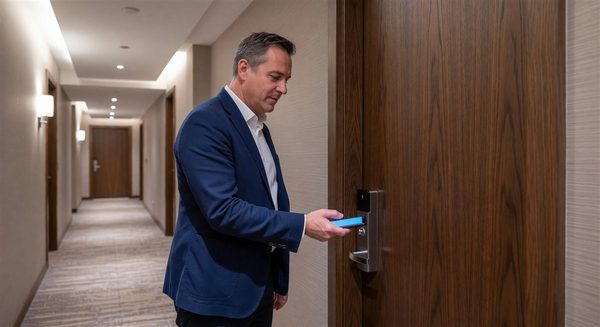
The phrase “smart room” gets applied to hotel guestroom technology loosely — sometimes meaning a TV with streaming apps, sometimes meaning a fully integrated IoT environment where lighting, temperature, blinds, and entertainment are all connected and controllable from a single interface. The gap between the marketing and the operational reality is significant.
For facility managers and directors of engineering who have to make the technology work after it’s sold to ownership and marketed to guests, understanding what smart room technology actually requires and delivers is the more useful frame.
What “Smart Room” Actually Means
At minimum, a hotel smart room involves some degree of:
- Networked sensing: Occupancy detection, temperature monitoring, and possibly humidity and air quality
- Integrated control: Multiple systems (HVAC, lighting, window treatments) controllable from a single interface
- Personalization capability: Guest preferences stored and applied (temperature, lighting, entertainment history)
- Remote management: Staff or system ability to manage room conditions remotely
Beyond this baseline, smart room technology ranges from modest enhancements (occupancy-sensing HVAC setback and a programmable thermostat) to elaborate deployments (voice-activated controls, facial recognition, predictive pre-conditioning, and real-time energy monitoring at the room level).
The Systems That Make Up a Smart Room
Environmental Control
Thermostat and HVAC control: The most impactful smart room element from both a guest comfort and energy management perspective. A networked thermostat with occupancy sensing and remote management capability is the functional core of most smart room deployments.
Lighting control: Networked LED fixtures with dimmability and programmable scenes. A “good morning” scene that brings bedroom lighting up gradually, a “watch TV” scene that sets appropriate ambient light, and an “all off” button that kills every light in the room before sleep — these are the practical guest benefits.
Window treatment control: Motorized blinds or curtains controllable via the room panel, in-room tablet, or guest app. Meaningful for rooms with strong sun exposure or high-floor city views. The motor reliability issue is worth noting — motorized blind motors in hotel rooms are a recurring maintenance item.
Room Control Interface
Smart room systems need an interface through which guests interact with the technology. Options:
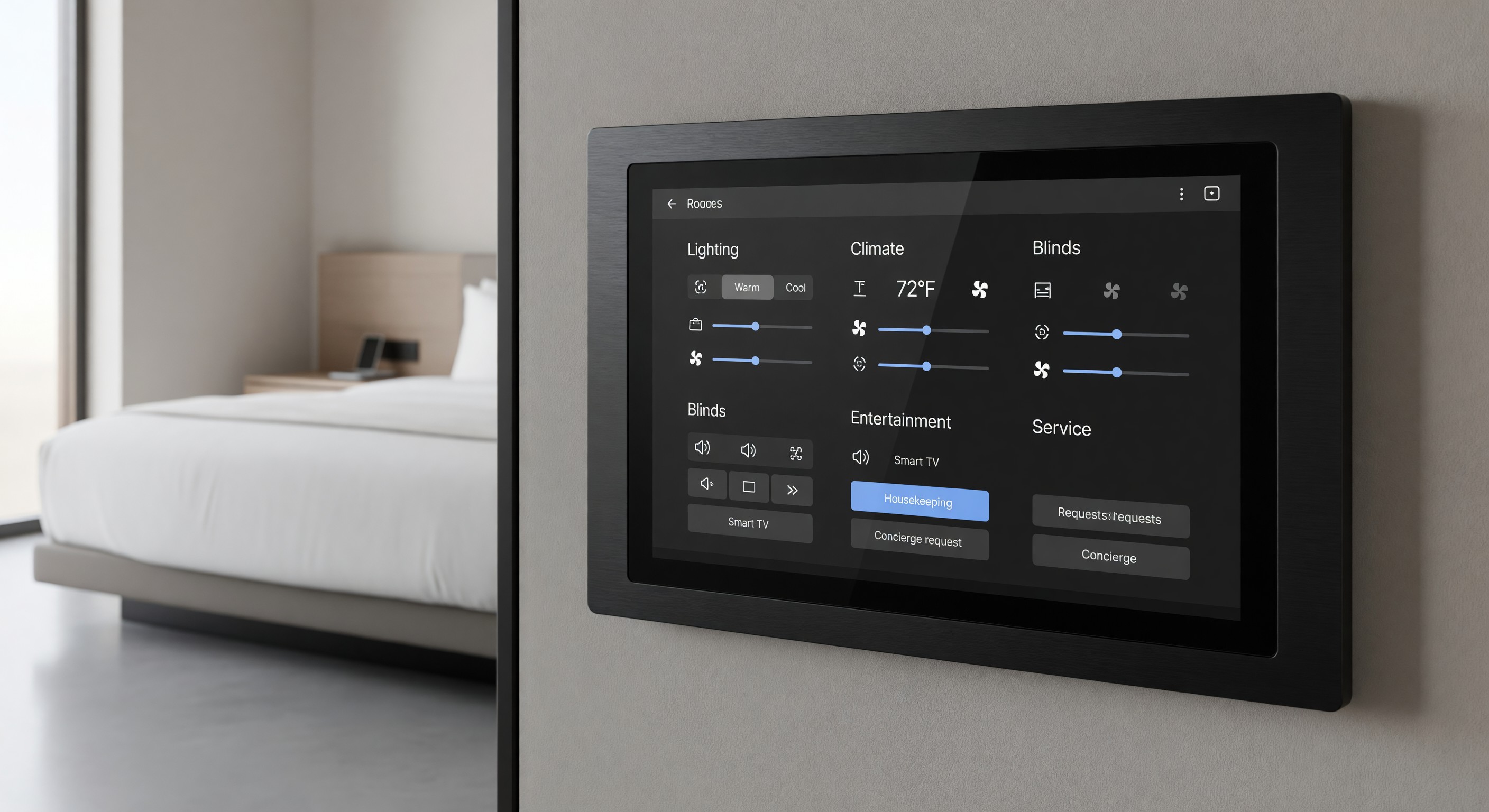
Physical panels: Mounted at bedside and/or by the door. Buttons and/or a touchscreen that controls HVAC, lighting, DND/MUR, and curtains. Most durable, lowest tech support requirement, works for all guests regardless of smartphone ownership.
In-room tablet: A tablet mounted at bedside serving as the room companion — room controls plus hotel services, local information, and entertainment. Higher upfront cost, requires ongoing device management, battery and charging issues common.
Guest smartphone app: Control via the guest’s own device. No hardware cost in the room, but requires guest app adoption, and the experience is only as good as the app.
Voice assistant: Control via voice commands. High-interest feature, privacy concerns and inconsistent guest adoption remain real challenges.
Most properties deploy a combination: a physical panel as the reliable baseline with app or voice as supplementary options.
In-Room Entertainment Integration
Smart room entertainment goes beyond cable TV to include:
- App-based streaming (Netflix, Disney+, HBO, etc.) from the guest’s account
- Casting from the guest’s device to the TV
- Integration with the room control interface (dim lights when movie starts)
- Bluetooth speaker pairing
The operational challenge: guests come from many streaming service configurations and many device types. The entertainment integration must work for the guest who has an iPhone and Netflix, the guest with an Android and Hulu, and the guest who just wants to watch ESPN. Test the full range of use cases before deploying at scale.
Network Requirements
Smart room technology is highly network-dependent. Every connected device in a smart room adds network load and requires proper network segmentation.
Device count per room: A fully equipped smart room might include:
- Smart TV (or streaming device)
- Thermostat/HVAC controller
- Lighting gateway
- Window treatment controller
- In-room tablet (if deployed)
- Occupancy sensor
- Door lock (if online)
This is 6–8 property devices per room, before guest devices. A 200-room hotel might have 1,200–1,600 property IoT devices on its network.
Network segmentation: Property IoT devices must be on a separate VLAN from guest devices. A guest who connects to the hotel WiFi should not be able to discover or interact with room control devices.
Bandwidth: IoT devices typically have low bandwidth requirements individually, but the management and monitoring traffic from hundreds of devices adds up. More important is latency — smart room controls should be responsive, which requires low-latency network paths.
Reliability: A smart room control system that relies on network connectivity must remain functional when the network is slow or intermittent. Design for graceful degradation — if the network is down, the thermostat should still allow manual adjustment.
Implementation Considerations
Phased Deployment
Smart room technology should be deployed on a phased basis:
Phase 1: Networked thermostats with occupancy sensing (energy savings justification, immediate operational benefit)
Phase 2: Lighting control and basic room panel (guest experience improvement, supports energy management)
Phase 3: Full integration including entertainment and guest app (premium experience positioning)
Deploying all phases simultaneously in a retrofit project multiplies the construction complexity, coordination requirements, and the chance of integration failures.
Vendor Ecosystem Fragmentation
One of the significant challenges in smart room deployments is vendor fragmentation. The HVAC control might come from one vendor, lighting from another, the room panel from a third, the TV system from a fourth, and the building management integration from a fifth. Getting these systems to interoperate reliably requires careful vendor selection, a defined integration architecture, and strong systems integration expertise during implementation.
Emerging standards (Matter, BACnet, KNX) aim to improve interoperability, but hotel-specific integrated platforms from vendors like Crestron, AMX, and Control4 hospitality have been the more common solution for high-end deployments.
Training and Support
Smart room technology requires sustained operations support. Plan for:
- Engineering and front desk training on troubleshooting common guest issues
- Vendor support contracts for each system component
- Remote monitoring and management capability (don’t deploy a system you can only troubleshoot by sending someone to the room)
- Guest-facing documentation (a one-page room guide covering the most common controls)
What Delivers Real Value vs. What’s a Gimmick
High value:
- Occupancy-sensing HVAC setback (clear energy ROI, invisible to guests)
- Reliable keycard-controlled HVAC (matches system to occupancy without sensors)
- Streamlined streaming TV (guests want their content, this delivers it)
- USB-C charging at bedside (universal appreciation, low cost)
- “All lights off” bedside button (high-frequency guest need, easy to deliver)
Mixed value:
- In-room tablets (high maintenance cost, inconsistent guest adoption)
- Voice assistants (niche appeal, privacy concerns, management overhead)
- Motorized window treatments (guest appreciation, but high maintenance)
Often overhyped:
- Facial recognition for preferences (privacy concern exceeds convenience benefit for most guests)
- Robot delivery to rooms (operationally complex, novelty wears off)
- Elaborate pre-arrival preference apps (adoption too low to justify complexity)
FAQ
What’s the typical ROI timeline for a smart room deployment? Energy management components (occupancy-sensing HVAC) typically pay back in 2–4 years. Guest experience components (entertainment, room controls) don’t generate direct ROI — they’re evaluated on guest satisfaction impact, competitive positioning, and brand compliance. The full system ROI depends heavily on how you weight these factors.
How do we handle smart room technology failures that affect the guest? Every smart room deployment needs a clear fallback procedure. If the room tablet is broken, the guest should be able to call the front desk. If the HVAC controller fails, the thermostat should have a manual override. Design for resilience from day one.
Should we deploy smart room technology in all rooms or just a subset? Consider deploying first in a single floor or wing as a pilot. This provides real operational experience before full commitment, creates a showcase for brand purposes, and allows you to find the integration failures in a controlled setting.
How do we manage guest privacy with smart room data collection? Define clearly what data is collected (temperature settings, occupancy state, TV viewing history), how long it’s retained, who can access it, and how it’s used. Disclose this in your privacy policy and any in-room documentation. Never retain personally identifiable information linked to room sensor data after checkout without explicit consent.
Further Reading from Authoritative Sources
- DOE smart room technology and building energy management resources — The DOE Buildings program provides smart room energy management research, occupancy sensor standards, and HVAC optimization guidance applicable to hotel smart room energy management ROI analysis and technology selection.
- HFTP hotel smart room technology and IoT integration standards — HFTP provides hospitality technology professionals with smart room standards, IoT integration frameworks, and vendor evaluation guidance applicable to hotel smart room technology selection, deployment, and ongoing operations.