The hotel guest app has emerged as a central element of the digital guest experience — a single interface for pre-arrival communication, mobile check-in, room access, service requests, dining reservations, and post-stay feedback. For brand hotels, the brand’s proprietary app handles this function. For independents, boutique collections, and regional chains, third-party guest app platforms offer comparable functionality without the need for proprietary development.
This guide helps facility and technology managers evaluate the guest app platform landscape, understand integration requirements, plan implementation, and measure whether the investment in digital guest experience is delivering returns.
What Guest App Platforms Do
Modern hotel guest experience platforms — a category that includes both mobile apps and web-based guest portals — typically cover:
Pre-arrival: Online check-in, room preference selection, upsell offers (upgrades, dining, spa, parking), welcome messaging, and local recommendations.
Arrival and access: Mobile key issuance (for compatible lock systems), digital room assignment, and arrival time communication.
In-stay services: Service requests (extra towels, amenity delivery, maintenance reporting), F&B ordering for room service or restaurant reservation, chat messaging with hotel staff, activity booking.
Information: Digital compendium replacing in-room binder, local restaurant recommendations, property map, event calendars.
Departure: Express checkout, folio review, late checkout requests, transportation booking.
Post-stay: Review requests, loyalty enrollment, future stay promotions.
The value proposition for guests is convenience and reduced friction. The value proposition for hotels is operational efficiency (automated service requests reduce phone volume), revenue capture (in-app upsells convert at measurable rates), and guest satisfaction data.
Major Platform Providers
The guest experience platform market includes established hospitality technology companies and newer SaaS entrants. Notable platforms as of 2023:
Nonius: Strong European market presence, broad PMS integration library, includes mobile key and TV interactive platform in the suite.
Cendyn: CRM-integrated guest platform with strong personalization capabilities driven by guest history data.
Quore: Operations-focused platform emphasizing housekeeping and maintenance workflows alongside guest-facing functionality.
Alice (now part of Actabl): Hotel operations and guest messaging platform popular with independent hotels and boutique properties.
Benbria/Loop: Messaging-focused platform for real-time guest communication via SMS, WhatsApp, and app.
Canary Technologies: Guest journey management with contactless check-in, upsells, and digital tipping.
Revinate: CRM and messaging platform with strong direct booking recovery and guest satisfaction features.
Platform selection should be driven by specific use case priorities, existing technology stack compatibility, and support model. Request demonstrations from 3–5 vendors and speak with reference properties of similar size and type.
PMS Integration: The Critical Dependency
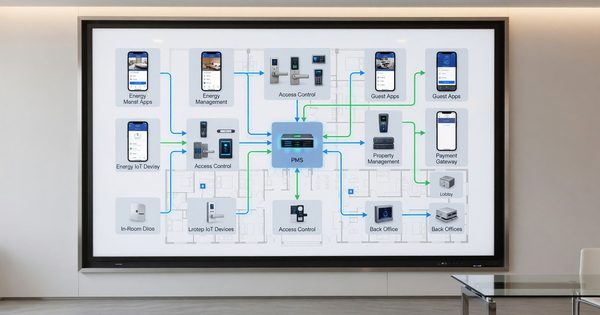
Guest app functionality depends heavily on PMS integration quality. Without PMS connection, the app cannot access reservation data, cannot post charges to folios, cannot issue mobile keys based on check-in status, and cannot trigger personalized messaging based on guest lifecycle events.
Evaluate PMS integration on:
Real-time versus batch sync: Real-time integration (reservation data updates instantly in the guest platform) is necessary for mobile check-in and mobile key issuance. Batch sync (hourly or nightly updates) is adequate for post-stay communication but inadequate for arrival experience use cases.
Bidirectional write capability: Can the platform write data back to the PMS — posting charges, updating preferences, logging service requests? Read-only integrations severely limit functionality.
Integration certifications: Ask each platform vendor which PMS systems they support with certified integrations. “We can integrate with your PMS” often means a custom integration of uncertain quality — certified integrations with documented PMS connector libraries are far more reliable.
Common PMS platforms with broad guest app integration support: Oracle OPERA, Mews, Cloudbeds, Protel, StayNTouch, Agilysys Visual One. Proprietary or legacy PMS systems may require middleware integration layers.
Guest Adoption Strategies
Platform features only create value if guests use them. Typical adoption rates without active promotion: 10–20% of check-ins complete mobile check-in; 20–40% engage with some pre-arrival communication. With active promotion:
- Pre-arrival email with clear mobile check-in call to action: 35–55% engagement
- Post-booking text message with app download link: 25–40% download rate for brand-loyal guests
- Front desk promotion of mobile key at check-in: incremental adoption of 10–15%
- Loyalty benefit attached to app use (bonus points, room upgrade priority): meaningfully improves enrollment
Simplify the path to first use. Guests who must download an app, create an account, verify email, and then complete mobile check-in will abandon at each step. Best-practice platforms allow web-based (no app download required) mobile check-in via a link in the pre-arrival email.
Service Request Automation
The operational ROI of guest messaging platforms often comes from service request automation and routing. Instead of a guest calling the front desk, who calls housekeeping, who radios the housekeeper — a guest’s towel request routes directly to the housekeeping app and is dispatched to the assigned floor attendant with status tracking visible to the front desk supervisor.
This streamlining reduces the time-to-fulfill for standard service requests by 30–50% in well-implemented deployments, and provides data on service request volume, type, and response time that supports staffing optimization and service improvement.
Revenue Generation Measurement
In-app upsells — room upgrades, F&B, spa, parking, late checkout — should be tracked with specific revenue attribution. A guest app platform that cannot report clearly on how much revenue was generated through the app, by which upsell offer, at which property is not providing the data needed to manage the investment.
Metrics to track:
- Upsell conversion rate (offers presented vs. accepted)
- Revenue per offer by upsell category
- Mobile check-in rate
- Service request volume through app vs. phone
- Guest satisfaction scores for app-adopting guests vs. non-adopting guests (do digital-first guests rate stays higher?)
Frequently Asked Questions
How much does a hotel guest app platform cost? SaaS pricing for hotel guest platforms typically ranges from $200–$800 per month for small independent hotels to $1,000–$3,000+ per month for full-service properties with multiple modules (messaging, mobile key, upsell, operations). Some platforms charge per room per month; others use flat monthly fees with usage tiers. Integration setup fees of $2,000–$10,000 are common.
Can independent hotels deploy a guest app platform without IT staff? Yes — most modern guest experience platforms are designed for hospitality operators, not IT teams. PMS integration is handled by the vendor during onboarding. Ongoing operation requires a designated staff person (typically a front desk manager or operations director) who manages content, reviews messaging workflows, and monitors adoption metrics. Heavy IT involvement is not required.
How do guest app platforms handle guests who don’t have smartphones? Platforms should support web-based (no app download) access via email links for guests who prefer not to use apps or don’t have compatible devices. Traditional check-in processes must remain available for all guests who prefer human interaction. Guest-facing technology should always be additive, not a replacement for service options that some guests strongly prefer.
What guest experience metrics most justify the investment in a guest app platform? Primary justification metrics: in-app upsell revenue (quantifiable against platform cost), service request response time improvement (labor efficiency), and TripAdvisor/Google review volume increase (platforms that prompt post-stay reviews have demonstrated meaningful improvement in review volume, which drives direct booking conversion). Guest satisfaction score improvement for digital-first guests is a secondary indicator.
Further Reading from Authoritative Sources
- HFTP hotel guest technology platform standards and PMS integration guidance — HFTP provides hospitality technology standards for guest-facing platform evaluation, PMS integration specifications, and technology ROI measurement frameworks applicable to hotel guest app platform selection, implementation planning, and performance measurement.
- AHLA hotel guest app investment and digital guest experience standards — AHLA provides hospitality industry guidance on digital guest experience investment, mobile platform adoption strategies, and guest satisfaction measurement frameworks applicable to hotel guest app platform ROI justification and implementation priorities.