Lighting is one of the most straightforward energy efficiency investments available to hotel facility managers. LED technology has matured to the point where it delivers better quality light than the fluorescent and incandescent technologies it replaces, uses 60–75% less energy, and lasts 3–5 times longer. The payback periods for well-executed hotel LED retrofits are typically 2–4 years — often the best ROI of any facility investment available.
Despite this, many hotel properties still operate significant portions of their lighting on legacy technology. The reasons vary: concerns about light quality change affecting guest perception, uncertainty about compatibility with existing dimmers and controls, and the complexity of managing a multi-area retrofit across an occupied property.
This guide addresses the practical execution of hotel LED retrofits.
Energy and Financial Case
Where Hotel Lighting Energy Goes
Lighting energy in hotels is distributed across several distinct areas with different characteristics:
Guestrooms: Individual A-lamps in table and floor lamps, G-lamps in vanity fixtures, BR-series lamps in recessed fixtures. High fixture count but relatively low hours of operation (guests are often out of the room during peak daylight hours).
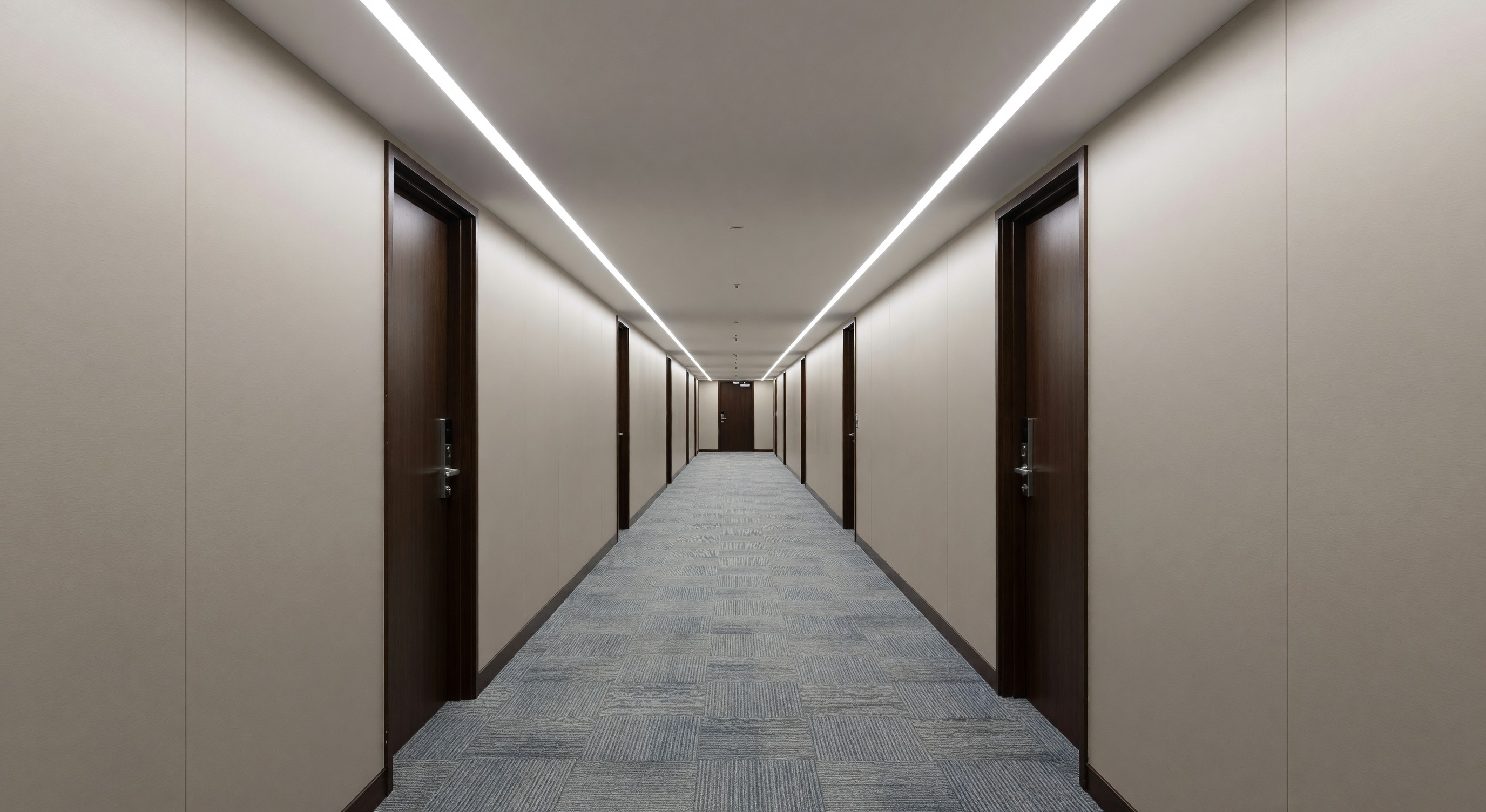
Corridors and stairwells: Linear fixtures or recessed downlights operating 24/7. High operating hours make this a high-priority retrofit target.
Lobby and public areas: Higher-quality decorative fixtures that contribute to the property’s aesthetic. Quality of light matters more here; a retrofit that changes the ambiance noticeably may require guest satisfaction monitoring.
Meeting rooms and ballrooms: Often still on fluorescent linear fixtures or halogen PAR lamps for theatrical applications. Ballrooms with dimmable wash lighting and spotlighting present specific dimming compatibility challenges.
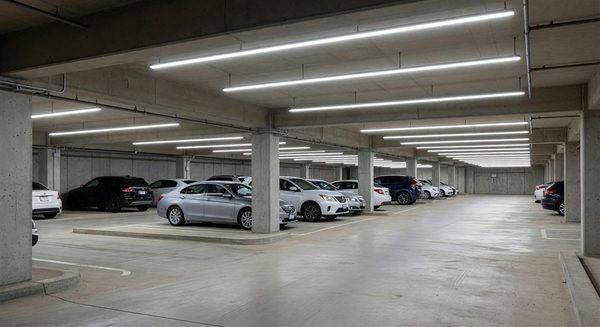
Parking structures and exterior: Linear fluorescent (T8 and T5) fixtures in parking structures, HID (high-intensity discharge) fixtures for exterior area lighting and sign lighting. These are among the highest-impact retrofit targets due to 24/7 operation.
Back-of-house: Kitchens, laundry, mechanical rooms, and service corridors. Primarily functional; quality isn’t a guest concern.
Sample Energy Calculation
Guestroom corridor (200 guestroom hotel with average 180 feet of corridor per floor on 8 floors):
- Current: 50-watt incandescent equivalent recessed downlights, one per 8 feet
- LED replacement: 10-watt LED downlight with equivalent light output
- Per fixture savings: 40 watts
- Fixture count: 180 total
- Annual savings: 40W × 180 fixtures × 8,760 hours × $0.12/kWh = $75,686/year (This calculation assumes 24/7 operation; actual savings depend on hours of operation)
Parking structure (400 spaces, currently 120 50-watt fluorescent fixtures):
- LED replacement: 30 watts per fixture with better light distribution
- Annual savings: 20W × 120 × 8,760 × $0.12 = $25,229/year
LED Technology Selection
Color Temperature
The color temperature of LED lamps significantly affects the ambiance of the space. Measured in Kelvin (K):
2700K–3000K (warm white): Mimics incandescent light. Suitable for guestrooms, lobbies, restaurants, and anywhere a warm, residential feel is appropriate. This is the right choice for most hotel guestroom and hospitality applications.
3500K–4000K (neutral white): Between warm and cool. Appropriate for meeting rooms, corridors, and fitness centers where task lighting is more important than ambiance.
5000K–6500K (cool/daylight): Clinical, energetic light. Appropriate for back-of-house kitchen and laundry applications, not for guest areas.
Color Rendering Index (CRI)
CRI measures how accurately a light source renders colors compared to natural light. The scale is 0–100; higher is better.
CRI 80+: Minimum acceptable for guest-facing areas. Colors appear reasonably accurate.
CRI 90+: Recommended for lobbies, restaurants, and anywhere the visual environment is part of the brand experience. Colors render with near-natural accuracy.
CRI 95+: High-fidelity applications like art display, makeup vanities, and high-end retail spaces within the property.
Specify minimum CRI 90 for guestrooms (particularly bathroom vanity fixtures where guests apply makeup and assess their appearance), lobbies, and restaurants. CRI 80 is acceptable for corridors and back-of-house.
Dimming Compatibility
Dimming compatibility is the most common source of problems in LED retrofit projects. LED lamps require a compatible dimmer — most older dimmers were designed for incandescent loads and do not work well with LED.
Symptoms of dimmer incompatibility:
- Buzzing or humming from the fixture or dimmer
- Flickering, particularly at lower dim levels
- Limited dimming range (lamp goes from full bright to off with very little gradation)
- Lamp doesn’t dim as low as the old incandescent did
Solutions:
- Use TRIAC-dimmable LED lamps with standard 0-10V dimmers (most common dimming interface in commercial applications)
- Replace existing dimmers with LED-compatible versions from the same manufacturer as the LED lamps (compatibility is tested by most lamp manufacturers)
- Test lamp/dimmer compatibility before purchasing full quantities
For ballrooms and meeting rooms with complex theatrical dimming systems, engage a lighting controls specialist before specifying LED replacements.
Retrofit Strategy by Area
Guestrooms: Opportunity and Complexity
Guestrooms have high fixture counts and meaningful energy savings potential, but the light quality change is highly visible to guests. A poorly executed guestroom LED retrofit — wrong color temperature, buzzing dimmers, or CRI that makes skin tones look unflattering — generates complaints that outweigh the energy savings.
Pre-retrofit process:
- Identify all fixture types in a standard guestroom (and suite)
- Source LED replacements for each at 2700K, CRI 90+
- Mock up the complete lighting scheme in one room before ordering full quantities
- Have the director of sales and/or GM review the mock-up room for aesthetic approval
- Test dimmer compatibility in the mock-up room
Implementation approach: Consider retrofitting guestrooms during regular renovation cycles — when rooms are already being painted or having FF&E replaced — to minimize the disruption of entering occupied rooms.
Corridors: High Impact, Simpler Execution
Corridors are 24/7 operating environments where LED retrofit delivers the highest energy savings per project dollar. The aesthetic requirements are simpler (no need to replicate incandescent warmth exactly), and the retrofit can be planned around a single fixture type or small number of types.
Add occupancy or motion sensor control to corridor lighting during the retrofit. Dimming corridors to 20–30% during low-traffic overnight hours (11 PM – 6 AM) and restoring to full brightness when motion is detected can reduce corridor lighting energy consumption by an additional 40–60%.
Parking Structures: High ROI
Parking structure LED retrofits offer some of the best ROI in the hotel, because:
- 24/7 operation means maximum energy savings
- Modern LED lighting exceeds older fluorescent systems on photometric coverage — often allowing reduced fixture count while maintaining or improving light levels
- Maintenance savings are significant (LED lamps don’t need to be changed nearly as frequently as fluorescent tubes)
Specify LED fixtures designed for parking structure applications — typically high-efficiency linear fixtures or area lights with appropriate photometry for the ceiling height and space geometry.
Exterior: Security and Aesthetics
Exterior LED retrofit replaces area lights (HID: metal halide or high-pressure sodium) with LED area lights. The light quality improvement is dramatic — LED area lights provide consistent white light that is both aesthetically better and more useful for CCTV camera performance.
HID fixtures take several minutes to warm up after a power interruption. LED area lights are instantly on, which is relevant for emergency lighting scenarios and for the appearance of the property during automatic dusk-to-dawn cycling.
Implementation Planning
Phasing the Project
Implement a hotel LED retrofit in phases that match the occupancy calendar and the maintenance team’s capacity:
- Start with back-of-house and parking (no guest impact, high ROI)
- Progress to corridors and public areas (minimize disruption, high impact)
- Finish with guestrooms (highest complexity, highest fixture count)
Rebates and Incentive Programs
Most utility companies offer rebates for LED retrofits in commercial properties. These rebates can offset 20–40% of the project cost. Before specifying products and quantities:
- Contact your utility company’s energy efficiency program
- Verify which products qualify for rebates
- Understand the documentation requirements for rebate claims
- Factor rebate timing into the project cash flow (rebates often come months after installation)
FAQ
Will guests notice the change from incandescent to LED in guestrooms? With properly specified LED lamps (2700K, CRI 90+, compatible dimmers), most guests don’t notice the difference — or notice that the room looks better. The risk is in poor specification: lamps that are too cool (3000K+ in warm-ambiance rooms), too low CRI (colors look flat), or that flicker on existing dimmers.
How much can LED lighting realistically save at our property? For a full-service hotel with legacy lighting across all areas, a comprehensive LED retrofit typically reduces total lighting energy consumption by 60–70%. In dollar terms, $30,000–$80,000 in annual savings is achievable for a 200-room full-service property depending on electricity rates and current system characteristics.
Do we need to replace the fixtures or just the lamps? Depends on the situation. For standard Edison-base sockets, lamp-only replacement is often possible and less expensive. For fluorescent linear fixtures, “plug-and-play” LED tubes allow lamp-only replacement, but driver-bypass LED tubes (more efficient) require some rewiring. For newer fixture types, full fixture replacement is typically required.
What warranty should we expect on LED lamps and fixtures? Commercial-grade LED lamps should carry a minimum 3-year warranty; 5-year is better. Commercial LED fixtures often carry 5-year warranties, some 10-year. Avoid products with less than 3-year warranties for hotel applications — the maintenance cost of premature replacements eliminates the savings.
Further Reading from Authoritative Sources
- DOE SSL lighting energy efficiency program — The DOE Solid-State Lighting program provides performance standards, testing data, and commercial lighting guidance including the DesignLights Consortium qualified products list used to verify rebate eligibility.
- NIST lighting measurement and photometric standards — NIST provides the measurement standards and photometric testing protocols that underpin CRI, color temperature, and lumen output specifications used in hotel LED product selection.