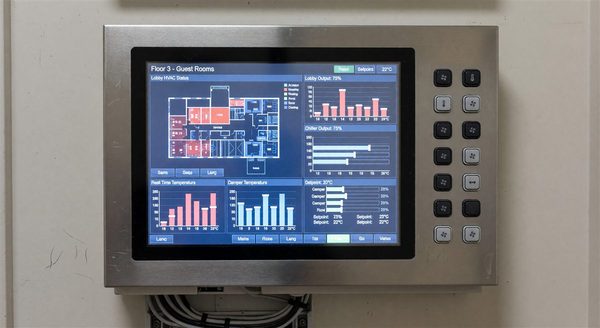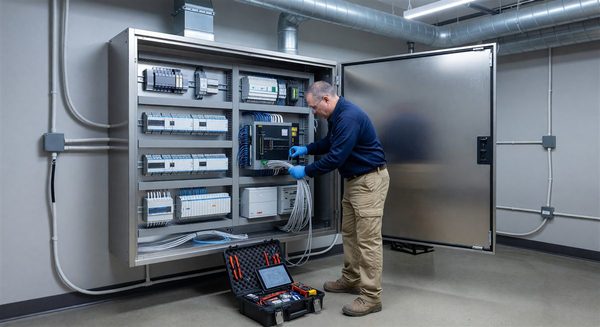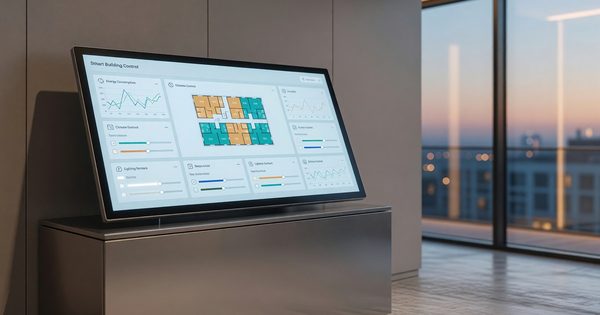
The capital case for a full HVAC controls replacement is straightforward on paper but difficult to approve in practice. For most hotel engineering directors, the rip-and-replace path — pneumatic or first-generation DDC controls out, modern BACnet BAS in — carries a price tag between $400,000 and $1.2 million for a full-service property, a payback horizon measured in years, and a disruption footprint that makes owners nervous. The result is a large population of hotel properties running HVAC systems that are mechanically sound but controls-limited: equipment that could perform better if only the intelligence layer above it were different.
AI-powered HVAC controls have emerged as the retrofit path for exactly this situation. Rather than replacing the equipment or the full controls infrastructure, AI overlay platforms attach to existing systems and introduce machine learning at the optimization layer — adjusting setpoints, staging, and scheduling based on occupancy patterns, weather data, and utility rate signals that legacy controls never considered. The energy savings numbers being reported by properties deploying these platforms are meaningful: 20–35% reductions in HVAC energy spend are consistently cited in recent deployments across property types.
What AI Controls Actually Do Differently
Legacy HVAC controls operate on fixed logic: occupied setpoints during defined hours, setback during unoccupied periods, stage sequencing based on schedule. The control system does not know what is actually happening in the building — it follows the programming, which reflects conditions at the time of setup, not current reality.
AI HVAC platforms change the control layer in several specific ways:
Occupancy prediction rather than schedule assumption. Machine learning models trained on historical check-in data, event calendars, and real-time PMS feeds can predict which rooms will be occupied 30–60 minutes out and condition them accordingly — without running full conditioning in rooms that will remain empty. Properties using Verdant’s smart thermostat platform report average guestroom energy reductions of 45%, with overall energy bill savings of up to 18%, driven primarily by this occupancy-based logic operating at the individual room level.
Weather-responsive sequencing. AI platforms that pull real-time and forecast weather data can adjust chiller staging, cooling tower operation, and economizer logic dynamically. Rather than switching between cooling modes based on a fixed outdoor air temperature threshold, the system anticipates what the load will be and positions equipment ahead of it — reducing the energy penalty of reactive catching-up.
Utility rate optimization. Time-of-use and demand charge structures create significant pricing variation across the operating day. AI controls that incorporate rate schedules can pre-cool the building during low-rate periods, shift compressor starts away from peak demand windows, and reduce consumption during high-rate intervals — all while maintaining comfort targets. This is optimization that static schedules cannot perform, because it requires continuous calculation against a changing rate variable.
Fault detection as a byproduct. When an AI platform is monitoring equipment performance continuously and comparing it against learned baselines, anomalies surface early. A fan coil unit drawing more current than its historical pattern, a zone consistently failing to reach setpoint within normal recovery time, a chiller operating at degraded efficiency — these conditions appear in the data before they become guest complaints or equipment failures.
The Retrofit Architecture — No Full Replacement Required
The key commercial argument for AI controls is that they operate as an overlay on existing infrastructure, not a replacement. The integration path varies by what’s already in place:
PTAC and VTAC rooms: For properties with packaged terminal equipment in guestrooms, smart thermostat platforms like Verdant (now part of Copeland) replace the existing thermostat unit and connect to a cloud management platform. No changes to the mechanical equipment or room wiring beyond the thermostat swap are required. Verdant has deployed this approach across more than 6,000 hotel properties.
Central plant with legacy DDC: AIIR’s Intelligent HVAC product, deployed in its first hotel installation in Tennessee in October 2025, takes a sensor-first approach — adding interior and exterior sensors that feed an AI layer without requiring controller-level replacement. Building management system integration allows pre-conditioning based on PMS check-in times while the existing mechanical infrastructure remains in place.
Properties with BACnet DDC already present: AI optimization layers like Nantum (acquired by Johnson Controls in early 2026) can connect to existing BACnet-compliant BAS infrastructure through standard integration protocols, adding predictive and ML-based optimization on top of the existing control layer. This approach requires the fewest hardware changes — the AI platform subscribes to existing data points and overwrites setpoints within defined envelopes.
Honeywell Forge: For full-service properties with more complex HVAC infrastructure, Honeywell’s Forge energy management platform integrates with building systems to provide AI-driven optimization, anomaly detection, and reporting. The Washington Hilton is among the properties using Honeywell’s building management capabilities, and Honeywell’s documented case studies report 20–25% energy reductions from smart occupancy-based HVAC management.
Marriott’s Natural Gas Reduction: A Reference Point
Marriott International’s AI HVAC initiative provides one of the most cited documented outcomes in the hospitality sector. By deploying AI to optimize natural gas consumption across selected properties — adjusting boiler operation, hot water heating schedules, and heating staging based on predictive load modeling — Marriott achieved a 25% reduction in natural gas consumption at participating properties without mechanical replacement. The initiative fed into Marriott’s commitment to reduce carbon intensity by 30%, using AI energy management as a primary delivery mechanism rather than capital equipment replacement.
The Marriott example is instructive because it illustrates what AI controls optimize that legacy controls cannot: the system was not doing something new mechanically — it was sequencing and staging existing equipment more intelligently against a continuously updated picture of actual load.
What Engineering Teams Need to Evaluate
Before committing to an AI HVAC platform, facility managers should assess three areas:
Data infrastructure readiness: AI optimization requires data. At minimum, this means reliable occupancy data (from PMS integration, room sensors, or both), real-time equipment performance data (energy metering at the circuit or unit level), and weather data feeds. Properties without metering infrastructure at the room or zone level will need to add sensors as part of the deployment — this is typically a modest addition to project cost but needs to be scoped.
Integration pathways with existing systems: Verify that the AI platform being evaluated has a documented, working integration with your PMS and your existing BAS (if present). “Integration available” in a vendor proposal means different things — get a reference from a comparable property running the same PMS-BAS combination.
Setpoint authority and guest experience guardrails: AI optimization that adjusts room temperatures without appropriate limits can generate guest complaints that offset energy savings with service recovery costs. Ensure any platform being evaluated allows engineering to define minimum and maximum setpoint envelopes that the AI operates within, and that guest-initiated adjustments are handled appropriately (most platforms include a grace period after guest thermostat interaction before optimization resumes).
Marriott’s documented 25% natural gas reduction, Verdant’s 45% average guestroom energy reduction across a base of 6,000+ properties, and AIIR’s up-to-30% energy savings claim on PTAC retrofit installations all point in the same direction: the primary constraint on hotel HVAC energy performance is increasingly the intelligence layer, not the mechanical equipment. AI controls address that constraint without requiring the capital commitment of a full system replacement — which is why the ROI math for these overlay deployments tends to be substantially more favorable than the traditional controls upgrade calculation.
Frequently Asked Questions
Do AI HVAC controls work with older equipment that doesn’t have modern sensors? Most AI overlay platforms add their own sensor layer as part of deployment. Smart thermostat platforms like Verdant replace the existing room thermostat and bring occupancy sensing with them. Central plant AI overlays typically require the installation of energy metering at key points (air handling units, chillers, major distribution circuits) as part of setup. The cost of adding sensors is generally included in project scoping and does not require modifying the mechanical equipment itself.
How does AI HVAC interact with guest thermostat controls? AI platforms designed for hospitality include logic to respect guest interaction. When a guest adjusts room temperature, most platforms enter a defined hold period (typically 1–3 hours, configurable) before resuming optimization. Setpoint envelopes — engineering-defined minimum and maximum temperatures the system will permit — remain in effect throughout. The guest adjusts within the permitted range; the AI operates within the permitted range; the two coexist.
What is the typical payback period for an AI HVAC retrofit? Payback depends on the existing energy spend, the platform deployed, and the baseline efficiency of the existing controls. Properties replacing manual or schedule-only controls with AI optimization at the room level (smart thermostat deployment) frequently report simple paybacks of 12–24 months. Central plant AI overlay projects with higher capital investment and larger energy spend have reported paybacks in the 2–4 year range. These are substantially shorter than full controls replacement projects, which is the primary financial argument for the overlay approach.
Which industry bodies have published guidance on AI HVAC for hotels? ASHRAE has published guidance on advanced controls and fault detection through its Guideline 36 (high-performance sequences of operation) and ongoing work on AI integration with building systems. HFTP addresses energy management technology in its hospitality FM resources. AHLA’s sustainability programs reference smart energy management as a core component of its hotel sustainability certification framework.
Further Reading from Authoritative Sources
- ASHRAE Guideline 36 and building controls resources — ASHRAE’s guidelines for high-performance HVAC sequences of operation provide the foundational framework within which AI optimization platforms operate.
- DOE Building Technologies Office — smart building controls — The DOE Buildings program documents advanced controls research, fault detection guidance, and grid-interactive building resources applicable to hotel energy management.
- HFTP hospitality facility management resources — HFTP publishes facility management guidance for hospitality professionals, including technology adoption frameworks for energy management systems.